5/31/2009

Excerpt from the Journal of Advanced Appraisal Studies

Mike Wyrostek a financial planner and appraiser from the Chicago area wrote an article about how financial planning and appraising can and should work together. He has been successful in blending the professions together and in making clients more aware of the value of their personal property.

Mike Wyrostek has been a professional financial and estate planner for over 20 years. President of Value in Valuables, Mike received his ISA status in 2006. Now, Mike blends his estate plans knowledge with his love of antiques and art to offer his clients a unique combination and blend of skills, called the S.T.A.K.E method.

To order the Journal of Advanced Appraisal Studies, click HERE.

From Knowing About Other Assets

Let me show you the exact point where financial planning and appraising intersect.

One of the first tasks a financial planner performs is to conduct a detailed interview with the client. In fact, to open a new account, I check for what’s called “suitability.”

Suitability includes completing a detailed data sheet. Liquid assets (easily converted into cash like stocks) and illiquid assets (hard to convert into cash, like a home) plus liabilities get detailed on a form. The purpose is to arrive at the net worth of a client.

At the end of the asset list, there’s one line left to complete: Other Assets. (Note: You also see the other assets line on loan applications.) There’s just enough room on the form to enter antiques or art. But not much more. Certainly not the comprehensive information required for assets or liabilities.

That’s as far as it goes when it comes to probing these assets.

My point is, in the financial planning world, little or no focus is placed on other assets. So, this is where the professional appraiser can add tremendous value not only to the financial planner but their clients. Plus, Financial Planners tend to target the appraiser’s same market sweet spot.

Six factors influencing the financial planners market

In these volatile economic times, people need to know more than ever what they have. Not only do they need to know what they have, they need to know what it’s worth!

In addition, the sheer demographics of our population dictate the market approaches for financial planners. Here are six factors impacting financial planners now:

• Longer Life- As people live longer (Life expectancy in the United States went from 47 in 1900 to 78 in 2008.) we accumulate and collect more “stuff”. In fact, a study cited in the April issue of AARP suggested that 37 million identify themselves as collectors. The vast majority of them are over 50.
• Downsizing- 8,000 baby boomers will turn 62 every day for the next 17 years. As boomers age they may be considering downsizing into a smaller home. Some want to just start simplifying their lives by letting go of other assets. And others may want to convert assets into a liquid investment that can pay them monthly income.
• Value Added Services- To acquire and keep clients, FPs need to provide new and different value added services. As we know, most FPs do not concern themselves with the “other assets” their client may have.

But as business in the FP world becomes more competitive, you’re guaranteed to get the attention of forward thinking FPs with innovative ways to work their client’s assets.

• Fee Based Accounts- The trend with FPs is fee based accounts. This means an FP is paid a percent of the amount of financial assets under their control. The larger amount of assets the more they earn. So, FPs need to continually increase the assets under their management (e.g., convert antiques into cash/investments)
• Personal Asset Focus- Many financial planners have older clients. They’ve accumulated antiques and collections for many years and may have never given much thought to the value of these personal assets. They don’t realize these collections could have appreciated a great deal in value over the years - especially if these collections were accumulated in the 1950’s and 1960’s. It’s important that these assets be reviewed and appraised because they represent a vital portion of the complete FP process. This is where the true value of the professional appraiser lies for the financial planner profession.
• Part of the Investment Portfolio- Possessing art, antiques and collections as a part of an investment portfolio is becoming more and more common. I know we collect because we love and have a passion for it, but I believe there’s more. Many more people are conscious of the possible appreciation their collections might have over the years. This is one more reason why FPs need to include professionally appraised personal assets into the total financial planning picture.

5/30/2009

Lawsuit Allowed to Proceed Against Warhol Foundation

Randy Kennedy of the NY Times is reporting a judge has allowed a class action suit to brought against the Warhol Foundation for fraud and other deeds in authenticating Warhol art. The AW Blog originally posted about this potential lawsuit at the end of March (click HERE to read that post). Film producer Joe Simon-Whelan brought the class action suit against the Foundation after it twice deemed the painting inauthentic. Simon-Whelan is claiming the Foundation intentionally declares Warhol art inauthentic in order to prop up prices of its own collection.

Kennedy reports Warhol’s estate determined earlier that it was real. Mr. Simon-Whelan maintains that beyond his case the foundation and board have conducted a 20-year conspiracy to inflate the prices for Warhol works — and thus the value of the foundation’s holdings — by denying the authenticity of a certain number as a way to create artificial scarcity. The board and foundation have denied the accusations and sought to have the suit dismissed. Judge Laura Taylor Swain ruled that Mr. Simon-Whelan had asserted his allegations “plausibly” enough for the case to continue to the discovery phase on many of its claims.

To read the full NY Times post, click HERE.

5/29/2009

Tiffany Shows Sales Decline

The Wall Street Journal is reporting 1st quarter profits at Tiffany's are off 64% from a year ago. Also, first quarter US sales have declined 34% from those reported a year ago. The article stated there were some signs the slump was slowing, but it does show the top end of the market is not immune to economic woes. The NY flagship store saw sales drop 42% for 1st quarter 2009 and 34% for 4th quarter 2008. The article states high end sales, those over $50,000.00 were impacted the most.

The WSJ article states The takeaway is that "there are benefits to geographical diversification," Aaron said in an interview after the call. "If one area recovers slowly, the pace may be better in other places that we have locations."

Still, Tiffany is struggling, with fiscal first-quarter earnings plummeting 64% and margins weakening mostly on higher product costs.

"While currently there are some signs of stabilization in trends overall, the U.S. has improved only slightly in May, which keeps us cautious as this region accounts for approximately 50% of sales," said Credit Suisse analyst Paul Lejuez in a research note.

Tiffany shares are off 83 cents, or 3%, to $27.30.

High-end jewelry sales over $50,000 continues to post the greatest decline among Tiffany's product offerings as the wealthy display frugality.

Tiffany and some other prestige brands have resisted moving downscale. Tiffany earlier this month did broaden its scope by buying the upscale Lambertson Truex handbag brand. Rivals LVMH Moet Hennessy Louis Vuitton (LVMUY) and Hermes International SA (RMS.FR) have escaped some of the luxury-sector wreckage with help from branded handbags.

To read the full WSJ article, click HERE.

Results: Christie's Hong Kong Auction Series

The consolidated results are in for the late May Hong Kong auction series at Christie's. Original expectations were for the series of sales to bring just under $100 million. The series totaled $137 million. The sale featured 1,659 lots, and saw over 50% of those lots sell over their high auction catalog estimates. Some of the smaller day sales information is missing, but most of the sales results are listed below. Christie's spokesmen felt the sale was very successful, and would only help with future sales in the Hong Kong location. The expectations are that with the recent series of sales being successful, more consignors will be interested in selling at future Hong Kong sales and thus increase the quality of the auction and the lots being offered.

The series of sales included:
  • Southeast Asian Modern and Contemporary Art - $2.6 million, 97/72 lots selling, 74%
  • Finest and Rarest Wines - $3.6 million, 209/206 lots selling for a 97% buy through
  • Asian Contemporary Arts and Chinese 20th Century Art - Day and Evening Sales - $36.4 million, evening sale selling $23.4 million, 38/34 lots selling for a 89%, one of the two day sales bringing 5.3 million 160/122 lots selling for a 76% buy through
  • Fine Chines Modern Paintings & Calligraphy - $12.6 million, Modern painting sale bringin $8.8 million, 207/160 lots selling for 77% buy through
  • Jewels - $33 million, 230/206 lots selling for a 90% buy through
  • The Imperial Sale - Important Chinese Ceramics and Works of Art - 41.6 million, 186/127 lots selling for a 64% buy through
  • Important Watches $ 7.5 million, 330/312 lots selling for a 95% buy through
Christie's Asia President, Andrew Foster stated about the sale "This season we saw an art market far stronger than anticipated, with success across all categories. While total sales do not match the early 2008 peak of the market, average lot values this Spring exceeded 2008 Autumn figures by around 30%. In some categories, including Chinese Works of Art, there has been an increase in value since the 2007/2008 peak. This indicates that in Asia, art, jewels, watches and wine have retained value, possibly more than other asset classes. Supply was a limiting factor for us this season, as we could easily have sold more high-value, top-quality properties, given the demand. We hope sellers will review these results and approach the Autumn season fully confident in Christie's ability to gauge the market and add value. We are moving forward strongly in Asia, where Christie's strategy is to embrace the future and expand. In addition to our new high-security fine art storage service (Christie's Fine Art Storage Service - CFASS) at the Singapore FreePort, a free trade zone environment that provides an opportunity to substantially increase our services to clients, as well as our global private sales of art, we are also proud to announce a major client-facing expansion of our Hong Kong offices, substantially increasing space and allowing for extensive client entertainment and exhibition of art."

The Obama's, the White House and Art

Fellow appraiser Christine Guernsey sent me this Wall Street Journal article on the Obama's and how they plan on decorating the living quarters and public rooms of the White House. The Obama's taste runs away from the traditional and leans decidedly towards modern art and diversity. The article indicates that artists typically displayed in the White House have seen increased interest and increased values.

The Wall Street Journal reports The Obamas are sending ripples through the art world as they put the call out to museums, galleries and private collectors that they’d like to borrow modern art by African-American, Asian, Hispanic and female artists for the White House. In a sharp departure from the 19th-century still lifes, pastorals and portraits that dominate the White House’s public rooms, they are choosing bold, abstract art works.

The overhaul is an important event for the art market. The Obamas’ art choices could affect the market values of the works and artists they decide to display. Museums and collectors have been moving quickly to offer up works for inclusion in the iconic space.

The article continues Collectors say the art picks by the Obamas will likely affect the artists’ market values—or at least raise their profiles. After George W. Bush displayed El Paso, Texas-born artist Tom Lea’s “Rio Grande,” a photorealistic view of a cactus set against gray clouds, in the Oval Office, the price of the artist’s paintings shot up roughly 300%, says Adair Margo, owner of an El Paso gallery that sells Mr. Lea’s work. (Mr. Lea passed away in 2001, which also boosted the value of his work.)

The Obamas’ interest in modern art began before they moved to Washington. The couple’s Hyde Park home featured modern art and black-and-white photographs, according to several Chicago friends. On one of their first dates, Mr. Obama took Michelle Robinson to the Art Institute of Chicago.

A White House spokeswoman says the Obamas enjoy all types of art but want to “round out the permanent collection” and “give new voices” to modern American artists of all races and backgrounds.

To read the full WSJ article, click HERE.

Why People Buy Into Fakes and Forgeries

AW Blog subscriber Peter Kostoulakos sent me the line to an article in the NY Times by Errol Morris entitled Bamboozling Ourselves. Morris discusses the two books that were recently published on Vemeer forger Hans Van Meegeren. The books, The Man Who Made Vemeer and the Forgers Spell are both widely acclaimed. I read the Man Who Made Vemeer, and it reads like a novel. I highly recommend it.

Morris is writing a 7 part series on why people are susceptible to forgery and fakes, so the series should get very interesting.

Morris states There is something compelling about two people writing about the same man at the same time, as if the authors themselves might be doppelgangers, or at least mirrored two aspects of Van Meegeren’s biography. Both books begin on May 29, 1945. Shortly after the liberation of Holland, Han van Meegeren, a painter and art dealer living in Amsterdam was arrested for collaboration with the Third Reich. He was accused among other things of having sold a Vermeer to Reichsmarshal Hermann Göring — essentially of having plundered the patrimony of his homeland for his own benefit and the benefit of the Nazis. To save his skin — the penalty for collaborating was imprisonment or hanging — Van Meegeren revealed that the painting sold to Göring and many other paintings that he had sold as works of the Dutch masters were forgeries. He had painted all of them.

To read the article by Morris, click HERE.

5/28/2009

Salander Working in a Gallery

According to Lindsay Pollock and Philip Boroff of Bloomberg, Lawrence Salander is working in a gallery owned by a "friend" in Millbrook, NY. Salander's father in law also works at the gallery, called Phoenix Art, opened several weeks ago. Salander is of course owner of the now bankrupt Salander-O'Riley Galleries in New York City, and has been criminally indicted both fraud and grand larceny for his past activities at the gallery.

Pollock and Boroff report Salander, who turns 60 on Friday, had been unemployed, as was his second wife, Julie, according to a letter she wrote to bankruptcy court in April. She was working for Natasha Richardson until the actress died following a ski accident in March. The couple have four children; Lawrence Salander has three other children from his previous marriage.

Millbrook’s newest galleristo works on leafy Franklin Avenue, across the street from a bank and hardware store. Art merchants down the block aren’t impressed.

“Wow, the chutzpah,” said Thelma Zwirn, the owner of Millbrook Gallery & Antiques. “You’d think he’d be ashamed and want to hide.”

Salander’s new venture is modest compared with Salander- O’Reilly Galleries LLC, the gallery he operated in a $154,000-a- month mansion off Madison Avenue. There, he sold Old Master paintings and modernist artworks to hedge-fund managers and well-heeled collectors.

They continue The Phoenix gallery exhibits works by Hudson Valley artists, including canvases by painter Ralph Della-Volpe, and small abstract canvases by Salander himself, priced at $100 apiece according to an antiques dealer down the street.

The current exhibition, “Photography and Manipulation,” features landscape photographs by Annemiek Do Gersten and is on view though June 30.

One of the few vestiges of Salander’s former days as a highflying dealer was a marble sculpture of a seated boy, attributed to famed Italian sculptor Antonio Canova, who died in 1822.

The walls are painted an elegant salmon hue and the wooden floors shine with varnish. The sprawling gallery was formerly three spaces, since combined, including a defunct department store.

To read the Bloomberg piece, click HERE.

Results: Christies Hong Kong Imperial Sale

While I am still waiting for Christie's to release consolidated sales results of the recent Hong Kong auctions, the Imperial Sales of Important Chinese Ceramics and Works of Art did well.

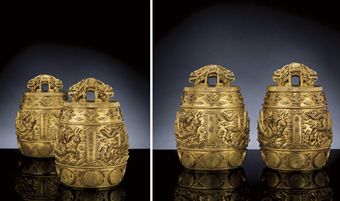
The sale offered 186 lots with 127 selling for a sell through rate of 68%. Of the lots sold during this particular sale, 64% of the lots sold for above the catalogs high estimate. The top selling lot was a pair of Imperial Gilt Bronze Dragon Ritual Bells (see image), estimated at $1.29 million to $1.94 million and selling for $5.85 million. The sale totaled $over $41.5 million dollars. Many mainland Chinese were bidders at this sale and the early sales this week.

Christie's stated "We are extremely pleased with the exceptional results of today's sale of Important Chinese Ceramics and Works of Art. There was fiercely competitive bidding on the phones and in a packed auction room between local and international clients. In a sale in which 64% of the lots sold over the high estimate, a new record was achieved for two previously unseen Imperial ritual bronze Dragon bells which sold for HK$45.4 million/US$5.85 million, while a rare celadonglazed tianqiuping vase, Qianlong period, from a private European collection, which sold more than 12 times the estimate. We are delighted that the market for Chinese works of art continues to go from strength to strength. We saw consistent global interest across a wide range of fine works of art including imperial ceramics, jades, furniture and lacquer among others, reflecting an enduring appreciation by collectors worldwide for rare works of exceptional quality which are attractively estimated,” says Pola Antebi, Senior Vice President, Specialist Head of the Chinese Ceramics & Works of Art Department, Christie’s.

All of the sales combined were expected to generate close to $97 million. I will try to consolidate the main sales over the next few days, or as soon as Christie's releases the totals. From a quick review, it appears the sales have been successful, although much different in scope and size from last year.

5/27/2009

Heritage Expanding NY and LA Locations

I just received the following email from Heritage Auction Galleries, looking for specialist for positions in both New York and Los Angeles auction galleries. Many of you may be on the same mailing list, but in the event you are not.

The email states:

While other auction firms have reported shrinking sales and significant lay-offs, Heritage, the world's third largest auction house, is adding multiple world-class experts to its current staff in over 25 different categories. These experts will, in some cases, head new departments and in others will enhance existing department expertise. We have positions open at our headquarters in Dallas as well as at our new state-of-the-art galleries in prime locations in both Midtown Manhattan and Beverly Hills, scheduled to open in late 2009, or in early 2010.

We believe Heritage's business model of transparency and respect for our bidders' time is the wave of the future, as clients are discovering us in record numbers (read our Mission and Values statement here). In fact, we recently enjoyed our most profitable quarter ever (Jan-Mar 2009), as well as the best April in our 33-year history as an auction house. Our 2009 sales volume will likely match or exceed our record 2008 numbers even as the other major auction houses report 60% sales decreases.

Heritage is now ready to hire the world's best experts to support existing departments and launch new ones, especially in the following categories, though we will consider many other areas as well, including sub-categories:

  • American Art
  • Ancient Coinage
  • Antiquities
  • Asian Art
  • Books, Maps, and Prints
  • Decorative Arts
  • European Art
  • Jewelry and Timepieces
  • Latin American Art
  • Modern and Contemporary Art
  • Photography
  • Vintage Automobiles
  • Wine

These are top, high profile positions; we are seeking ambitious candidates who will bring their excellent reputation, business ethics, strong work ethic, organizational skills, and knowledge to represent Heritage in the best light. Preferred candidates will have more than 5 years in a major auction house environment, or experience as a commercial dealer (a combination of both would be ideal). Writing and public speaking talents and skills are a plus. Job duties will include obtaining consignments; supervising the vetting of condition; authentication of properties consigned; reviewing inquiries; proofing of cataloging, essays, and advertising copy; marketing specific objects to important clients, and supervising two or more auctions per year with full bottom-line responsibility in the case of department heads.

If you are interested and feel you have the qualifications we seek, please email your resume and salary history to Experts@HA.com.

Please note: If you know other people who meet the qualifications described above, we would be grateful if you would forward this email to them.

Thanks you,

Heritage Client Services
Bid@HA.com
3500 Maple Ave. 17th Floor
Dallas, TX 75219-3941
1-800-872-6467

Sotheby's Canadian Sale Misses Mark

The Canadian Press is reporting the recent joint sale between Sotheby's and Ritchie's in Toronto again failed to live up to expectations. Some lots did well, but the sale overall was below most expectations. The Canadian Press reported the sale was expected to generate between $4 million and $5.5 million, and sold 70% of the lots for $3.5 million including buyers premium. Those items that did sell, apparently sold well, but there were still 30% of the 142 lots offered which failed to sell. The top selling lot was a Lawren Harris (see image) oil on board of mountain peaks in British Columbia which realized $175,000.00 including buyers premium.

As has been the case with many other recent auctions and sales, quality is selling, mediocrity in art is not. The catch is with the economy, can sales generate opportunities for those with quality fine and decorative arts to sell in this slow market. A case can certainly be made, that if the quality is there, the current economic situation will not hinder or, at the most have a minor impact on the final price.

The Canadian Press reports, Veteran Winnipeg-based dealer David Loch said that overall the auction was also "weak as far as the content of the paintings."

"You have to remember what we've gone through in the last little while," he said. "People would be very reluctant to put great paintings up for auction this time unless they had to ..."

"Why would you put something into an auction where the market is feeling a bit abused or hurt or whatever?"

Canada's fine-art market is also going through a price correction on previously overhyped paintings, says art collector Ash Prakash.

"The amazing thing that we have learned, even in this market, is that when something rare shows up, it will still stand up, but mediocrity will bring nothing forward, both in results and in interest," he said.

"There are certain iconic painters in Canadian art and the fact is, economic depression or recession aside, their work is genuinely, genuinely scarce, and when it shows up it will do well. It's the stuff in the middle that is subject to fluctuations based on the quality and the economic conditions."

To read the full article, click HERE.

Results: Christie's Hong Kong

Bloomberg is reporting an excellent start to Christies Hong Kong Sales, which should wrap up on the 27th. The collection of sales, including Asian and Chinese Contemporary sales, Fine Chinese Modern, Jewels, and the Imperial sale of ceramics and decorative arts. Bloomberg reports there were over 1,600 lots being offered, with a potential of near $97 million in sales. I'll try to consolidate all of the sales when the data is available, but so far, the start looks very promising. In the painting sale 34 of the 38 lots sold, for a total of just of $24 million.

Bloomberg reports on the painting sale, A painting by Chinese artist Sanyu (see image) fetched a record HK$42.1 million ($5.4 million) at a Hong Kong auction as bidders fought for lots, betting that the worst of Asia’s art-market slump is over.

Of the 38 lots offered yesterday at Christie’s International’s top selection of Asian art, 34 sold, raising a combined HK$181.7 million, according to the London-based auction house. That’s about twice the company’s presale estimate, said Kate Malin, a Christie’s spokeswoman. The 1950s oil painting “Cat and Birds,” the top lot, achieved a record price at auction for a work by deceased painter Sanyu.

“The results speak for themselves,” Michael Wang, chief executive of My Humble House Art Space and one of Asia’s top art collectors, said in an interview at the sale. “It’s a huge success. This auction tells me the slump in Asia’s artworks has ended.”

To read the Bloomberg article, click HERE.

5/26/2009

New NY State Auction Laws

The June 2009 issue of Maine Antique Digest is reporting NY State lawmaker Richard L. Brodsky is proposing changes to NY Law that effects the way many NY auctioneers may sell in the state. This is of course important to appraisers, dealers and collectors as many of the major auction houses sell from New York City, including Sotheby's and Christies. Many of which set the market for prices. The MAD site does not yet have a link up for the article, so I went directly to NY Assemblyman Brodsky's site. Info on the bill (A01730A or in the NY Senate #4313) can be read by clicking HERE.

Brodsky's website states New York State law does not currently address auction requirements. The world's major auction houses are located in New York State and are an important source of economic activity and tourism. Thus, it is important that State law provide protections for all parties to auctions. This bill for the first time codifies and enhances, in State law, the safeguards and protections applicable in the City of New York. This legislation is the product of in-depth study of the issues, and has been developed with in put from auction houses, regulators, art dealers and others interested in ensuring that New York State remains the world's premier auction center.

Many of the propose items are common sense and are already being done. Many are not. I specifically like the first item, where the auctioneer will be held responsible for the truth of statements contained in any catalog. Many of the proposed requirements bring more transparency to the auction process, and the MAD article states both Christie's and Sotheby's worked closely with Assemblyman Brodsky to develop the bill and both support the changes.

The main changes to the proposed law include:

* The Auctioneer will be held responsible for the truth of statements
contained in any catalogue etc.

* The consignor must warrant that he or she has complete and lawful
right, title, and interest in property being auctioned

* It must be disclosed if an auctioneer or auction house has certain
financial interests in an article being auctioned

* It must be disclosed if a consignor is to receive a rebate
commission or when he or she will be allowed to bid upon and buy back
their own article

* If there is a "reserve price" it must be disclosed that the item/lot
is being sold subject to reserve

* If there is no reserve price there shall not be any indication given
that the item/lot is being sold at reserve

* It must be disclosed if an auctioneer extends a loan to a purchaser

* Detailed information must be provided about any jewelry being sold

* The auctioneer shall issue an invoice to each purchaser with
specific information

* Each auction sale must be advertised at least once in the seven days
preceding the auction

* Prospective purchasers must be allowed to inspect articles for sale

* Checks must be sent to anyone entitled to proceeds of a sale within
14 days

* Except to implement the reserve price no auctioneer, consignor etc.
shall make a bid unless their status as someone with inside
information has been disclosed

* Whenever an estimated value of an item is posted a description of
such estimate must also be provided

* Any advertisement indicating an auction for a business' liquidation
must state the name of that business

* If the reserve price is not bid, the auctioneer may withdraw a lot
from sale


* The auctioneer may open bidding on any lot by placing a bid on
behalf of the seller

* After the reserve price has been reached an auctioneer may not bid
on behalf of the consignor

* The reserve price shall not exceed the minimum estimated value of
the lot

* An auctioneer may not offer more than one article for sale at any
time unless combining of articles/lots is indicated prior to the
initial bid

* An auctioneer may not represent a manufacturer's or owner's
guarantee unless such guarantee accompanies the article

* An auctioneer may not offer an article contained in a carton or
package unless it is announced that the bidder can reject the item
upon opening such package.

Jeffrey S. Evans & Associates

For those of you who follow glass and lighting specialties, many may be aware of the recent changes that have occurred at Green Valley Auctions. Owner Jeffrey Evans has left the family business and opened his own auction house called Jeffrey S. Evans and Associates in Mt Crawford, VA. Green Valley Auction long known for its auction sales of glass, early lighting and Southern Decorative arts. Mr. Jeffrey Evans will maintain the catalog sales, while Green Valley Auctions continues with regular estate auctions owned by brother Gregory.

The first Jeffrey S. Evans & Associates catalog sale of antique lighting will occur on June 6th and the first glass catalog auction is scheduled for June 27th. The new auction site is online at http://www.jeffreysevans.com and the catalog sale is being offered online by Artfact Auctions and is available by clicking HERE.

5/25/2009

Sotheby's Resells Halsey Minor Purchase

Nearly a year ago art collector Halsey Minor purchased a group of paintings from Sotheby's for $16.8 million, including Edward Hicks' ' "The Peaceable Kingdom With the Leopard of Serenity" which Minor paid $9.6 million for, a record for an American folk art painting. There were several other paintings purchased at this sale by Minor, including a Childe Hassam painting, entitled Paris, A Winters Day which sold for $3.9 million (see image). Mr. Minor had issues with the how the Hicks painting was represented, stating Sotheby's had an interest in the painting which was not revealed, refused to pay, and the two parties are now in litigation.

Sotheby's decided to put the Hassam oil in its American sale of late last week. The painting sold for $2.3 million, incurring a loss of $1.6 million. Although the litigation, and various claims are interesting to following, what I find even more interesting as an appraiser is the loss of value in the Hassam painting over the course of the year, from $3.9 million to $2.3 million. This represents a loss of approximately 41% over the course of the year.

Some of the loss can be attributed to the various market issues the fine and decorative arts have been going through in the recent past, especially the past 6-8 months. Some of it can also be attributed to a painting being resold, and no longer being fresh to the market place.

I am not sure who is taking the loss on this sale. I wonder if the original consignor was paid by Sotheby's, I would think so as Minor was a regular collector of fine art. I would think Sotheby's is responsible for the moment until the litigation is concluded. In any event, a very interesting situation for all involved, especially appraisers as we view the various suits and market maneuverings.

To read some of the previous posts on this situation from the AW blog, click HERE and HERE.

5/24/2009

Results: Sotheby's NY American Painting Sale

Last week Sotheby's held its American Painting Sale. The sale generated $15.3 million in sales, with only two works selling for over a $1 million. They were the Childe Hassam (noted in the other post of today, regarding Halsey Minor) and a Grandma Moses, Country Fair, dated 1950, which sold for $1.08 million including buyers premium (see image). There were 107 lots offered for sale with 66 selling for a 61.7% buy through rate. The pre sale estimate range was $17 - $25 million, although nearly 38% of the art failed to sell, those that did, seemed to have done reasonably well.

Art Info stated about the sale Many of the buyers, however, did not show their faces on the day of the sale. “No one came to town,” notes Eli Wilner, the antique frame dealer who loaned nearly 50 frames to the Christie’s and Sotheby’s sessions and who did attend the sales. In some cases, absentee bidders even seemed to be rewarded for not being there. For instance, the buyer of Mary Cassatt’s study Two Mothers and a Child in a Boat (1910) got it for $25,000, well under its $30,000 low estimate. And another no-show really hit the jackpot, paying just $338,500 for a rather somber portrait of the 19th-century philanthropist famous for his work in education reform, Robert C. Ogden, that was estimated to go for between $400,000 and $600,000. The work was of three by Thomas Eakins being deaccessioned by Washington, D.C.’s Hirshhorn Museum. One, Study for William Rush and His Model (circa 1908), made $122,500 (est. $80–120,000). A third did not sell.

Madoff Victims Continue Sell Off

The Christine Seib of the London Times Online is reporting many Madoff victims are selling items at sales by Kodner Galleries an auction house in Palm Beach area of Florida. It appears many of the prices being realized at these sales are well below the auction house estimates. Kodner recently sold 75 items from 5 individuals victimized by the Madoff investment fraud. Kodner Galleries is currently negotiating with additional Madoff victims for future sales.

Seib reports Kodner was first approached by an investor desperate to raise some cash more than four months ago and word has since spread amongst the community of victims, with hard-up retirees flocking to the auction house to offload antiques, art work and other precious items.

Seib continues Loyd Breen, Kodner’s auction co-ordinator, said: "We have appointments this week to see five more people for our next auction. It’s snowballing."

"We cut them a good deal and get the cash to them quickly because some of these people are really in dire straits," he added.

Last night’s auction bounty included a print of the Marc Chagall painting The Magic Flute, which had been expected to sell for between $20,000 and $30,000 but went for $19,000.

A Picasso etching sold for $5,400, at the lower end of its $5,000 to $7,000 pre-sale estimate.

A spectacular 70-carat diamond, emerald and platinum necklace had a pre-sale estimate of $150,000 but was bought by Florida attorney Stacey Guilianti for $75,000.

To read the Times Online article, click HERE.

5/23/2009

Excerpt from the Journal of Advanced Appraisal Studies

Darlene Hines, ISA CAPP wrote an article entitled The Enslaved African American Artisan: Contributions to the Decorative Arts.

Darlene Hines, ISA CAPP, is president of Nostalgia Antique Appraisal Services, in the Detroit Area. She is an Executive member of the International Soceity of Appraisers (ISA) Board of Directors. Mrs. Hines is a member of the Detroit Institute of Arts, The Committee of African American Arts, the Visiting Committee of European and Decorative Arts, and member of the “7 Square Forum” for the promotion of the study of Appraising and Decorative Arts of minorities. Mrs. Hines holds a Master’s of Science Degree in Education and Management with studies toward a Doctorate Degree in Administration and Curriculum Development.

To order the journal, visit www.appraisaljournal.org

From the article:

The African American Artisan’s career in decorative arts is little known to the general public. This article seeks to correct the misconcep-tion that the decorative arts are a less characteristic mode of expression for the African American. Although the interpretive arts, such as music, dance, drama, and poetry have been viewed as the African American’s special talent, we fail to realize that the dominant arts in the African homeland were the decorative and craft arts. These skills involve every skill in the category of the European fine arts. The Western world knows today that the African American was a master artist in the idioms of his original African culture of decoration and design.

A study of the African American artisan begins with the first Afri-cans brought to America through forced migration as indentured servants to Jamestown, Virginia in the 1619. Consequently, history reveals that Africans took part in the Spanish expeditions of Ponce de Leon, Narvaez, and Coronado as early as the 1520’s. Nevertheless, the events of 1619 are the foundation used in this article relating to the origins of African American artisans in the United States. Indentured servants were laborers who were under contract, or indenture, to work for another person for a specific time. When the contract expired, the laborer was free. Africans brought to the colonies in later years were bought and sold as slaves. Unlike the indentured, slaves were laborers who had no contract or rights and had to work for their owners for their entire lives. These enslaved Africans joined in the work of building our nation, a work which demanded strenuous mental and physical capabilities.

There are many unanswered questions that need to be researched and these questions have prompted my burning desire to learn more of the contributions of the enslaved and free African American artisans (craftsman) and their impact on furniture making and the decorative arts. W. E. B. DuBois wrote “What had been the experience of the members of this group, so rapidly increasing by birth and by activities of slave-catcher and slave-trader? Had there been anything in the African’s life which would render the Negroes capable of taking a part in the building of homes, the acquiring of wealth, the developing of the new land, the building of the nation? Is there any evidence of mechanical skills among the African natives?” (The Atlanta University Publications, New York: Aro Press and the New York Times, 1969, originally 1902), pp.24-27.

A look into the culture of African life may help us to answer these questions. To understand the factors leading to the skills of the enslaved African American artisan, it is necessary to understand the historical background of the subject. Research indicates that the skills of these enslaved laborers were not created in the American colonies; such skills were identified on the slave ship manifest. Therefore we can safely assume that African American craftsmanship, had it’s inception in the continent of Africa. Blacks are credited as being the first to fashion bone and ivory, and engage in iron, wood, and gold.

5/22/2009

Expectations for Christie's Hong Kong Sale

James Promfret of Reuters is reporting that Chrisite's has scaled back the size and scope of its upcoming Asian sale in Hong Kong. For example, last years sale brought $310 million in sales, this particular sale is expected to bring closer to just under $100 million.

Promfret reports Auction house Christie's will scale back its spring sales of Asian art in Hong Kong, yet the tighter, more cheaply-priced lots are expected to bring fresh confidence to a fragile market, its COO said on Thursday.

Promfret continues "What we're looking for out of these sales ... is that the market has found a new level of comfort with prices and activity," Christie's Chief Operating Officer Andy Foster told Reuters on the eve of the sales which kick off on Saturday.

"It's not that we're suddenly going to reach, in this season, the sales levels of spring 2008 at the peak of the market. But we believe that what we're seeing is going to lead to a real feeling of confidence in the region that the market's back on track."

Since the financial crisis deepened last October, broader demand for Asian art has shrivelled, and valuations have fallen, particularly for once red-hot Chinese contemporary art.

Foster admitted to difficulties in convincing collectors to sell right now, but said demand for top artwork remained strong and was growing, particularly among mainland Chinese collectors.

"High quality items of Chinese works of art can still achieve extremely high price points," he said.

To read the full Reuters article, click HERE.

5/21/2009

Portfolio.com and Magazine Gets a Second Chance

Financial magazine and website Portfolio, was closed this past April by owner Conde Nast. It was a shame since every once in a while there was excellent reporting on the fine and decorative arts markets. After closing, there was one less source for good information and content on the fine and decorative art markets. The loss was similar, but not as significant as when the NY Sun paper closed a while back.

The New York Observer is now reporting the magazine and website will be back, stating in July and will be associated with the American City Business Journals, such as the local/regional Bizjournal publications and websites, owned by Advanced Publications which also owns Conde Nast. Hopefully the new editorial direction will allow continue to cover fine and decorative art collecting and related fields.

A press release stated Bizjournals.com will oversee both the editorial and business sides of the site. The Portfolio.com editorial team and sales staff will be based in New York. In addition to newly created content, the site will share content with other Condé Nast sites including Wired.com, GolfDigest.com, and WWD.com, as it did previously. The site will also be the home of the archives of all the popular content published by Portfolio's print and digital properties over the last two years.

On top of its existing strengths, Portfolio.com will be able to leverage the collaborative skills and insights of the more than 600 ACBJ business journalists around the country. The site now will have access to local market intelligence and work collaboratively with ACBJ newsrooms across the country, presenting the most important local insights through a national lens and making it unique among national business media.
"We knew that Portfolio.com was a highly valuable asset, with an established digital brand, strong direct navigation by users, and a solid long tail of traffic from content published over the past two years," David Carey, Group President, Condé Nast said. "We saw ACBJ as a perfect match due to its great editorial resources in the business arena, and view this as a win for both Portfolio.com¹s readers and the company."

Christies Being Sued After Reopening Bidding

Bloomberg is reporting that contemporary art collector Gregory Callimanopulos is suing Christie's after his $3 million bid was accepted by the auctioneer on Sam Francis’s painting Grey. Christies reopened the bidding, claiming a paddle in the audience was raised as the hammer was coming down. The painting eventually hammered down at $3.2 million to the competing bidder said to be the Curator of the Broad Art Foundation operated by billionaire Eli Broad. The final price for the Francis, $3.7 million including buyers premium.

Auction policy typically states that a bid is not final until the hammer strikes, but the auctioneer has much leeway in deciding to reopen a lot if he feels it is necessary. It will be interesting to see how this process evolves and if the lawsuit has merit and is considered by the courts.

The report states According to the suit, auctioneer Christopher Burge announced to the packed saleroom that the hypnotic gray painting, with a presale estimate of $2 million to $3 million, “sold to the telephone for $3 million.”

But Burge then reopened bidding, the suit claims, because he said a paddle in the room went up as the hammer fell, the suit said.

“This was not correct,” according to the suit.

April Jacobs, co-head of Christie’s contemporary sale and the staffer who handled Callimanopulos’s bid, concurred with his account, according to the suit.

“‘From my vantage point, I did not see a new paddle go up before the hammer went down,’” Jacobs wrote in a May 14 e-mail to Callimanopulos’s curator, who was not identified.

“In my opinion, we (Ms. Jacobs and Mr. Callimanopulos) were the final bidder, and the piece sold to us for $3M,” the e-mail said, according to the suit.

Callimanopulos seeks a declaration that the work is his, for $3 million, plus commissions. He also seeks attorney’s fees and “other, further and different relief” as the court deems just and proper.

To read the Bloomberg article, click HERE.

5/20/2009

Auction House Promotes Stimulus Plan

Fellow appraiser and Art/Antiques Info provider Francine Proulx (I've mentioned Francine and her email lists of appraisal useful Internet sites and educational opportunities on the AW Blog in the past, well worth looking into) forwarded me this email from James Julia auctions. It is the auction houses stimulus plan to lure consignors and entice introductory services, and it certainly has some interesting and old school ideas. The incentives for appraisers consulting with clients in liquidating collections seems beneficial as well. The free pick up on large collections (anywhere) is very interesting as well. James Julia Auctions might be worth talking to if you are liquidating an estate or only a single item. The terms are great for the consignor at 0% on some higher end items.

Contact James Julia Auctioneer & Appraisers P.O Box 830 Fairfield, Maine 04937 Tel: 207-453-7125 Fax: 207-453-2502 info@jamesdjulia.com.

The incentive include:

1. 0% commission. That's right, only 0% commission on expensive items. Also very competitive rates on less expensive items. Julia's has always tendered some of the best terms in the industry and is, in part, just one of the many reasons why we are one of the leading auction houses in North America.
2. Cash advances. On important collections or consignments.
3. Finder's fees. We pay significant fees for leads on large and important collections (recently one agent received a check for $165,000 for his lead on a single collection). As Abraham Lincoln is credited with once saying, "...knowledge is your stock in trade". If you know about a collection that could possibly be coming to market, call us immediately. How could you ever make a significant amount of money in an easier way?
4. Free pick upon large collections and large consignments, anywhere.
5. The finest marketing and promotion plan in the business. Our promotion and marketing efforts are the most aggressive in the business. Our catalogs are the finest within the industry. We work for you and we do everything we can to maximize your return.
6.We are auctioneers only, not dealer/auctioneers. Our time, energy, money and efforts are all expended on you. We do not compete with our buyers' buying or with our sellers' selling. We work for you only!!
7. Financial security. James D. Julia's is solid as a rock: in the business for 40 years with our last 5 being the most successful in our history. Banking references available from our banker of many, many years.
8. The strongest rate of return! For a matter of years now, our firm has consistently conducted the highest grossing firearms auctions in history. In addition, we have maintained the highest average sale value per lot on a consistent basis. The last couple of auctions have averaged around $10,000 per lot, per sale. Our Lamp & Glass, Toy, Doll & Advertising and Antiques & Fine Art Divisions are also leaders in their fields.

Christies to Open Art Storage Facility in Singapore

Art Daily is reporting that Christie's is opening a large art storage facility in the freeport section of Singapore's Changi airport. The freeport facility will allow the transfer, and storage options for customers of Christie's. The facility is supposed to be state of the art, including advanced climate control and security devices. Christie's is taking nearly 40% of the space int he facility and is expected to court Asian, Russian and Middle Eastern collectors.

The ArtDaily post is rather short, so a cut and paste of the announcement will work. Singapore is battling Honk Kong to be the market leader in Asian fine and decorative arts.

Leading art business Christie’s International announced that Christie’s Fine Art Storage Services (CFASS), provider of customized storage solutions for fine art, antiques and collectibles, will open a new ultra-high security facility at The Singapore FreePort in January 2010. This long-term offering with The Singapore FreePort Pte. Ltd. underscores Christie’s commitment to Singapore and marks the firm’s continued investment in Asia.

The Singapore FreePort, supported by the Singapore Economic Development Board (EDB), is the largest freeport dedicated to the storage of fine art and high value collectibles in the world, and the first in Asia. Its shareholders include the Singapore National Arts Council and the National Heritage Board of Singapore. Through the long-term contract between CFASS and the Singapore FreePort Pte Ltd., the CFASS Singapore facility will comprise roughly 40% of the FreePort’s Phase 1 floor area available for lease, out of approximately 22,500 square meters gross floor area, with an option to add capacity in Phase 2 when it is completed in early 2014.

Located at Changi Airport, CFASS Singapore at The Singapore FreePort allows for the rapid and safe transfer of fine art, collectibles, and other valuables. Offering cutting-edge security technology, strong rooms and storage solutions ranging from single item storage for individual items and small collections to fully-managed exclusive units ranging from 10 square meters to very large spaces, the world-class facility of CFASS Singapore at the Singapore FreePort offers services and infrastructure that are unmatched anywhere in the world. In addition to fully customized storage solutions, CFASS Singapore will offer enhanced services designed to accommodate the growing needs of a diverse clientele, whether they need to store a single object or an entire storage room to hold a substantial collection.

Mr Andy Foster, Chief Operating Officer of Christie’ s International and President of Asia, said, “The opening of CFASS Singapore and our agreement with The Singapore FreePort Pte Ltd underscore Christie’s long-term commitment not only to Singapore, but to our business in Asia. This facility stands as the most advanced of its type in the world, and the services that it provides clients not only in Asia but around world make it the perfect partner for international fine art collectors, dealers, institutions and others looking for a safe, stable and secure location to store and trade valuable collections. And by providing for additional sophisticated services in the future, CFASS Singapore will meet the complex needs of its global clientele. ”

5/19/2009

The Fine Art Fund

Melanie Tringham of the Financial Times and Claudia Carpenter of Bloomberg reports of a new art investment fund. The fund, called the Fine Art Fund is looking to raise $100 million to invest in fine art over the next year.

CEO and major investor Philip Hoffman claims to have earmarked $50 million with pledges from additional investors for another $50 million. The FT states Hoffman has 16 billionaire families willing to invest between $10 and $15 million each as well as his own contributions. He has interest in purchasing collections from Spain and England.

Carpenter states His investor group is seeking to buy two art collections worth up to $65 million and owned by a Spanish bank and a manufacturer, the Financial Times reported today. Hoffman declined to identify the owners. “It’s a buyer’s market in some areas,” Hoffman said. “In Old Masters, it’s not.”

The Financial Times reports A number of other corporate art collections are expected to come onto the market during the course of 2009. The syndicate is raising additional money in expectation of bidding for them.

The biggest collections in the corporate art world tend to be in the banking sector, with law firms also big spenders. Many companies have bought art to support young artists as part of their corporate social responsibility programmes, alongside sponsoring exhibitions and fairs.

The biggest corporate art collection is considered to be that owned by Deutsche Bank, which has a large steel sculpture by Anish Kapoor, and a Damien Hirst dot painting, among its 56,000 items. Deutsche Bank has said, however, that it remains committed to owning its art collection.

Another big collection is owned by UBS. It has work by Roy Lichtenstein and Willem de Kooning, but has also said it is keeping its collection.

Mr Hoffman, whose Fine Art Fund numbers 16 billionaire families as investors, said each investor in his institutional art syndicate - currently amounting to five or six - would invest between $10m and $15m each, and his fund would put in the balance. Mr Hoffman said he would sell the art on over a period of five years.

To read the Bloomberg article, click HERE, or click HERE for the Financial Times article (more depth than the Bloomberg piece).

5/18/2009

Tech Tip: New Search Engine - Wolfram Alhpa

There is a new computational search engine now up and running on the Internet called Wolframalpha. I dont know how useful it will be for appraisers, but it is an interesting site and when searched it can return much specific information including graphs and charts. You can enter dates and it gives general information, and you can also ask specific questions. Many will queries will compute and return usable and specific content. If, as an appraiser you are looking for some statistics, probabilities or numbers, along with the right question, the site could be useful.

The site is at http://www.wolframalpha.com/

From the Wolframalpha Site:

Wolfram|Alpha's long-term goal is to make all systematic knowledge immediately computable and accessible to everyone. We aim to collect and curate all objective data; implement every known model, method, and algorithm; and make it possible to compute whatever can be computed about anything. Our goal is to build on the achievements of science and other systematizations of knowledge to provide a single source that can be relied on by everyone for definitive answers to factual queries.

Wolfram|Alpha aims to bring expert-level knowledge and capabilities to the broadest possible range of people—spanning all professions and education levels. Our goal is to accept completely free-form input, and to serve as a knowledge engine that generates powerful results and presents them with maximum clarity.

I entered "appraisal" in the search box, and this is the return, as you can see the information returned is answer or query based as opposed to web site location based such as Google.

Input interpretation:Mathematica form

appraisal  (English word)


Pronunciation:

\\:0259pr\\:02c8e\\:026<span class=az\\:0259l (uhpr\'eyzuhl)" title="\:0259pr\:02c8e\:026az\:0259l (uhpr'eyzuhl)...">


Synonyms:

Noun:

sorting | assessment\<span class=ncommercial instrument | estimate | estimation" title="sorting | assessment...">


Narrower terms:Show categories

acid test  |  assay  |  check  |  critical analysis  |  critical appraisal  |  evaluation  |  <span class=overappraisal | overestimate | overestimation | overvaluation | rating | reappraisal | reassessment | revaluation | review | underevaluation | valuation" title="acid test | assay | check | critical analysis | critical appraisal | evaluation | overappraisal | overestimate | overestimation | overvaluation | rating | reappraisal | reassessment | revaluation | review | underevaluation | valuation...">


Broader terms:Show categories

categorisation  |  categorization  |  classification  |  commercial document  |  commercial instrument  |  estimate  |  estimation  |  sorting


Synonym network:Hide labelsMore


Hyphenation:

<span class=ap-prais-al" title="ap-prais-al...">

All About Fractional Giving and the Tax Code

Loyola Chicago Law student Katrina Gordon recently wrote an excellent piece on fractional giving and the pension protection act. Where is My Monet? Museums and Donors Lose an Important Incentive for Fractional Giving is a 46 page online pdf file. Although I have not posted on any current news from Congress on the PPA and and fractional gifts (I dont think there is any current news on potential changes), I did report several months ago on the AW Blog that there is the possibility the law might be changed (click HERE to read the AW Blog post).

While changes in the law are being considered, Ms. Gordon's article is of interest to all personal property appraisers who could be writing reports for fractional gifts.

The paper covers Fractional Giving prior to the PPA, Artwork Valuation, Recapture Provision, Property Ownership, and Estate and Tax Consequences.

A small excerpt from Ms. Gordon's analysis, (please excuse the way the roman numeral footnotes numbers pasted) The major changes to fractional donation rules seriously hinder tax incentives and will inevitably cause a decline in this method of charitable giving.clxxxviii Museums and art advocates were quick to react to the PPA, decrying the new rules; “[t]his is the death of fractional gifts,” stated Ralph E. Lerner, a lawyer who specializes in art law.clxxxix This Part will demonstrate that failing to adopt suggestions from the various proposals and amend parts of the PPA will have a devastating effect on fractional donations.cxc Next, this Part will examine how Congress has attempted to curb tax advantages to fractional giving in the past and compare those actions and consequences to the current situation under the PPA.cxci Finally, this Part posits that although the PPA is currently unsuitable for fractional giving, at the very least, the PPA ensures that the public benefits from donations.cxcii

Overall a very good academic paper which won honorable mention in the Paul Faherty Tax Writing Competition. It is a paper I recommend all appraiser have a review who may be now, or in the future be writing appraisaals for fractional gifts. To read the paper, click HERE.

Call for Articles - Journal of Advanced Appraisal Studies 2010

The Journal of Advanced Appraisal Studies is quickly becoming the publication of choice for personal property appraisers. It is an annual journal written and edited specifically for personal property appraisers. It has been positively reviewed in Maine Antique Digest and endorsed by Wendell Garrett.

Original research articles, reviews , and discussions of professional appraisal issues and concerns from a variety of perspectives, theories, approaches, and methodologies are welcome. The next edition of The Journal of Advanced Appraisal studies will be published in March, 2010. Submission deadlines is fall of 2009. The articles must be original works, not previously published and a minimum of 3,000 words.

We are interested in articles covering the following personal property topics:

  • Research Reports
  • Opinion Pieces
  • Interviews
  • Book Reviews
  • Ethics
  • Valuation
  • Authentication
  • Appraisal Theory
  • Appraisal Methodology
  • Marketing
  • Product Knowledge
  • Legal Issues
  • Conservation
For additional information and submission proposals on this exciting project contact the editor, Todd W. Sigety, ISA CAPP at toddsig01@gmail.com or 703-836-1020.

5/17/2009

Sotheby's to Combine Auctions

Carol Vogel of the NY Times recently had a short post in her Inside Art column on the combining of sales by the major auction houses in order to reduce expenses. Christie's recently merged their 19th century European and old master sales, now Sotheby's will hold a June 4th combined old master and antiquities sale. The Inside Art post was rather short, so I cut and pasted.

Vogel reports Christie’s announced in January that as part of its downsizing it would merge its 19th-century European art, old master paintings, old master drawings and British drawings into one department. Many in the art world speculated that it was only a matter of time before Sotheby’s would follow.

But Sotheby’s is holding fast, keeping these departments separate while not ruling out the occasional collaboration. Next month its old master paintings and antiquities departments are holding a joint sale for the first time.

The sale, “Old Master Painting, European Sculpture and Antiquities,” will take place on June 4 in New York. Included in the sale will be three paintings being sold by the Los Angeles County Museum of Art — a Pieter de Hooch, a Gerard ter Borch and a Rubens — as well as antiquities like a monumental granite head of the Egyptian ruler King Nectanebo II estimated at $600,000 to $900,000 and an Egyptian portrait of a mummy painted on wood and dating from the fourth century A.D. estimated at $150,000 to $250,000.

“For the last few years we have exhibited our works together,” said George Wachter, director of Sotheby’s old master paintings department worldwide. “And since we both decided to cut back on the number of works we will sell this season, we thought it might be interesting to put the two sales together.”

5/16/2009

Excerpt from the Journal of Advanced Appraisal Studies


Brian Kathenes, ISA CAPP wrote an interesting article for the Journal of Advanced Appraisal Studies entitled Autographs, Manusripts, and Historical Documents: How to Identify Common Faakes, Forgeries and Facsimiles.

Brian as his bio indicates has appraised a wide variety of property, from expert witness testimony of the Nixon Watergate papers to the Batmobile.

Brian Kathenes is the Managing Partner of National Appraisal Consultants, a firm specializing in appraisal practice business development and challenging appraisal engagements. Brian is the past Chairman of the ISA Ethics Committee, and has served as an expert witness on: Richard Nixon versus the United States of America -- The Watergate Presidential Papers Trial. Kathenes has been the keynote speaker at the Library of Congress in Washington, DC. Brian was the on-air appraiser and science fiction & technology consultant for Discovery Channel’s POP NATION: America’s Coolest Stuff, and is the co-author of Betcha Didn’t Know That – 101 Antique and Collectibles Trivia Tips That Could Make You Rich Famous and the Hit of The Party. He has appraised the Batmobile, the Back to the Future Car, and memorabilia from the blockbuster movie Titanic, including the giant ship model. He has appraised items that have been on the Moon, and even appraised (and played) Elvis’ guitar.

To order the Journal of Advanced Appraisal Studies with the full article by Brian Kathenes, click HERE.

Tips for Identifying Non-genuine Printed Signatures

These non-genuine signatures in books, letters, notes, and cards are printed with the same ink used to print the text of the letter, the book, or the note.

This printer’s ink is fairly thick and is pressed or rolled onto the page using a variety of printing techniques. Since the ink used to print the signature is the same as the text ink, the characteristics of the printed text and the signature will be the same.

Due to the viscosity of the ink and the speed of printing, printer’s ink will leave small ink voids within most signatures. The ink color of the signature will be identical to the printed text and the texture will also be the same.
Characteristics of printed signatures on letters, documents, and books can be readily identified by the following characteristics:

• ink color in the signature is identical to the ink color of the text printing
• intensity of the ink is uniform throughout the signature.
• signature and the type or printing has a "flat" look -- it lacks depth and character.
• signature does not ‘flow’ like a handwritten signature.

Engravings with Signatures

Another common version of a non-genuine signature is found with-in the medium of engravings. Most engravings found in any biographical or historical reference will contain a facsimile signature below the engraved portrait image. Only in very rare exceptions will you find a genuine signature below any of these engravings.

19th century engravings were a popular and common way of illu-strating books. Quality engravings are quite collectible and in most cases fairly common. Many engravings of notables have been removed from biographical references such as Appletons' Cyclopedia of American Biogra-phy. Usually a signature appears below the image.

Upon close inspection - a 10 power loupe is sufficient - the appraiser will spot the engraved lines in the widest areas of the "signature." These lines are imprints of the scores in the plate which held the ink as the plate was inked and an impression made. A genuine signature will not produce a pattern as seen in an engraved image or engraved signature.

5/15/2009

Chinese Vase Sells for $1.2 million

Here is a situation that should be of interest to all appraisers. Fellow appraiser Daphne Rosenzweig, Ph.D., ISA CAPP notified a group of appraisers about a Chinese vase which recently sold at Brunk Auction House in Ashville, NC for $1.2 million, including buyers premium. It was the highest selling piece ever at a Brunk sale.

The catalog noted Qianlong period (1736-1795) markings, but considered the vase 20th century and listed a $400.00 - $800.00 catalog estimate. Even with expert advice, the authenticity of the vase remained questionable, enough so the auction house listed as a 20th century item. This shows the difficulty of authentication and that appraiser need to aware. many time what we see as appraiser works the opposite way, with the client thinking the item is more valuable than it is. Here is an occasion where the property appears to be worth more, at least in the minds of those bidding, far more than what was expected.

According to the Ashville Citizens Times, several experts looked at the vase and questioned the authenticity, hence the 20th century listing. The Citizens Times reports What made this vase so special? It's from the Qianlong period, which means it was made between 1736-95. And it was in very good shape.

Still, scholars who examined the vase for Brunk had mixed opinions on its authenticity.

“Obviously people bidding on this thought it was authentic,” Brunk said, “and they are probably right.”

To read the Citizens Times article, click HERE.

5/14/2009

Results: Chrsitie's on a Roll

Wednesday evening Christies New York held its Post War and Contemporary Sale. Results were strong, as they were for the impressionist modern sale of last week. The Christie's sale are a stark contrast from both the Sotheby's Contemporary and Impressionist/Modern sales held earlier this week and last week. It will be interesting to track the comparison and review the rationale for the success and Christie's sales and the lower performance by Sotheby's in these two important sales categories.

The Christie's PW/Contemporary sale offered 54 lots with 49 selling, for a buy through rate of over 90%. The sale grossed $93.7 million including buyers premium, with the average lot selling for $1.9 million. The sale estimate range was $71.5 million to $104.5 million. The estimates, for the most part were on target, coming toward the higher end of the estimates. The top lot was David Hockney's Beverly Hills Housewife which sold for $7.92 million, including premium (see image).

The Wall Street Journal reported Christie's crowded salesroom at Rockefeller Center did rekindle a measure of optimism in the art world. That's partly thanks to dealers bidding in force for their own artists and bargain hunters who chased a few works just over their low estimates and occasionally much higher. Buyers are no longer hesitant to drop $1 million on a painting – 30 works in this sale passed that mark-yet only four went on to top $5 million, down from 18 at last spring's sale.

otheby's muted sale had unnerved Christie's, and specialists said they spent much of the day convincing sellers to slash their minimum asking prices. In the end, Christie's didn't need to bother because it had tied its sale's fate to the coveted estate of Los Angeles collector Betty Freeman. Ms. Freeman was an early champion of artists such as David Hockney and Sam Francis, and her group of 19 works fetched a combined $31.6 million. (The group was priced to sell for up to $37 million.)

To read the WSJ review of the sale, click HERE.

Chubb Collectors Newsletter

Fellow appraiser Nancy Bosch recently sent me a link to the most recent Chubb Collectors Newsletter. It has some interesting items in it. It reports the US Congress may be near in passing the Artist Museum Partnership Bill which will allow artist to deduct donations for more than the cost of supplies. I have posted on this bill in the past (click HERE to read), but it does take a while for the bills to work there way through Congress and to be reconciled. Hopefully it will be approved and become law, it is fair to museums in getting more work from contemporary artists, it is fair to the artist in receiving a donation amount more than for just materials, and should bring additional work to appraisers. A win/win for all involved.

The Chubb Collector also has a condensed version of Matthew Wilcox's article on illustration art from the Journal of Advanced Appraisal Studies, and an article on Art Level Oriental Rugs and How to recognize them.

All in all, a very good issue of the Chubb Collector.

To read the Chubb Collectors newsletter, click HERE.

5/13/2009

Results: Sotheby's NY Contemporary Sale

Tuesday evening Sotheby's held it Contemporary art sale in New York. 48 lots were offered with 39 selling, for a sell through rate of 81%. The sale totaled $47.03 million including buyers premiums. The total low estimate was $51.8 million. The top selling lot was Jeff Koons's "Baroque Egg With Bow" (see image) which sold for $5.45 million. We are still talking about a lot of money, but at this sale last year Sotheby's total sale amount was $362 million with the top lot by Francis Bacon selling for $86 million. The comparisons between last years sale and this years certainty puts the current state of the market in perspective.

The NY Times reports Vastly diminished in both offerings and price levels, the sale reflected what Tobias Meyer, the worldwide director of Sotheby’s contemporary art department and the evening’s auctioneer, described as “a recalibrated market.” That the evening’s total fell below its $51.8 million low estimate did not seem to matter. Although selective, some collectors were still in the mood to shop. But price did matter. Although Sotheby’s York Avenue salesroom was teeming with collectors, dealers and curiosity seekers, bidding for the most part was consistently thin, especially for anything more than $1 million.

To read the NY Times review of the auction, click HERE.

Upper Market for Antiques Shows Strength

Caitlin Kelly of the NY Times recently reported that the upper end of the antique market remains strong. This has been the case for a while, with the upper end, best of the best still selling, but the middle market continuing to show signs of weakness. The report is basically stating there remains collectors with a lot of money and many can still afford to purchase, and continue to purchase the best at the upper market levels. Those collectors falling into the middle market may have been hurt more by current economic realities, and thus have less desire and wherewith all to purchase, leaving the middle segment stagnant.

A dealer from Houston states that middle market dealers are getting squeezed out of the market. This may be so, but I believe it is more of a current trend given the existing economic issues and concerns. If there is strength and interest at the upper market levels, that usually finds a way to trickle down to the middle levels as well.

The article does confirm it is an excellent time to make purchases, as there are numerous good deals in all market levels for fine art, decorative art and jewelry. There is really nothing new in the NY Times piece that we as professional appraiser dont already know. But it does confirm the various issues and sales opportunities at the middle and upper levels. All good and solid information for market reports as this has been the case for about the past year, perhaps a bit longer.

The NY Times article states The sale appears consistent with a trend that antiques dealers around the country have noted: despite the recession, demand remains strongest for the best and most costly items. That may seem counterintuitive, but the dealers say that people who have a lot of money still must do something with it — and some of those people are a little down on the stock market these days.“There’s still plenty of money,” said John Keith Russell, a dealer in Westchester County, N.Y., who specializes in Shaker goods and is president of the 100-member, invitation-only Antique Dealers’ Association of America. “We obviously have seen a slowing in the market, but we have not noticed any weakness in the highest end of the market. The commitment by collectors is still as aggressive as it was two years ago.”
The article continues Recent auction prices confirm that the high end is holding up well, said S. Clayton Pennington, editor of the monthly national trade publication Maine Antique Digest. “I think the middle market has been down for a while, at least a year,” he said.“The business has changed,” agreed Ronald Kinney, owner of R & S Antiques in Houston, a 30-year-old firm. “The lower-end buyers are getting squeezed out, generally speaking. Those who used to spend that kind of money either don’t have it anymore or aren’t willing to spend it.”
To read the full article, click HERE.