1/31/2010

Results: Sotheby's Old Master Week in NY

I would think many at Sotheby's are smiling after last weeks Old Master sale in New York City.  The complete old master sales totaled $74.2 million including buyers premium. This was near the top end of the pre sale estimates of  $52.5 to $75.5 million.

The main Important Old Master Paintings and Sculpture sale brought $61.6 million, which was at the top end of the sales estimate of $63 million.  According to Sotheby's the sale saw a dozen lots sell for over $1 million and 60% of the lots sold topped the pre sale high estimate. The sale offered 200 lots with 147 selling and 53 being bought in for a respectable 73.5% sell through rate. The average sold lot price was $419,000.00. The top selling lot was a Sir Anthony van Dyck, Two Studies of a Bearded Man, estimated at $5/$7 million and selling for $7.25 million (see image). The buyer of the van Dyck was anonymous. Five of the top ten lots sold to European private collectors, two went to private American collectors, one to the trade and two were anonymous buyers.

Sotheby's reports
George Wachter, Co-Chairman of Sotheby’s Old Master Paintings Department Worldwide said, “Immediately following our sale last January, I knew that our approach to putting together future auctions was going to have to change to fit the environment in which we were living. We were incredibly stringent as we collected property for both our June 2009 sale and the current sale. Not only did we focus on presenting the best quality, but we worked with consignors to help them understand that attractive estimates are what this market desires. The results of this week’s sales prove that thesis and we are thrilled with the results.”

The morning session began with energy as the first lot of the sale, Borghese di Piero’s The Visitation jumped to $170,500 against an estimate of $40/60,000. Francesco di Vannuccio’s The Madonna and Child Reliquary followed shortly thereafter, with as many as four clients bidding and driving the price to $1,022,500 (est. $300/500,000).

The sale’s top price of $7,250,500 was garnered by Sir Anthony Van Dyck’s Two Studies of a Bearded Man (est. $5/7 million). The picture was painted by the young Sir Anthony Van Dyck when he was still in Rubens’s studio and shows how fully the artist absorbed the lessons of his master, as well as how soon he had begun to assert his own style.

Two artist records were set during Thursday’s sale. An artist record** was set for the monumental masterpiece Jupiter and Antiope by the great 17th century Dutch artist Hendrick Goltzius when it sold to a European Private Collector for
$6,802,500.

ASA Webinar on Folk Art

WEBINAR: Antique Folk Art and the Modern Interpretations.

Folk Art encompasses a lot of territory. Paintings, objects, textiles and every other media find their places in the world of Folk Art.

As a rule, modern Folk Art interpretations are not meant to be fraudulent. In fact, most currently made objects are made in homage to past ones. However, the lack of facts or removal of identification causes problems for collectors and appraisers.

Are you aware of the interpretations that are out there in the marketplace? Would you know an antique folk art object from a 20th century revival piece? If not, your due diligence becomes a significant issue for recognizing and appraising this property. It does not matter if you are a generalist, fine art or decorative arts appraiser, this seminar will allow you to see just how closely some artisans interpret antique objects. You will be shown examples of antiques against an early 20th century revival and more recent examples. You will gain an understanding of the interpreter’s work through Susan’s interviews with artisans currently making these objects.
Susan Golashovsky, ASA, is an accredited senior appraiser with the American Society of Appraisers with tested specialties in American Folk Art, Antique Furniture and General/Residential Contents. Susan was involved with the retail end of Americana and Country antiques before becoming an appraiser. Now an independent appraiser based in Doylestown, PA , Susan attends every antiques auction and vetted crafts show that time allows.

Folk Art encompasses a lot of territory. Paintings, objects, textiles and every other media find their places in the world of Folk Art.

The webinar lasts one hour and begins at 2pm EST, Feb. 12, 2010.

This is a great opportunity to earn continuing education credits at a low price!

Non-member: $75.00 Member: $65.00 Designated Member: $65.00

The Web site is http://www.appraisers.org/Education/ViewClass.aspx?ClassID=2362&View=Syllabus for more information and to register for the webinar.

1/30/2010

The Chinese to the Rescue

As many of us know, the Chinese have been very active in both the US financial (buying US bonds), industrial (buying companies) and art markets for Chinese art.  Kelly Crow of the Wall Street Journal writes that the wealthy Chinese art collectors may be the saviors of the the large auction houses. With upcoming sales of impressionist art, both Christie's and Sotheby's look for and perhaps need the active involvement of wealthy Chinese collectors to cross over from oriental art to western art. In the past Russians were very important to the success of the large art sales at the international houses, now perhaps that pattern is shifting.

As the important sales unfold over the next few weeks it will be interesting to see who the purchasers are, and if indeed many come from mainland China. I will try to post purchaser information from the top sales items if released. It will also be interesting to see if the momentum continues from some bright spots at the end of 2009.

Crow writes
Until recently, Asians have fixated on collecting their own cultural heritage, a focus that has steadily lifted prices for everything from Imperial porcelain vases to contemporary painters such as Zeng Fanzhi. Now, an influx of collectors from mainland China, Hong Kong and Taiwan are branching out to seek artists from the 20th century Western canon, such as Claude Monet, Paul Gauguin and Edgar Degas.

Joseph Lau, a billionaire real-estate developer from Hong Kong, is one of the bigger buyers, having paid Sotheby's $39 million for Gauguin's Tahitian bathing scene, "Te Poipoi (The Morning)," in late 2008.

Asian collectors, many of whom were educated in the West or travel there frequently, are seeking Impressionist artworks as new status symbols, said David Norman, co-chairman of Sotheby's Impressionist and modern art world-wide. They are buying colored gems and Champagne for similar reasons, he added.

"These people are already sophisticated buyers of their own work," he said, "but they've got an international outlook now, and they want the best-known names in art."

Their purchasing power was evident during the last major round of auctions in New York in November, when Asian collectors won several works, including Christie's $10.7 million Degas ballet scene, "Danseuses," and Sotheby's $8.1 million Picasso portrait, "Femme au chapeau vert."
Click HERE to read the full WSJ article.

1/29/2010

New Art Fund With with a Twist

Kelly Crow writing for the Wall Street Journal has a good piece on Wall Street financier, art collector and art investor Asher Edelman.  Edelman has started a new art financing fund called Art Assured Ltd. Edelman plans on not only financing art, but to funding a step further and stake money on art in upcoming auctions in the form of guarantees. This financial arrangement is similar to the auction house guarantee or perhaps a third party guarantee on auction lots where a minimum price is guaranteed to the consignor, If the piece sells for above the guarantee there is an agreed upon split of the additional profits. If the sale does not meet the guaranteed price, the fund is obligated to purchase at that level. Christie's and Sotheby's were both active in guarantees and then were financially hurt by them and have all but stopped the process, although there is a rumor that there will be some select guarantees by the major houses during 2010. The reduction in guarantees over the past year to 18 months resulted in fewer high quality consignments.

Edlemen also hopes to use the fund to guarantee lower level works of art as well. A very interesting article to read, and perhaps a new way for the art market to grow and hopefully prosper.
Mr. Edelman plans to step into that void. When a seller consigns a work to auction, Mr. Edelman's firm, Art Assure, will pledge to buy the piece if it doesn't sell for an agreed-upon minimum price. In exchange, the seller will pay the firm a fee of about 5% to 10% of the work's guaranteed price.

Unlike the auction houses, Mr. Edelman says he is also willing to stake a vast array of lower-priced objects—a $55,000 Modernist work on paper, say. Auction houses have traditionally focused on guaranteeing their sales' big-ticket lots, which are most likely to be bid up. Mr. Edelman says that smaller-ticket items represent an untapped market—opening up many more potential clients to him—and he expects to profit from the greater volume of works.

Some in the art world say the plan has the potential to lubricate the entire market by convincing more collectors to funnel art into auctions without fear that their pieces will go unsold and lose value. "Businesses like Asher's could be tapping into a new leverage business based on a potential collateral pool worth tens of billions," says Marc Porter, Christie's chairman.

The plan is also creating some controversy in the art world. Auction houses disclose in their catalogs when they've provided a guarantee for a particular work, because they have a stake in its sale—in a sense, they are partial owners. One of the cardinal rules of the auction process is that sellers aren't allowed to bid on their own work, because they could bid up the sale price.

But there is no disclosure process for a work that has been privately guaranteed, and Mr. Edelman says he wouldn't rule out bidding on a work he had guaranteed if a client other than the seller asked him to buy it. Collectors could wind up bidding against him, not realizing that he stands to profit from the piece selling well. Mr. Edelman says that he wouldn't bid up a work simply to inflate the sale price.

Rival lenders say Mr. Edelman should disclose which works he may be staking and also bidding on. Disclosure would help to "keep the playing field even," says Andrew Rose, president of Art Finance Partners, so that collectors know when a rival bidder is also a seller with a vested interest.

Mr. Edelman says his idea is legal, doesn't require any public disclosure and could benefit the entire market by convincing more collectors to trade works.

To read the full WSJ article click HERE.

1/28/2010

Furniture Index Falls


I have been making an effort to report more positive news on the AW Blog, the only problem is for every one positive article or news story about the fine and decorative arts, there are usually numerous negative ones.  Unfortunately here is an an article reporting more disappointing news, although probably not unexpected to those familiar with and specializing in the decorative arts and furniture. Roland Arkell reporting for the Antiques Trade Gazette is stating the Antiques Collectors Club (ACC) antique furniture index (AFI) fell 7% during 2009. Arkell states this has been the largest one year drop in the furniture index since its inception. It reveals both poor auction results and dealer sales.

The index, started in 1968 at 100 at reached a high of 3492 points in 2003. The Antique Furniture Index saw decreased in all seven categories. The last time it was at this low of a level was in 1998.

The ATG article and the ACC AFI are good sources to use when defining the current market and lower valuations to clients.

Arkell reports
Volume was undoubtedly down as vendors wait for better times. London salerooms, in particular, sold conspicuously fewer lots of furniture in 2009, and even previously dependable stalwarts such as oak (-5%) and country furniture (-9%) were hit hard as buyers grew increasingly picky against a gloomy economic background.

The results are disappointing after two years when, as the index remained static, some kind of recovery was anticipated.

The AFI is derived from a variety of 1400 typical, rather than exceptional, pieces of antique furniture from seven distinct periods or categories illustrated and charted in the ACC book, British Antique Furniture. The number crunching is based on both auction and retail prices recorded across the country, although, more than ever, compiler John Andrews observed the greatest number of transactions taking place at auction.

Here much 19th century furniture has been selling for drastically reduced prices – the Regency index (-8%) is one of the worst hit since the market turned in 2001 – and a long list of once desirable furniture forms have lost ground, particularly those associated with the flight from formal dining and entertaining.

The separate Victorian & Edwardian index, started in 1973 and once the recipient of spectacular gains, continues to plummet. Standard late 19th and early 20th century cabinetmaking continues to languish among the unfashionable and it dropped a further 12 per cent, mirroring double-digit falls in recent years.

As usual, there were some spectacular sales at the ‘top end’, but as the quantity of high-quality pieces brought to the market diminished, even these ‘exceptions to the rule’ were less abundant than in the previous year.
To read the full ATG article, click HERE.

Ownership Claim Against a Vermeer


Catherine Hickley writing for Bloomberg states the ownership of the famous Vermeer once in the collection of Adolf Hitler is now in question. The Art of Painting is owned by the Austrian government and hangs in  Kunsthistorisches Museum in Vienna, Austria.

The ownership was previously contested in the 1960's, but the ownership by the Austrian government was found legitimate. Art experts believe the painting could be worth well more than $200 million with only 34 paintings considered to be true Vermeers. The painting is thought to have been created between 1665 nd 1668 and is considered by many to be one of his best works.

Hickley reports in Bloomberg
Sale to Hitler

Jaromir Czernin inherited “The Art of Painting” in 1929. He decided to sell it, and in 1937 negotiated with U.S. Treasury Secretary Andrew Mellon for a price of $1 million in gold. Austria agreed to grant the export permit, Theiss said.

Then, with the annexation of Austria to the German Reich in 1938, the sale abroad was no longer permissible. Czernin, whose family was Austrian aristocracy, began negotiating with the German industrialist Philipp Reemtsma. Theiss said Reemtsma may have been acting on behalf of Reichsmarschall Hermann Goering, who was desperate for a Vermeer for his own private collection -- so desperate, that he once traded 150 paintings for a forgery by Han van Meegeren.

As soon as Hitler found out about the talks, he made use of the “Fuehrervorbehalt,” his prerogative to acquire before others, because he wanted the picture for his Fuehrermuseum in Linz, the city where he spent his childhood. He acquired it for 1.65 million Reichsmarks (about $660,000 at the time). Reemtsma had offered 2 million Reichsmarks, Theiss said.

“It was important that Hitler got it for less,” Theiss said. “He wanted to show Goering: I am the more successful because I got it cheaper.”

Gestapo Arrest

The Vienna-based heirs, represented by Jaromir Czernin’s daughter Sophie Huvos Czernin, say the use of that prerogative amounted to a sale under duress. They argue that Czernin had no option but to sell the painting to Hitler because he was married to a “second-degree Jewish half-breed.” Czernin was later deprived of his estates and was held by the Gestapo for three months, according to a memorandum from Wolf Theiss.

The price paid by Hitler was nevertheless by far the highest he paid for any artwork for his planned museum in Linz, according to Birgit Schwarz, a historian who has published two books about Hitler and his art collection.
To read the full article, click HERE.

1/27/2010

Results: Christie's Americana Week

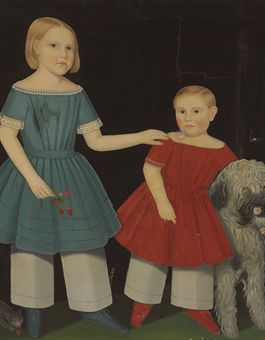
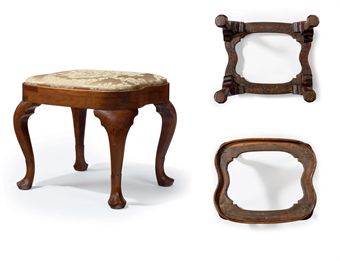
Christie's has now posted the results for their recent sales in NY during American Week. The sale offered 466 lots with 398 selling for a very respectable sell through rate of 86%. The sale totaled $5,681,025.00 (which is less than the single lot of the silver punch bowl sold at Sotheby's).  The top lot was an Ammi Phillips double portrait selling for $782,500 against an estimate of $300k/$500k (see image).  The number two lot was the Queen Anne Compass stool (covered here on the AW Blog) for $482.500 with buyers premium against an estimate of $300k/$500k.

Of the top ten lots only two, including the Phillips painting and one other lot sold above the high estimate, and one even sold below the low estimate.

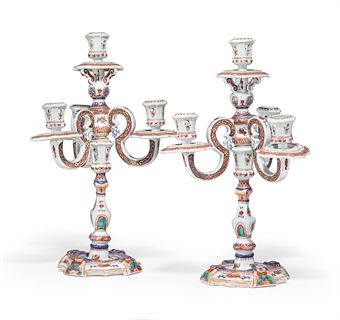
The Benjamin F. Edwards decorative arts sale had 407 lots offered with 373 selling for a sell through rate of 92%. The sale totaled $7.18 million. Six of the top ten lots in the Edwards sale bested the pre sale high estimate, and the other four top ten fell within the pre sale estimates.  The top lot was a pair of Verte-Imari CandelabraCirca 1725, which sold for $242,500.00 against an estimate of $80k/$100k (see image). This single owner sale easily bested the main Christie's Americana sale in total value.

Chrisites statements about the Americana sale are rather generic and certainly lack much enthusiasm or excitement, and center more on comments such as active bidding and an active room.

Christie's stated about the Americana sale
Jennifer Pitman, Head Of Sale, Silver Department said: “The top price for the monumental silver ewer by Paul Revere reflected the importance of American church silver from the First Parish Church in Beverly.”

Margot Rosenberg, Head Of Department, American Decorative Arts, commented: “This was a strong sale for the American Furniture and Folk Art category, with active bidding at every level. We witnessed strong competition for the rarest items, including the newly discovered brother-and-sister portrait by Ammi Phillips which sold for $782,500 - the second highest price on record for the artist - and the rare Queen Anne Philadelphia compass-seat stool. Top prices were achieved for property from prominent estate collections, including the Thomas J. Carroll Trust, and the Estate of Mary Frances Bowles Couper, among others.”

Becky MacGuire, Senior Specialist, Chinese Export Porcelain said: “Our sale of Chinese Export Art today demonstrated the continued strength of this traditional collecting field. Bidders were active in the room, on the phones and online, and literally hailed from around the globe.

ISA Assets 2010 - Toronto, Canada

On April 30 - May 3 ISA will celebrated its 30th anniversary with its annual conference, Assets 2010 in Toronto, Canada.  Over the past few years ISA has become known as leader in presenting some of the best personal property appraisal conference programs in the profession. Speakers at the recent Baltimore and Charleston Conferences included author and arts scholar Wendell Garrett, author and dealer Sumpter Priddy, Tom Savage of Wintethur, Andrew Brunk of Brunks Auction, Wes Cowan of Cowans Auction, Janet Moffitt of the IRS, Ron Fuchs of the Reeves Collection, Art Law author Judith Bressler, Lita Solis Cohen from Maine Antique Digest, and author and scholar Carrie Rebora Barratt from the MET.

The Toronto Assets 2010 continues in the same tradition.  The conference will have strong programs for fine art, jewelry and antiques and residential contents. The Conference is open to non members and of course members from other appraisal organizations.

The recent press release on the conference follows:
(Toronto, Canada) The International Society of Appraisers will celebrate its thirtieth birthday with an in depth three pronged Conference in Toronto on April 30-May 3. The Conference, entitled “Assets 2010”, will consist of programs in Fine Arts, Antiques and Residential Contents and Gems & Jewelry. Conference coordinator Kathryn Minard, ISA, CAPP, and conference co-chairs Irene Szylinger and Catherine Williams and Jim Poag, Gems and Jewelry program coordinator have arranged a lineup of credentialed powerhouse presenters for each session, a pair of dynamic keynote speakers, Robert Ramsay and David Ben, and scheduled tours of such important venues as the Art Gallery of Ontario, the Royal Ontario Museum, the Gardiner Museum of Ceramics, the Bata Shoe Museum, the Textile Museum of Canada, Corona Jewelry Company, the Stephen Bulger Gallery and a tour of a private residence featuring Jamieson Tribal Art.

According to Minard one of the main points of emphasis for this Conference is affordability and flexibility. ISA has arranged very generous rates for participants at the host hotel, the Park Hyatt Toronto in downtown Ontario. It is close to convenient public transportation and is surrounded by a wide variety of eating establishments for all tastes and budgets.

While the Conference will have three distinct sections, participants will be encouraged to pick and choose among sessions to accommodate the cross-over interests of many attendees.

The Fine Art program will feature sessions on the art market, contemporary photography, Inuit art, authentication, insurance appraisals, cross border appraisals and report writing. Presenters will include gallery owners, dealers and auctioneers, university professors and curators, representatives of AXA Art Insurance, the Senior Conservation Scientist from the Canadian Conservation Institute, a report writing specialist, and a representative of the Canadian Cultural Property Export Review Board and cross border appraisal experts from ISA.

The Antiques and Residential Contents program will feature sessions on hallmarks, quilts, Victorian, style and design, paperweights, insurance appraisals, appraising pop culture, cross border appraisals and report writing. Presenters include some of the same presenters in the Fine Art program plus representatives from the Hallmark Research Institute, the assistant curator of the Royal Ontario Museum, a representative of the American Quilters Association and a collection management specialist.

The Gems & Jewelry adds a costume jewelry expert, a representative from Korite International, the maker of Ammolite jewelry from Calgary, a representative from Ontario based Byrex Gems and the author of the Rolex Report as well as several presenters in the other categories.

The Conference itself is very reasonably priced beginning at $575 for ISA members with Super Saver early registration which ends January 31. Rates are slightly higher after that. Special rates are available for single day events and for spouses/guests. The tours and events are also very reasonably priced. To register online go to http://www.assets2010.org.
Site of the course is the Park Hyatt Toronto, 4 Avenue Road, Toronto, Ontario M5R 2E8 Canada, (416) 925-1234. A group discount rate is available through ISA for accommodations at the hotel. Hotel registration is available online at the above address.

For more information contact the International Society of Appraisers, 737 N. Michigan Ave., Suite 2100, Chicago IL 60611, phone (312) 981-6778, fax (312) 981-6787, email isa@isa-appraisers.org, website www.isa-appraisers.org

For more information, click HERE.

1/26/2010

The Parisian Auction Market

The Antiques Trade Gazette had a good article on the results of Parisian auction houses in 2009. As would be expected, the news is not terribly good, but on the positive side, the overall feel is confidence is returning and 2010 should show some signs of growth. The average loss in sales for the Parisian auction houses was estimated at 20%.

The ATG article states Christie's regained the title of the largest house in Paris with 455.2 million Euros in sales. That is a substantial factor of 3 above 2008, but it did include the YSL sale of, and if factored out Christie's would have had $112.8 million euros in sales. Without the YSL sale, sales at Christies would have declined by nearly 25%. But the sale was held and was a fantastic success, one of the few bright spots in the market during 2009.

Sotheby's had sales of 98 million euros, down 37% from 2008, followed by Artcurial with 88 million Euros in sales, down a modest 13%. Piasa was the largest seller of 70 firms at the Hotel Drouot, with total Hotel Drouot sales at 410 million Euros.
Drouot, where sales were stable, resisted relatively well, no doubt because, as an insignificant centre for auctions of contemporary art, Paris was better placed to resist the global market crisis than many other venues.

Meanwhile the gap between the ‘big three’ (Christie’s, Sotheby’s and Artcurial) and the rest continued to widen.

Christie’s, whose sales of 455.2m euros (£410m) were treble their 2008 total, regained the top spot they have held with one exception since 2002 (the first full year they and Sotheby’s were allowed to sell in France). Excluding the Bergé/St-Laurent sale, that total would have read 112.8m euros (£101.6m), a drop of 25 per cent – prompting Christie’s French boss François Curiel to observe that: “We’re back at 2005 levels, before the upsurge and speculative bubble.”

Even without the Bergé/St-Laurent sale, Christie’s would still have regained the top spot they lost in 2008 to Sotheby’s, whose 98m euros (£88m) total was a 37 per cent fall (albeit after successive annual hikes of 92 and 30 per cent). At both firms, foreign buyers accounted for over three-quarters of turnover.

Of the leading French firms, Artcurial resisted best, consolidating their third position with sales of 81m euros (£73m), down a relatively modest 13 per cent: a shortfall largely accounted for by a 9m euros (25 per cent) drop in sales of modern and contemporary art.

But Artcurial opened up a significant – possibly definitive – gap with long-term rivals Tajan, where sales plummeted 38 per cent to 35.8m euros (£32.3m).
To read the full Antiques Trade Gazette article, click HERE.

Sotheby's Important Americana Results


Sotheby's has released the summary on the recent Americana sale in New York.  Of course you are aware of the $5.9 million silver punch bowl I posted on the other day.  The American Sale totaled $13.33 million.  301 lots were offered for sale with 241 selling and 60 being bought in.  The sell through rate was a very good 80.1%.  The second highest selling lot in the sale was a Chippendale Figured Mahogany Bombe Slant Frond Desk selling for $689,500 against an estimate of $400,000/$1 million (see image).

Six of the top ten sold with the pre sale estimates, with another lot just over the high estimate (actually pushed over by the buyers premium) and three lots which sold for multiples of the high estimate, including the silver punch bowl, a two Federal paint decorated Baltimore Klismos side chairs, each selling as an individual lot for $194,500 against the pre sale estimates of $35k/$70k.

In addition to the main Americana decorative arts sale there was a single owner Chinese Export sale from the estate of Elinor Gordon.  This sale brought an additional $1.695 against a an estimate range of $850,000/$1.3 million. The Gordon sale sold nearly 95% of its lots.

Sotheby's stated
Leslie Keno, Head of Sotheby’s American Furniture, noted, “With over two thousand visitors coming through our exhibition and a packed saleroom, there was a noticeable energy and enthusiasm this season among both long-standing clients and many first-time bidders. We saw renewed confidence among buyers, which generated lively competition and strong prices.”

Nancy Druckman, Head of American Folk Art, said, “We were encouraged by the consistency of the quality of material on offer this season, and saw a perceptible energy and appetite among buyers.”

Leading the Saturday morning session of Important America including furniture, folk art and carpets was The Important Ranlett-Rust Family Chippendale Figured Mahogany Bombé Slant-Front Desk, Probably by Francis Cook, Marblehead, Massachusetts, circa 1770, which totaled $698,500 (est. $400,000/1 million). The desk is one of the rarest surviving examples of the esteemed bombé form; only twelve additional examples are known. Extensive research suggests the desk was made north of Boston, in Marblehead, Massachusetts and through careful
comparison with extant signed pieces the desk has been attributed to Francis Cook.

The Captain Samuel Morris Pair of Queen Anne Carved and Figured Walnut Rounded-Stile Compass-Seat Side Chairs, Philadelphia, Pennsylvania, circa 1745, was also sought after, bringing $362,500 (est.$200/500,000). Standing as superior examples of the Philadelphia Queen Anne style, these side chairs display a unified sculptural design, extremely fine construction and high-quality carving rarely matched on other seating furniture in the era.

A recently discovered Important Federal Carved and Figured Mahogany Marble-Top Pier Table, attributed to Thomas Seymour with John Seymour, carving attributed to Thomas Wightman, circa 1805 sold for $218,500 (est. $100/200,000). The table is among the most sophisticated, ambitious and elaborate pieces of American Furniture made in the Federal period. Only three other tables of similarly ambitious design are known. The present table retains its original finish and imported marble top and has remained in a private Pennsylvania collection since the 1960s.

Two Federal Paint-Decorated Klismos Side Chairs Attributed to John and Hugh Finlay, Baltimore, Maryland, circa 1809 representing the apex of Federal style jumped to $194,500 each (est. $35/75,000 each).

1/25/2010

Art Palm Beach - A Boost to the Middle Market


Jan Sjostrun writing in the Palm Beach Daily News reports the recent Art Palm Beach contemporary art fair was a success..... for the middle market. Most of what we have been hearing in the past is only the top end of the market has been successful, and even that has been impacted in the contemporary sector.

Sjostrum reports Art Palm Beach saw fewer top level dealers attend, but crowds of 20,000 visiting the show and strong sales between the $5,000.00 and $50,000.00 levels. This is good news for the middle markets which has been nearly forgotten and greatly discounted by statements such as only the best is selling. I have been guilty of that as well, but when I see articles on the middle market, and its strength, I have to smile. The art fair was geared toward the middle market by the promoters, and if the reports are correct, the fair was a success for those middle market galleries, and less so for the upper end of the market at the fair.

Sjostrum reports
The Lesters founded the fair 13 years ago, and they're veteran fair organizers. But they haven't organized a contemporary fair in this market since they sold their Palm Beach fairs to dmg world media in 2001. The couple reacquired the fairs from dmg last year.

"We have a lot to learn," David Lester said. "We're not doing it the same old way."

As he sees it, he and his wife are reinventing the fair to keep up with changing market conditions. They plan to lure the next generation of collectors with fresh galleries from around the world selling art at affordable prices.

Seasoned collectors were underwhelmed. Palm Beach collector Dale Anderson praised the revamped layout, the strong lecture series and Colombian artist Federico Uribe's sprawling sneaker-parts installation at the rear of the fair. But "it was an awful lot of icing and very little cake," she said.

Many good dealers that exhibited in the past weren't there, West Palm Beach collector Elayne Mordes said.

Upper-tier exhibitors also noted the scarcity of top galleries. Sales improved over last year, said Bjorn Wetterling of Wetterling Gallery. But "I'd like to see more blue-chip galleries," he said.

Palm Beach exhibitor Ellen Liman said her moderately priced paintings were selling well.

"At $15,000, a collector can enjoy something and not worry if it's an asset class," she said.

Fiber art dealer Browngrotta Arts reported consistent sales, but "like everyone else, the highest-end pieces are not going," director Tom Grotta said.
To read the full article, click HERE.

Museum Goer Falls for Picasso


Carol Vogel, reporting in the NY Times states a woman taking an adult education class at the Metropolitan Museum of Art, tripped and fell into and damaged a +$100 million Picasso. The painting, from Picasso's Rose period was damaged in the lower right side corner and incurring a 6 inch tear.

As terrible as it sounds, and as bad as the woman must feel, I am surprised this type of situation does not occur more often.  Take into account the museums and close access they provide to art as well as auction house previews and the possibility of accidents and damage can be substantial.

The painting will be part of the upcoming "Picasso in the Metropolitan Museum of Art,” The exception with nearly 250 works from the museums collection Picasso's opening on April 27. The repairs are expected to be completed by the start of the exhibition.

Vogel states
Immediately after the accident the painting was taken to the Met’s conservation studio so experts could assess the damage, museum officials said. A statement released by the Met on Sunday afternoon said, “The damage did not occur in the focal point of the composition and the curatorial
and conservation staffs fully expect that the repair —which will take place in the coming weeks — will be unobtrusive.”

The canvas — about 6 feet by 4 feet — was hanging on the wall of a second-floor gallery with other early Picassos. The museum declined to identify the woman, but said she was not injured.

1/24/2010

Silver Record at Sotheby's


Sotheby's set a new auction record for American silver with the sale of an early punch bowl. The New York punch bowl made between 1700 and 1710 by Cornelius Kierstede sold for an amazing $5.9 million with buyers premium. The pre sale estimate was $400,000.00 to $800,000.00. The previous record for American silver was $775,750.00.

I just posted about the Philadelphia compass seat stool which sold at Christies versus the similar record breaking stool which sold for 10 times the amount a little over a year earlier. A few years ago we had the Philadelphia tea table soar to record prices as well. What I find so interesting is the values being paid for exceptionally high quality select items are not merely above the high end of the estimates, but are selling for multiples of the high estimate.

The two session American sale at Sotheby's sold $13.33 million  and the Elinor Gordon Chinese Export porcelain sale totaled $1.69 million including buyers premium. The Christie's American decorative arts sale s currently at $4.67 million with more items to sell on the 25th.  I will post more details on the NY American sales once full results are listed.

Sotheby's reports
NEW YORK, NY.- A new auction record for American silver was set this afternoon at Sotheby’s when a Silver Punch Bowl by Cornelius Kierstede, made in New York between 1700 and 1710, sold for an astonishing $5,906,500. With a pre-sale estimate of $400/800,000 auctioneer David Redden opened the bidding at $275,000 and almost instantly a bid of $500,000 was called out by Ian Irving of Ian Irving Ltd. As many as six different bidders raised their paddles, but at around $3 million the battle was reduced to two determined clients, an anonymous gentleman seated in the room and New York dealer S.J. Shrubsole. The competition continued for several minutes before the winning bid was cast by the anonymous purchaser in the room; bringing the gavel down to rousing applause. The final price of $5.9 million is more than seven times the previous record for American silver, and is the second highest price ever paid for any piece of silver at auction.

The bowl has descended in the family of Commodore Joshua Loring, whose stately home in Jamaica Plain , Massachusetts , the Loring-Greenough House, has been preserved as an historic site. A Royalist, Loring abandoned his residence in August 1774 to take refuge in Boston , and the family emigrated to London in 1776. According to tradition, the bowl was hidden in a well on the property during the Revolution. Retrieved by the family, it descended quietly with them in England , completely unknown, until the owners sent a grainy photograph to Sotheby’s London silver department in March of 2009.

The punch bowl was included in Sotheby’s sale of Important Americana, which continues tomorrow morning at 10am, and will be followed by Chinese Export Porcelain from the Private Collection of Elinor Gordon at 2pm.

The previous auction record for American silver was $775,750, paid for both The Richard and Alice Brackett Cup, An American Silver Wine Cup, John Hull and Robert Sanderson, Sr., Boston, circa 1660, sold from the collection of Quincy Church at Sotheby’s in January 2001, and A Superb Early American Silver Two-Handled Grace Cup and Cover, John Coney, Boston, circa 1715, also descended with a Royalist family in England and sold at Sotheby’s in January 2002.

1/23/2010

Winter Antiques Show

Lindsay Pollock writes an early review on the opening of the 56th annual Winter Antiques Show.  According to the report sales have so far been very strong.  Last year many dealers reported struggling at the show, but this year appears to be different with buyers having more confidence, and perhaps a bit of pent up demand from putting off purchases.

Pollock reports
Tickets to attend the first hour of the annual show, held at the Park Avenue Armory, cost $1,000 to $2,500. Publisher and collector Peter M. Brant and Sallie Krawcheck, president of Global Wealth & Investment Management at Bank of America Corp., the fair’s main sponsor, were among attendees.

“Last year was somber,” said folk-art dealer David Schorsch. “This is a different year and it’s back. It’s not crazy, but it’s back.”

Sales were sluggish at the 2009 edition, amid a dismal economic outlook. A year later, buyers are more confident and eager to spend.

The Winter Show, known to cater to the tastes -- and pocketbooks -- of New York’s rich, hosts 75 exhibitors this year and runs through Jan. 31. Proceeds benefit East Side House Settlement, a South Bronx nonprofit organization.

German Armor

The fair presents a smattering of American and European furniture and fine art. London arms-and-armor dealer Peter Finer offered a 16th-century suit of German armor for $750,000 and an impressive 1574 German sword for $48,000.

Other marquee offerings include sculptor Paul Manship’s neo-classical, 9-foot-tall pink marble urn, priced at $6 million, at dealer Gerald Peters’s stand. Manship’s best-known work is Rockefeller Center’s golden “Prometheus” statue. The 7-ton urn, featuring American Indian-themed designs, was originally commissioned in 1914 for the driveway of Cleveland, Ohio, industrialist William Gwinn Mather’s estate.

Peters is also selling four gilt-bronze panels by Manship, originally designed for the facade of the American Telephone & Telegraph building on Lower Broadway. The panels represent the four elements -- air, fire, water and earth -- and are available as a set of four for $6 million.

Less expensive yard fare is available from Maine dealers James and Nancy Glazer, whose stand is dominated by a 1903 turquoise copper elk, which formerly topped an Elks club in Johnstown, Pennsylvania. The price: $425,000.
To read the full Bloomberg article, click HERE.

1/22/2010

A Tale of Two Stools


Christie's, January 22, 2010, $482,500.00

The Chistie's catalog entry stated
A very similar stool, possibly its mate, sold at Sothebys, New York, Property of Rear Admiral Edward P. Moore and Barbara Bingham Moore, September 26, 2008, lot 117.


Sotheby's, September 26, 2008, lot 117 sold for $5,234,500.00 (including buyers premium) and according to Christie's a possible mate.

I'll have more comments after I give this some time to reflect upon, process and consider.  It is a similar situation to the Philadelphia tea tables of a few years back as well.

I will either post here on the AW Blog or more than likely on the Appraisers Post with more depth and detail.

1/21/2010

Supply and Demand for Art Organizations

The Washington Post has an interesting article about arts organizations and a survey by the nonprofit group Americans for the Arts.  The survey results are both good and bad, as well as having some very interesting figures.  The good news is the growth of art organizations over the past 10 years has been very strong, although the article did not reveal the percentage of annual growth,  What I also found very interesting was the statement from American for the Arts that a new art organization is created every three hours.

Now, for the downside of the story, the survey reveals there has been a decline in the number of visitors at art institutions.  The article notes a 13 percent decline at art museums between 2003 and 2008. In effect, the supply and demand for arts organizations was out of equilibrium, with a growing supply and weakening demand.  Part of the decline is the way many people now consume cultural information......through the internet.

The Washington Post article states
This issue of supply and demand in the arts world is a troubling one, said the authors of the National Arts Index, because many groups have financial troubles and people of all ages are discovering new ways to experience the arts, including the Internet.

"Audience demand has failed to keep pace" with this boom in opportunities for arts participation, said Randy Cohen, the vice president for local arts advancement at the Americans for the Arts. "There is a new arts organization created every three hours."

Straitened financial circumstances and audience drift are issues that have been festering for years, and the recent recession didn't help. The analysts behind the index hope their data -- taken between 1998 and 2008 -- will clarify the predicament the arts find themselves in and provide a roadmap for new artistic and business models. "This first-ever annual measure confirms observations we have had for years," said Robert L. Lynch, the group's president and chief executive.

Attendance at art museums was down 13 percent from 2003 to 2008, the index found, while audiences at popular music events were down 6 percent. More people are taking classes in knitting and ceramics, as an arts participation survey by the National Endowment for the Arts reported last year.

Increasingly, people turn to the Internet for their arts consumption, whether they're seeking snippets of concerts or replays of stand-up comedy routines.
To read the full Washington Post article, click HERE.

Christie's 2009 Year in Review


The Christie's website has a good image based year in review slideshow. The slideshow has images and information on some of the top lots and interesting items offered by Christie's in 2009. You can also sort by category such as fine art, decorative arts, antiquities, wine and cigars etc. Additional sort functions are by location and specific sales.

Click HERE to view the Christie's 2009 year in review slideshow.

1/20/2010

Documentary Film on the Contemporary Art Bubble

Variety has a brief article on a documentary film by London Art Critic Ben Lewis on the contemporary art bubble. The film details how prices are manipulated by backroom deals, auction theater and public relations maneuvers being used to increase the value of collections. The film is entitled the Great Contemporary Art Bubble and was recently viewed at the Palm Springs Film Festival.

The pic argues that auctions are theater, the prices absurd (with multiyear payment plans negotiated by the houses in secret), and much of the buying is done by those who already own an artist's work, hoping that higher prices drive up the value of their entire collection. That last point is perhaps the most controversial, with Lewis confronting two unusually candid megacollectors on the subject: Aby Rosen and Alberto Mugrabi (who owns so many Warhols that, as Lewis points out, if art were regulated, his 9% stake would amount to cornering the market).

Though art-world entrepreneur Charles Saatchi helped trigger the outlandish prices commanded by Hirst and his fellow Young British Artists, he warrants only a brief mention in a film aimed at the period between 2003 and 2008, when an influx of oil money, Russian investors and speculation in recent Chinese art drove the prices in Sotheby's and Christie's contemporary sales up by 800%. With a finite number of impressionist and modernist paintings available, these new investors turned to work by living artists.

Are top sellers Hirst, Koons, Takashi Murakami, Anselm Reyle and Zhang Xiaogang the best artists of our age? Though Lewis reserves judgment, he appeals to those already skeptical of modern art's value, and is more than happy to reveal several reasons why such work dominates auctions: Today's richest collectors have large lofts to fill, and these artists' work comes big, often in multiples, produced by teams of assistants and blessed by powerful gallerists and collectors alike.

In Lewis' most outrageous stunt, the helmer attempts to confront Hirst dealers Jay Jopling and Larry Gagosian (the Rogers to his Michael Moore) with a leaked inventory of Hirst's unsold works. Lewis' access to artists proves more successful; he pays visits to Reyle's and Zhang's studios, where he asks the pros how they feel about the commodification of their work, and even tracks down the wealthy Asian businessman who purchased Zhang's record-setting Bloodline painting.
Click HERE to read the full article.

Antoher Warhol Foundation Suit

The Courthouse News Service is reporting on another lawsuit filed against the Warhol foundation for conflict of interest and  creating artificial scarcity. This is not the first suit against the foundation and the Warhol art authentication board.  Most of the suits claim the same thing, a conflict of interest between the foundation and the authentication board and the desire to control the Warhol market by limiting the number of authenticated art by Warhol.  It will be interesting to see how this and some of the other lawsuits turn out.

The current suit is brought by Susan Shaer who claims her Warhol painting is worth millions. The painting was reviewed in 1990 and the authentication board claimed it did not have enough information to pass judgment, and 14 years later asked Shaer to resubmit. Shaer claims this is only a ruse so that she will sign a release as she believes the authentication board will decline and then deface the artwork.

The Courthouse News Service states
Shaer claims a conflict of interest exists because the foundation employs authentication board members and owns $500 million worth of Warhol artwork.

By falsely declaring certain works as inauthentic, the board can "systematically exclude Warhol from the marketplace," Shaer says in her 43-page complaint.

Shaer says that without the board's intervention, independent sales would compete with the foundation's holdings in auctions and private sales.

Shaer says board members feel "free to abuse the authentication process in pursuit of their naked self interest."

The board's stamp of approval is necessary for anyone in the world to sell a Warhol work, which allows it to wield "disproportionate power over the Warhol market," according to the complaint.

Shaer says the board forces those who own Warhols to sign non-negotiable agreements that contain a "sweeping indemnity clause" before they submit the works for authentication.

The agreements allegedly give the board complete discretion to reverse its opinion at any time for no apparent reason - even after it has defaced a painting with "the board's equivalent of a scarlet letter."

Shaer says the board never explains the reasoning behind its denials, which shields its "determinations from scrutiny and liability."

Board employees are paid large salaries for their complicity in the scheme or turn a blind eye because of their prestigious positions on the high-profile board, according to the complaint.

Shaer claims that sales of Warhol artwork have dominated the multibillion-dollar market for modern and contemporary art.

The average price of a Warhol work at auction was $442,000 in 2006, according to the complaint.
To read the full CNS article, click HERE.

1/19/2010

1st USPAP 2012-2013 Exposure Draft Released


The Appraisal Foundation has released the first exposure draft for comment on proposed changes for the 2012-2013 edition of USPAP.  The first exposure and proposed changes focuses on the fundamentals of communication.  As Scope of Work rules have developed there appears to be a need for better communication of the assignment and that is what the first exposure draft deals with. The exposure draft mentions two alternatives for changes to the Communications Rule.

The exposure draft has contact information for making comments on the proposed changes, but keep in mind this is only the first draft of changes for the 2012-2013 edition of USPAP.

The exposure draft, dated January 5, 2010 states
The most important issue that has arisen over the past several years is the need for clearer expectations of an appraiser’s responsibilities when communicating in all parts of appraisal practice.

For the 2012-2013 edition of USPAP it is the ASB’s intent to clarify, in the Standards, what should or should not be required in a report. But prior to this there is a clear need to address the diverse communications that appraisers commonly provide their clients, prospective clients and users of appraisal services, that fall outside final assignment results. This has been referred to as “fundamentals” of communication. The ASB agrees that this clarification of fundamental communication responsibilities within appraisal practice must be addressed before any additional conceptual or structural changes to the reporting requirements in the Standards can be considered.

Therefore, just as the SCOPE OF WORK RULE was created to provide clarity in how to determine and disclose the array of services that appraisers provide for their clients, the ASB believes it will be valuable to have a similar Rule that provides clarity in how to address and disclose the diverse levels of communication that clients request or require.

The COMMUNICATION RULE is proposed for placement following the SCOPE OF WORK RULE. It begins with recognition of the primary expectation of the PREAMBLE that “it is essential that appraisers…communicate…to intended users of their services in a manner that is meaningful and not misleading.” It also clearly places responsibilities on appraisers to serve the public trust during communications at all stages of any service provided as part of appraisal practice.

The Rule covers appraisers’ responsibilities through all their activities, including everything from initial contact with potential clients to interactions with a client, intended users or other relevant parties following completion of an assignment. The Rule does not, however, include or address business-related communication such as completion dates, the timeframe for inspection of the property, or similar activities that are best classified separately as general business practices. Nor is this Rule intended to regulate internal communications among appraisers and others who are working together in an assignment.

In order to establish the best possible format for receipt of constructive comments, the ASB chose to draft and expose for comment two alternatives of a proposed COMMUNICATION RULE.

Both alternatives have similarities:
  • The definition of Report has been revised.
  • The Rule adds clarification to when an appraisal assignment is complete.
  • The Rule identifies minimum information that must be included in the communication of results for assignments other than those already specified in USPAP for appraisal, appraisal review and appraisal consulting assignments.
The two alternatives differ in their position on how to address draft or preliminary communication of all, or part, of an appraiser’s analyses, opinions and conclusions in an assignment.

The essential difference between Alternatives A and B of the COMMUNICATION RULE are these:
  • The allowance of only those reports that comply with reporting Standards, versus the inclusion of additional, allowable forms of communication and additional definitions.
  • How communication of all or part of an appraiser’s analyses, opinions and conclusions of assignment results must be reported under USPAP.
To read the full (15 pages) exposure draft, click HERE.

Christie's and the Gucci Collector


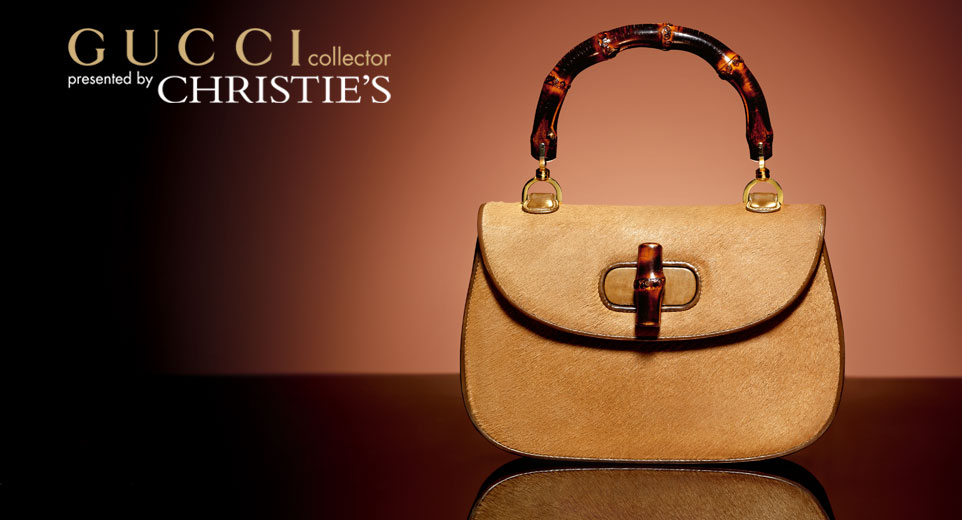
Christie's has announced on its website a new service for collectors of Gucci luxury goods. Both Gucci and Christie's specialists will participate in the program that encourages those with true Gucci items an opportunity for a free auction estimate and the ability to sell back to Gucci or through a Christie's sale. The site describe vintage Gucci as those special items with historic significance and relevance.

The program shows how popular and collectible luxury goods have become. Appraisers need to keep these items in mind when sorting through household contents.

Christie's website states:
Gucci Collector: Presented by Christie’s is pleased to provide the very first Gucci-certified online destination for appraising vintage Gucci products. The result of a unique partnership between the House of Gucci and Christie's, this unprecedented service is provided for avid Gucci collectors and enthusiasts alike.

A team of experts including Christie's Specialists as well as Gucci's own in-house archivists will assess the item, and Christie's will provide an auction estimate for qualifying submissions. Select owners will have the opportunity to sell their items to Gucci, or in a future Christie's auction, if desired.

Gucci Collector: Presented by Christie's is pleased to provide, at no charge, auction estimates for vintage Gucci products are historically significant items that have a relevance to Gucci's history for their style, illustration of a trend or possible link with a celebrity or historical figure. Generally, a vintage product is a less common piece and will be at least twenty years old, but other limited edition or special products may qualify.

Vintage Gucci items that are of a type and value typically sold at Christie's. Complete our online request form and we will provide you with a response within 2-4 weeks.
Please note that all estimates are provisional and subject to revision on personal examination by a specialist. Any property submitted under this service must be owned outright by the party seeking an estimate of value.

Please have the following information available:

* Clear color images of the front and back, and a close-up of the Gucci signature or mark
* Dimensions, medium and other details available (i.e. precious skins)
* History of the item (when, where and how was it acquired)
* Copies of receipts, appraisals or any literature relating to the item or certificates of authenticity, if available

To visit the Christies Gucci Collector page, click HERE.

1/18/2010

Art Buying Collectives

Emma Jacobs writes an interesting piece for the Financial Times about collectively purchasing art. The concept is not new as there have been private groups which formed investment groups for stocks and also real estate.  Here the group purchases art collectively, and then shares the art with members to display in their homes. The ideas allows for the group to purchase art where the individual may not be able to afford. The article states the main emphasis of the collective is to build a collection and experience the enjoyment of living with different pieces. The objective is not necessarily to make money or think of the art solely as investment vehicles, but I would think holding value is part of the equation as well.

Jacobs reports there can be complications and issues
Robert Lee, of the London collective, believes appreciation of the work is enhanced by the fact that the various pieces look so different in each member’s home – one lives on a houseboat, another in a flat in the city centre, while others have houses in the suburbs ranging from small Edwardian terraces to large Victorian villas.

Rotating artwork around members’ houses is not without its problems, however. “Sometimes people get attached to a picture and don’t want to see it go. Sometimes we find people are reluctant to hang a work – we’ll find it sitting in a garage or a spare room,” says Betts. Tim Eastop says for that reason one of the London collective’s rules is that “even if there’s a piece that we don’t like, we have to hang it”.

Fox believes “it works best when someone has to hang something they hated. Nine times out of 10 at the end of the six-month hanging period they love it. They are confronted by something challenging every day.”
To read the full Finanical Times article, click HERE. Not that for some article access registration is required at the Financial Times.

Liquidation at Tavern on the Green


Katya Kazakina reports in Bloomberg about the Bankruptcy sale at Tavern on the Green. Perhaps we should call in a liquidation sale, as over 850 pints of Bailey's Irish Cream and numerous bottles of wine sold at the sale. The sale included over 1,000 lots from the restaurant which lost its lease from the City of New York to a higher bidder.

Kazakina reports
“You can’t make a mistake at the prices we are selling these,” said Guernsey’s auctioneer Joanne Grant to encourage the bidders. “Have you been to a good bar lately?”

Deals abounded during the three-day, court-ordered auction. Richard Yorkowitz, who is about to open his own bar in Asbury Park, New Jersey, didn’t need much encouragement. He paid $3,225 for 1,250 bottles of wine from the famed restaurant in New York City’s Central Park, or $2.58 a bottle.

“That’s half the wholesale price,” said Yorkowitz, 45.

The restaurant filed for bankruptcy protection in September 2009, after losing its lease on the city-owned site to a higher bidder, and closed after throwing a New Year’s Eve gala.

The auction’s 1,000 or so lots comprised thousands of items, from banana-split dishes to stained-glass tableaus. There were no minimums and all but a few lots sold, according to Guernsey’s auction house, which conducted the sale. The tally was in “millions of dollars,” though less than the $8 million the restaurant owes its creditors, said Guernsey’s president, Arlan Ettinger. The bankruptcy lawyers directed him not to release the sale’s total, he said.
To read the complete article, click HERE.

1/17/2010

Hourly Rate Calculator


It has been a while since I posted an appropriate technology tip for appraisers on the AW Blog. Many appraisers charge by the hour, yet many dont factor into account the appropriate overhead and additional fees necessary to charge properly, or what should be an acceptable rate or return for our professional fees.  I have been displaying at the Annapolis Antiques Show this weekend and I have yet to have a chance to try this online hourly rate calculator.  It takes into consideration items such as office rent, travel, computer costs, software costs, communications, insurance, professional fees, advertising, billable hours, vacation sick days, profit or salary you expect, and then calculates and returns the hourly billing rate you should be charging.

The site is called Freelance Switch and the calculator is at http://freelanceswitch.com/rates/

Freelance Switch states on the website
We have developed this hourly rate calculator to give you a guide based on your costs, number of billable hours and desired profit. It is a simple tool for you to play with.

Remember your hourly rate should always take into account factors like market demand, industry standards, skill level and experience - things that unfortunately we can't put into a calculator!

Use these calculations as a guide and then modify to suit your circumstance and conditions.

It will take you about 5-20 minutes to complete depending on how
much attention you give each calculation.

Skull Withdrawn from Christie's Sale


Due to an ownership issue, a human skull that belonged to Yale's Skull and Bones society has been withdrawn.  The skull was supposedly used as a ballot box for voting, with a top flap or door cut into it and hinged to open and accept ballots.

The Associated Press report is very short, so I will post in its entirety.
NEW YORK -- A New York City auction house says a human skull that had been used as a ballot box by Yale's elite Skull and Bones society has been withdrawn from sale.

Christie's said Friday that the 19th century skull was being removed from the Jan. 22 sale due to a title claim. The auction house declined further comment.

The skull had been expected to sell for $10,000 to $20,000. Christie's only identified the seller as a European art collector.

The skull is fitted with a hinged flap and is believed to have been used during voting at the mysterious society's meetings. The club was founded in 1832 and publicly known members, called Bonesmen, include both presidents Bush and Massachusetts Sen. John Kerry.

1/15/2010

Chinese Export Porcelain


With the upcoming sale of Elinor Gordon's collection the Economist has published a good article on Chinese export. The article discusses several items with Gordon's collection and gives some general background and a short history of Chinese export porcelain.

The article states
By the 18th century, British, Dutch, Portuguese, Swedish and American trade with China was so well established that the new wealthy merchant class it created had taken to emulating the trappings of the landed gentry, designing coats of arms and commissioning entire porcelain services on which to flaunt them. No marriage or promotion was complete without a specially made plate to commemorate it.

This upward social mobility gave rise to a new phenomenon, the manufacture of Chinese porcelain and paintings for the export market.

Two centuries on, Chinese export porcelain attracts a quite different collector from those seeking Chinese porcelain proper. Whereas all Chinese treasures—whether jade, porcelain, lacquer, bamboo or rhinoceros horn—have an aesthetic appeal that prizes rarity, delicacy and symbolism above all, export porcelain speaks to the academic collector or, less politely, the “anorak” or “train-spotter”. The form is based on Meissen or other soft-paste porcelain, but it is not really European. Nor is it particularly Chinese, although it was made there.

Instead, it is a bit of a mish-mash. It appeals to buyers who seek to complete a particular series defined by decorative patterns, special coats of arms or links between different families.
To read the full Economist article, click HERE.

1/14/2010

UK Experiences Reduced Spending on the Arts

Farah Nayeri writing for Bloomberg has a rather sobering report on past and future spending for the arts from foundations and corporations.  According to the article, art tracking group Arts & Business, a nonprofit organization that links the arts with non-governmental donors, has seen a downturn in UK art funding  for the year ended March, 2009 and perhaps more importantly expects the lower level of funding in the UK to continue over the next two years.  Arts & Business reports the fiscal year ending March 2009 saw reductions in UK art spending by 6% from the previous year, down a total of over $250 million.

One of the hardest hit groups were museums in the UK, showing a 37% decline in giving. Here in the US there have been many reports, some posted on the AW Blog, about the decline in giving to museums and historic societies.  This could get worse if the US economy does not improve, and may also be impacted by changes in charitable donations laws which could impact many organizations and individuals ability and desire to give.

Nayeri states
the charity published a survey showing that spending by U.K.-based companies in the year ended March 31, 2009, fell 6 percent to 157.3 million pounds ($254 million).

Investment by businesses, individuals, and trusts and foundations together dropped 7 percent to 655 million pounds. Arts & Business is a nonprofit body that links the arts with non-governmental donors.

“We’re looking at bad figures for next year and the year after,” Tweedy said in a telephone interview. “The smaller arts organizations are suffering the most.”

After U.K. elections that are set to take place by June, arts subsidies are bound to be cut, Tweedy said. Philanthropists “are going to be the ones increasing the funding in the next eight to 10 years, not the government,” he said.

In the year ended March 31, 2008, a record total of 686.7 million pounds was given to U.K. arts organizations by companies, individuals, and trusts and foundations, up 12 percent on the previous year.

In the just-ended year individuals alone gave 363 million pounds -- more than twice what businesses gave, and a decline of 7 percent from last year. Trusts and foundations contributed 134.5 million pounds to arts and culture, also down 7 percent.

Museums suffered the biggest drop in giving, with a 37 percent decline to 80.8 million pounds.
To read the full article, click HERE.

About Irrevocable Bids

Lindsay Pollack has a very good article in the Art Newspaper about irrevocable bids.  I have posted about these bids in the past on the AW Blog, but there still seems to be a fair amount of misunderstanding about what they represent and how they can impact a sale.

As auctions houses started to suffer financially over the past year or two, they have backed away from the straight house guarantee to secure consignments. The large international houses have now embraced these new third party guarantees in order to transfer all or a portion of the risk in guarantees.

Pollack's article goes a long way to answering many of the questions about irrevocable bids and how they differ from guarantees.

Pollack states
Irrevocable bids were developed about 15 years ago by Sotheby’s as a way of passing on its exposure to an outside party. Christie’s began to do similar deals in the last five years. What was new in November 2008 was Sotheby’s decision to identify which lots were guaranteed by the house (a small circle is used), versus lots guaranteed by anonymous third parties (a circle plus a horse shoe). Christie’s only indicates which lots are guaranteed, with no special marker for third-party guarantees.

Sotheby’s said the decision to add the new symbol was in the interest of transparency. “We decided to make as full disclosure as possible, while still respecting the interest of both sellers and buyers,” said Mitchell Zuckerman, chairman of Sotheby’s financial services. Yet dealers and collectors say they aren’t clear how the process works.

Third-party guarantees are on the rise as auction houses pull back on straight guarantees. During the 2005-2008 boom years, Sotheby’s and Christie’s each laid out hundreds of millions in straight guarantees, mostly for modern and contemporary or impressionist art, with an estimated $700m in spring 2008 alone. This all changed with the credit crisis in autumn 2008, and resulting art market tumble. “We took losses,” said Zuckerman. “We announced we were going to stop giving guarantees.”
To read the full Art Newspaper article, click HERE.

1/13/2010

RICS Fourth Quarter 2009 Arts and Antiques Survey


RICS recently released its 4th quarter Arts and Antiques Survey, and the news is good. The survey revealed that the overall index is up, with 7 out of 10 sub-sectors showing increases, including furniture and even contemporary art.  The three sub-sectors that did not show increases were clocks, books and ceramics.  The survey was led by large increases in silver and jewelery, due to the high scrap value.

I always look forward to the RICS quarterly surveys and print them out to save.  They are a great tool to use when writing a market analysis.  Keep in mind the survey is for the UK, but it still has application to other international markets.

The RICS summary to the survey states
The net balance of surveyors reporting rising rather than falling prices edged up further in the fourth quarter, with the All Lot price balance increasing from +14 to +17 (the highest reading since Q1 2009). The rebound in the arts and antiques market coincides with the rebound in other asset classes such as equities and property.

Out of the ten subsectors covered in the survey, only three did not a record a positive net balance during the latest three month period; clocks, ceramics and books. For the second consecutive quarter, all price ranges recorded positive readings, with price momentum at the bottom end playing catch-up.

For the first time since Q3 2008, the contemporary art subsector recorded a positive net balance of +6, possibly signalling an end to the sharp downturn that has taken place in the subsector. In the oil and water colour subsector, prices rose at the headline level, but were still falling at the bottom end of the market.

Silver and Jewellery remained the best performing subsectors with net balances of +50 and +37 respectively. Their strength is in part due to the increased scrappage value of precious metals during the fourth quarter.

In terms of the demand and supply outlooks for Q1 2010, confidence fell slightly in both cases but still remains conformably in positive territory.
To read the full RICS 4th Quarter Arts and Antiques Survey, click HERE.

1/12/2010

Christies' Reports Growing Influence of Mainland Chinese Collectors

Le-Min Lim has a short but interesting, and not totally unexpected report on Bloomberg about the buying habits and appetite of mainland Chinese collectors as reported by specialists at Christie's.

The article is short, so I will take the liberty of publishing the full article.
By Le-Min Lim

Jan. 12 (Bloomberg) -- Mainland Chinese are buying more art at Christie’s International’s auctions in New York and Europe as their purchases “rose significantly” last year using wealth produced by a growing economy, Christie’s said.

Mainland China residents bought the most-expensive items at Christie’s New York jewelry auction in October and more than doubled their purchases of Chinese art last year at sales in London and New York, said Andrew Foster, president of Christie’s Asia, in a statement. Nine of the 10 priciest items at the second part of a Paris auction of Yves Saint Laurent’s effects in November were bought by Asians, Christie’s said, without saying how many were Chinese.

The past two years have seen the Chinese outbid Americans and Europeans for top-end Asian antiques and gems at art sales in Hong Kong, the world’s third-largest auction market after New York and London. Now, the Chinese are expanding their collection beyond traditional art to include watches, wine, jewels and some Western art, said Foster.

“The trend is crystal clear,” said Foster, who’s also Christie’s chief operating officer. Asia’s “wealth is migrating to art and lifestyle purchases, and not only in Hong Kong.”

Hong Kong is leading the global recovery in the art and auction markets, said Foster. Like rival Sotheby’s, the company holds biannual sales in the city. In 2009, Christie’s Hong Kong sales tallied HK$2.7 billion ($348 million), with buyers paying 27 percent more per lot at the second auction than the first.

Foster said “passion” is returning to the Hong Kong art market. “The head evaluates, but the heart rules the art market.”

Upcoming Impressionist Sales


Scott Reyburn of Bloomberg has good preview of the upcoming London Impressionist sales. The positive news is there is some very good lots being offered, including the recent edition of Dresdner Bank AG’s Alberto Giacometti sculpture Walking Man (life size) expect to bring close to $30 million. The London evening sales at Christie's and Sotheby's are expect to bring over $200 million. Sotheby's is offering 39 lots while Chirsties is offering 86 lots. In addition to the Giacometti, the sales will offer a Klimnt, a Cezanne, and two Picassos.

The article states one collector saying confidence is coming back to the market, and the quality offerings seem to confirm that opinion.

Reyburn states
“Commerzbank has a big collection, we have a big collection,” Martin Halusa, Dresdner’s head of media relations, said in a telephone interview. “The Giacometti is one of a group of works being sold or donated to museums as part of the general reorganization of the company.”

The Dresdner sculpture, from an edition of six, is the first example cast in the artist’s lifetime offered at auction, said Sotheby’s. It is valued at 12 million pounds to 18 million pounds, as is Klimt’s 1913 painting, “Church in Cassone -- Landscape with Cypresses.”

Cezanne’s Fruit

Cezanne’s 1893 to 1894 still life, “Pichet et Fruits Sur une Table,” was executed on paper laid down on panel.

The Cezanne had been sold by the Barnes Collection in Philadelphia in 1936, according to Sotheby’s.

“The presence of these three works shows visible confidence in the market,” Newman said in a telephone interview. “While we’ve had plenty of private sales, they don’t get reported.”
To read the full Bloomberg article, click HERE.

1/11/2010

New on the Appraisers Post


After a slow holiday season, the Appraisers Post (www.appraiserspost.com) has had a nice flurry of activity from posting appraisers.  New on the Appraisers Post is an excellent review by Stephen P. Sweeting, ASA MRICS of David Maloney's 3rd edition of Appraising Personal Property: Principles and Methodology.

Sweeting states
Although Appraising Personal Property is an excellent browse for anyone active as a valuer, I saw three key uses for this book within my own appraisal office:

1. A learning template for trainee appraisers to use in concert with formal education programs.
2. A refresher volume for our accredited appraisers.
3. A well-indexed reference aid that can be used in the way I used an earlier edition for guidance in my loss-of-value appraisal.

As an Integrated Studies scholar, I have to be impressed with this book’s dovetailing of theory and practice as well as the interdisciplinary approach that considers valuation, ethics, legal issues, and business in one volume. But as a practicing appraiser I see the third edition of Appraising Personal Property as more than a demonstration of integrated thinking. The volume is additionally a first-rate reference tool for any appraiser and an excellent addition to the body of literature for our profession.

Also on the Appraisers Post is a review of the new book on Antiques Roadshow: Behind the Scenes by Jerry Sampson, ASA.

Sampson states
This book really gives a true behind the scenes look at how this show operates. You'll get a look at how the executive producer Marsha Bemko and her staff have worked to adapt the British TV show for the American market. You'll meet the appraisers and learn early childhood influences as to why they choose this career. The set-up requirements, security and lay-out of auditoriums are explained in a way that makes it easy to understand why "Roadshow" doesn't come to every town. Of course, you'll get information from all the past years' highlights of interesting objects and you'll receive follow-ups as to what happened to several items after the cameras shut off. You'll understand and appreciate the articles pertaining to the "watermelon sword" and the Poe image. One of many interesting topics was learning how objects are selected for the camera. One chapter that I loved was "Missing Masterpieces;" it focused on what various appraisers longed to have walk onto the set of "Roadshow."

I have to say that as an appraiser, the one chapter that excited me was the chapter titled "The Final Reality." This chapter gave easy step-by-step hints and information for people looking for appraisals. Though there was no mention of The Uniform Standards of Professional Appraisal Practice (USPAP), I thought that the information provided in this chapter was very useful and factual.

David Maloney also addresses Qualified Appraisals and Appraisers.

Visit the Appraisers Post for commentary on topics of interest to personal property appraisers written by leading professional appraisers, click HERE to visit.

Watch Rodin's The Kiss Sell at Christies

Chris Hayes of PBAA sent me the link to a Christie's video of Rodin's The Kiss selling at Christie's It starts selling at $1.2 million and hammers down for $5.6 plus commission. The bidding starts out fast and furious and then slows.

The video is embedded on the Appraiser Workshops blog for those getting email.  It is located in the top right column.  Just click to play.

Visit the site and video at www.appraiserworkshops.blogspot.com.

ASA Course Offerings


Sharon Rollins, ASA the personal property chair at the American Society of Appraisers has sent me the upcoming ASA course offerings. Please note the special one hour webinar being held on February 12, 2010.  Additional information is listed at the bottom of the post.  For additional information on the classes, contact ASA on the personal property pages at  http://www.appraisers.org/PPHome/PPHome.aspx, or call 703-478-2228 or 800-272-8258.

The class schedule is as follows:
January 2010

22-23 Oriental Rug Appraisal* RISD

February 2010

5-6 Native American Art: Identification RISD
& Appraisal*
12 Folk Art Webinar by Susan Golashovsky, ASA Your Office!
12-15 PP/GJ POV 203 RISD
25-28 PP/GJ POV 203 NWU

March 2010

4-7 PP/GJ POV 203 Pratt
4-7 PP/GJ POV 201 UCI
8-9 Inspecting and Describing Fine Art UCI
8-9 Strategies for Handling and Managing
Difficult Appraisals* Pratt

11-14 PP/GJ POV 204 RISD
15-16 USPAP for PP RISD

April 2010

9-10 The Bauhaus* RISD
15-18 PP/GJ POV 204 NWU
19-20 USPAP for PP NWU
29-(May) 2 Intro to Appraising Antiques and Dec Arts RISD

May 2010

13-16 PP/GJ POV 202 UCI
17-18 Turning Gold and Silver into Green UCI
21 Resources for Appraisers (Beacon Hill, Boston) *RISD
20-23 PP/GJ POV204 Pratt
24-25 USPAP for PP Pratt
24-25 The Logic of the Argument* Pratt

June 2010

3-6 Appraising Fine Art* RISD
4-5 USPAP for PP UCI
16-17 Business of Contemporary Art* Pratt


ASA PRESENTS ...


Antique Folk Art and the Modern Interpretations WEBINAR

Whether you’re a generalist, fine arts or decorative art appraiser, don’t miss this affordable opportunity to increase your knowledge while also obtaining the education credits needed for reaccreditation. Learn first-hand from an expert with more than 20 years of experience in the field of antiques and folk art.

Susan Golashovsky, ASA, is an accredited specialist in American Folk Art, Antique Furniture and General/Residential Contents. She has interviewed artisans and examined their work to determine:

• How they interpret antiques
• What they do to make them appear “aged”
• The values of antiques versus new interpretations

This one-hour webinar, offered for the first time, will allow you to:

• Learn just how closely some artisans interpret antique objects
• See examples of antiques against revival and more recent examples
• Gain an understanding of the interpreter’s work through interviews with artisans currently making these objects
• And more


Date: Feb. 12, 2010
Time: 2 p.m. EST (one-hour duration)

Register NOW.

(NOW will link to this: http://www.appraisers.org/Education/ViewClass.aspx?ClassID=2362

1/10/2010

Estate Tax in 2010

I know I have covered much of this in past posts on the AW Blog, but CBS Money Watch had an excellent article, nicely laid out and simple to follow on the major issues involved for estate tax in 2010.  Again, one of the important factors to keep in mind is the now the cost basis of property instead of the stepped up basis for value at time of the death. Expectations remain that a new law will be passed and be retroactive, although there are constitutional issues and there could be some suits filed by wealthy estates.  Of course the sooner new law estate tax laws may be passed, the fewer suits are expected.

All appraisers should be closely monitoring these developments.

CBS Money Watch states
* Both the estate tax and the generation-skipping transfer tax (on assets given to grandchildren) were repealed at the end of 2009.
* Both taxes are scheduled to return in 2011 at the unfavorable rates that applied 10 years earlier. The amount that is exempt from each of these taxes will then be $1 million, and the tax on the rest will be 55 percent.
* There is still a gift tax if you give away more than $1 million during your lifetime, but the tax rate has been reduced from 45 percent to 35 percent.
* Heirs will now have to use the original price paid for an asset when computing their tax liability, instead of the value upon the owner’s death. This change of “cost basis” could be very expensive, and difficult, for heirs. For example, if you inherit shares of Microsoft (MSFT) that your father accumulated over many years, you might be stuck hunting for all his transaction slips and adjusting for stock splits along the way (a potential nightmare). And when you sell any of the shares, you may owe capital gains tax on the appreciation. Each estate can exempt $1.3 million of gains from this carryover basis rule, as it’s called. Another $3 million exemption applies to assets inherited from a spouse.

Most estate planners expect Congress to restore the taxes retroactively, and to put back in place the system that applied in 2009: a $3.5 million exemption for estate tax and generation-skipping transfer tax, with a 45 percent rate for these two taxes as well as the gift tax.
To read the full CBS Money Watch article, click HERE.

1/09/2010

More on Park West

Art Info and The Art Newspaper have both recently reported that a suit brought by Park West Gallery against two customers from London for libel (who are also suing Park West) has been dismissed.  The dismissal recommendation is based upon outside attorney reviews which also recommended that Park West should reimburse the two defendants legal expenses in the suit. According to the Park West's attorneys, they will agree to drop the suit, but not the rest of the recommendation, such as paying the defendants legal fees.

According to the reports, the couple purchased a partial set of the 1951 "Divine Comedy" series by Dali, and later purchased a complete set. The sets were purported to be signed by Dali. The Art Info report states experts who looked at the artwork for the defendants said they were authentic, but the signatures were not. Royal Caribbean was also involved in the suit as some of the art was purchased on one of their cruises. They were dropped from the suit, but now an appeals court has ordered them back as co defendants with Park West.

The Art Newspaper reports:
The story began in December 2007 when Day and Howard went on a cruise with Royal Caribbean. They purchased three Salvador Dalí prints from the artist’s “Divine Comedy” series, created in 1951, for over $97,000 from Park West Gallery which leases rooms on board Royal Caribbean cruise ships. After the cruise, Day and Howard purchased a complete set of Dalí’s “Divine Comedy” prints for over $483,000.

According to the gallery, each print in the series is signed by both the artist and the French publisher of the work. Day and Howard allege the gallery told them the acquisition was a sound investment which would escalate in value, a claim the gallery denies.

A few months later, Day and Howard decided to sell, but say they were told by a Sotheby’s expert that a complete signed set of “Divine Comedy” prints is worth between $60,000 and $80,000. At Day and Howard’s invitation, Dalí experts including Nicolas Descharnes, the son of the photographer Robert Des­charnes, a friend and associate of the artist, examined the prints and concluded that although they are genuine, the artist’s signatures are fake.
What a tangled web indeed.

To read the Art Info article, click HERE, to read the Art Newspaper article, click HERE..