2/28/2010

Giacometti Purchaser Identified

Scott Reyburn of Bloomberg is reporting the purchaser of the Giacomettin Walking Man Bronze which recently sold at Sotheby's London for $103.4 million was purchased by Lily Safra. Safra is the window of Lebanese Banker Edward Safra who died in an apartment fire in Monaco in 1999. Lily Safra is set to be worth $1 billion. Hong Kong-based real-estate developer Joseph Lau was also identified as one of the under bidders.

Phillip Hoffman of the London Based Fine Art Fund stated the purchase price was a freak event, brought about by a low estimate and wealthy people bidding crazily for a rare piece.

Reyburn reports
Two London-based dealers, speaking independently and anonymously to Bloomberg News, have identified the buyer as Safra.

“The sculpture has been delivered to her place in Belgravia,” said the first of these dealers, who has contacts with the shippers who transported the piece.

The second dealer said that Safra had become interested in buying the Giacometti after her negotiations for the private purchase of another cast of “Walking Man I” from a dealer had fallen through prior to the auction. This other version had been priced at about $45 million to $50 million, said the dealer.

“Mrs. Safra’s longstanding policy is to not respond to press inquiries of any type,” said Seth Goldschlager, a Paris- based public-relations consultant who is Safra’s spokesman, in an e-mail yesterday.

In a subsequent e-mail, Goldschlager would neither confirm nor deny that Safra was the buyer when told that Bloomberg News would publish her name as the purchaser.

Philanthropy

Safra is the chairwoman of the Edmond J. Safra Foundation, a philanthropic organization that supports projects devoted to education, science and medicine, religion and humanitarian issues in more than 50 countries, according to the foundation’s Web site.

She has a mansion, Villa Leopolda, at Villefranche-sur-Mer, near Monte Carlo. The property was valued at $500 million in 2008, making it the world’s most expensive house, according to the Guinness Book of Records. Goldschlager confirmed that Safra still owns Villa Leopolda.

Safra also owns property in Geneva, Monaco and New York, said Forbes.
 To read the full Bloomberg article, click HERE.

2/27/2010

Artfact and the iPhone

In early December I received an email from Susi Prescott at Artfact about the release of a new application for the iPhone.  I was immediately impressed and posted on the AW Blog and Appraisers Post. At the time, I was using an older model regular cell and not a smart phone, but I thought the idea of access to Artfact/Invaluable through a smaprtphone such as the iPhone was a great idea. Perhaps more importantly it could have significant benefits for the personal property appraiser.

Last week I had a Doctor’s appointment and when I arrived the receptionist said the Dr. was delayed in surgery, but was on his way to the office. If I could come back in about an hour or an hour and a half they would get me right in to see him.  I said sure, and drove over to a shopping center to kill some time. And, there was the AT&T phone store.  Well, the time away from the doctors was well spent.  I would like to say I purchased an iPhone, but I really think I made an investment in an excellent business tool.  And, if you like gadgets like me, it is also pretty cool tool.  Although I will say, if it was not for Susi telling me about the app , I don’t know if I would have made the change.

My cell plan could withstand the upgrade, so I purchased an iPhone 3gS with 16 gigabytes of storage for $200.00 (plus some accessories).  It has gps, maps, camera, video, calendar, email, clock, compass, messaging, stocks, Youtube, web surfing, wifi, plus the enormous library of applications such as the Artfact app.

For those unaware, an app is a software program designed to run on the iPhone or other smartphone. It is formatted properly for the small screen size.  Typical websites can be browsed, but if the formatting is not right, they can be hard to view and utilize, the smartphone application  takes care of this. With smartphones we have always had the option to send email, check some websites etc.  The development and popularity of smartphone and the software applications happens to make viewing and reading much easier, and gives the phone so much more utility.

Benefits for the appraiser are many, such as access to email and the web.  Calendars are great, because they can be synced to from your primary computer to smartphone.  The GPS on the iPhone is amazing for location, finding shops nearby, and directions.

Back to the Artfact app.  I log onto the iPhone/iTunes online store and download the Artfact app, which is free.  I have an Artfact account, I sign in, and there on my phone are thousands of comps with prices and upcoming auction info.  Some items you need to have a subscription to access, other content is totally free from the Artfact site. The app will even search recent and past auctions, although the full sold lot database of Artfact is not available through the app.  As the software is further developed and new versions are released I do hope more of the past auction database, beyond those of Artfact auction listings will soon be included and searchable with the iPhone. I can easily see using the smartphone as a regular tool in my appraisal practice when judging level of property or when looking for a quick on site value range opinion during a walk-thru. For more information on the iPhone app from Artfact, click HERE. If you have an iPhone and an Artfact subscription, there is no reason you should not be taking advantage of this free additional application and use of the Artfact auction site.

In addition to the great Artfact app, Live Auctioneers has an app with past sales information, Christie’s has an app with recent auction results,eBay has an app, and LinkedIn for networking. Hopefully, Sotheby's will soon have an application as well. I know I am going to benefit from all of the functions from the iPhone, Artfact and other software being developed for these devices.  My main thought of them prior to Susi's email was a texting device for kids, and to send and receive emails.  Perhaps I have been behind the times in getting a smartphone, but I am quickly learning, there really are many more uses than texts and email.  Thanks Susi.

2/26/2010

Giacometti Video

If you have not visited the AW Blog online, please note there is a short video from Financial Mirror TV on the sale of the record setting Giacometti sale at Sotheby's. Click HERE to visit the site, and the video is embedded at the top of the right sidebar.

Steve Roach, JD, ISA AM Joins Appraisers Post

I am pleased to announce that Steve Roach has joined the growing list of bloggers and contributors to the Appraisers Post.  Steve has a very diverse background in law, auctions, coins, and fine art.  We are pleased to add Steve and his vast experience to the growing list of appraisers and writers of the Appraisers Post.  Click HERE to visit the Appraisers Post.

Steve's bio:

Steve Roach, JD, ISA AM, combines the analytical perspective of an attorney with the trained eye of a connoisseur in his appraisal work with rare coins, fine art and collectibles. Steve is a member of the Texas State Bar and a licensed auctioneer working with auction houses and for charity and benefit auctions. He is available to serve as an expert witness and has particular expertise in working with attorneys and other fiduciaries to include hard-to-value assets in estate plans.

Steve graduated from the University of Michigan with a BA in art history with high honors and received his JD from The Ohio State University. Steve has been involved with rare coins his entire life, paying for his college education by working with some of the top dealers in the country. After finishing his BA, Steve joined Heritage Rare Coin Galleries in Dallas, TX where he worked as a rare coin grader and wholesale trader. Steve paid for law school by grading coins at ANACS, and upon graduation he returned to Heritage to serve as the director of its trusts and estates department. From there, he was recruited by Christie's to serve as a specialist in its 19th century European paintings department and upon the department's dissolution, Steve became an editor at Coin World, the world's largest hobby publication.

Contact Information:
Steve Roach, JD, ISA AM
PO Box 192344
Dallas, TX 75219
(214) 536-4309
www.steveroachonline.com
roach.steve@gmail.com

2/25/2010

American Association of Museums Has a Plan

The Artnewspaper is reporting the American Association of Museums has a new strategic plan.  Well, not exactly new, more of a first strategic plan in the 104 year life of the association (can that really be correct?). The AAM has a membership of 15,000 individual, 3,000 institutions and 300 corporate members.  That is a rather large association with a strong membership base not to have been operating under a strategic plan.  In any event, they have developed a rather simple plan, which is a full two pages in length, based around four words, which are:
  • Excellence
  • Sustainability
  • Advocacy
  • Allignment
Is this really the best an organization of this size, not to consider the connections to some high profile business leaders, can devise during this difficult economic times.  With that type of leadership and and lack of vision, it becomes a little clearer why so many museums and cultural institutions are having difficulties. The article states the museum world has long been against proper business planning, and I have seen that attitude in other reports, where the groups believe they are only institutions of cultural heritage, etc, and not businesses. Perhaps as endowments have shrunk, and giving has declined, they are starting to understand the business and commerce a little better.  We can only hope.

The Artnewspaper states
Each of the four single-word goals is followed by some bullet points with self-directed injunctions as to how they might be attained: for example: “Foster excellence through professional training,” and “Develop, deepen and diversify business opportunities.” The document is silent as to the financial and organisational implications of these goals for the AAM or its members.
Its creation was preceded by a professionally facilitated process of consultation, beginning with the board and membership of the AAM and extending to public bodies and other actual and potential stakeholders. It will be followed by an implementation plan in a few months. Notwithstanding the stated goal of openness, it is not the AAM’s intention to publish this. The Spark is, of course, not a plan at all—it is a set of broad aspirations, the realisation of which will in turn depend on a plan that is as yet unarticulated. It’s like taking the title page and chapter headings and calling it a book.
The habit of baldly asserting aspirations—often ones sufficiently vague not to invoke dissent—and calling it a plan, strategic or otherwise, is uncomfortably common in cultural planning. In the case of AAM, this is unfortunate, as there has probably never been a more important time for museums individually and collectively actually to plan, with intelligence, application and seriousness of purpose. Planning means working out a set of goals that further—or simply protect—the existential purposes of the institution, and then refining those goals and the paths to them until there is a robust institutional consensus as to how they can be achieved and by when. If there are no goals, there is no way of choosing a direction; but if there is no credible path mapped out as to how to reach the goals, however glorious, then it’s not a plan—it’s an untested assertion.
To read the full Artnewspaper article, click HERE.

More on the Phillips Move

Fellow appraiser and NYC resident Denny Levy sent me a good article from a few years ago on the building where Phillips is supposed to be moving to, 450 Park Avenue, which set a record for price per square foot. Some will find the NY Observer report about the building and the record pricce, especially those in the NYC area, very interesting, although not really appraisal or art related.

This is from the New York Observer
By John Koblin
July 17, 2007 |

When 450 Park Avenue went to contract two weeks ago, all the talk was of its record-breaking sale price, at nearly $1,600 per square foot. But among developers and brokers there was another point of interest. The question in those circles: Where were the Macklowes?

It was assumed all along—fairly or not—that Harry and Billy Macklowe would purchase 450 Park Avenue once it became available three months ago. The logic went that the Macklowes controlled the development site directly next to 450 Park and needed to somehow justify the hefty price tag that it took to put it together ($440 million for the Drake Hotel and $2,000 per foot for a row of tiny buildings along East 57th Street).

And it was believed that in order to build the best possible office tower and maximize their options in putting it together—a tower the Macklowes have dubbed 440 Park Avenue—it would be best to buy the building right next door.

Of course, they didn’t. The 32-story 450 Park Avenue went to Somerset Partners and Michael Tabor for a record sum.

And although the Macklowes were among the 25 groups that placed a bid on the building, two sources said, they balked at putting down $1,600 per foot.

The question is why.

Perhaps it was a shrewd economic decision, realizing that even the most creative architect would have a tough time designing an office building around a 32-story one, whether it was in the landlord’s hands or not. To own 450 Park would be an added benefit, not a necessity.

“The positive for [Harry] would have been to give himself control and flexibility,” said Michael Falsetta, executive vice president at Miller Cicero, an appraisal firm. “It would have left him more options.”

But perhaps there were other reasons for not buying it. One source familiar with the Macklowes said that if it were for sale last year, there’s no way they would have passed it up.

Indeed, things have changed in the past few months for the Macklowes.

After their major $7 billion buy of eight Manhattan buildings in February, the Macklowes have been scaling back. When it was discovered that SL Green had a buyout option on 717 Fifth Avenue as part of that $7 billion portfolio buy, the Macklowes immediately backed out. Last week, they sold a highly valued site near the United Nations for $151.9 million.

And, according to a source, they’re mulling a plan to sell a few towers from their mega-portfolio buy.

Is it a matter of having their hands in too many projects? Is it difficulty finding financing? Or is it another well-calculated and shrewd move?

If there’s one thing the Macklowe family history tells us, it could be absolutely any of the above.

2/24/2010

Phillips de Pury Moving to 57th Street

The New York post is reporting auction house Phillips de Pury appears to be moving to 57th Street at 450 Park Avenue. This location puts Phillips in prime luxury NY City real estate, surrounded by the likes of Bergdorf Goodman, Carnegie Hall, restaurant Nobu 57 and the Four Seasons Hotel. The article states Phillips has signed a lease for 5 five year period on 30,000 square feet at 450 Park Avenue, the building which sold in 2007 for a record $1,600.00 per square foot.

The NYP reports
Stalled or slow-moving development sites have left unsightly empty lots and craters.

Several store sites have failed to draw tenants after years of trying, while more space continues to come onto the market.

On the possible good news front, Phillips is said by several sources to have signed a lease for 30,000 square feet at the base of Somerset Partners' 450 Park Ave., the black-glass tower it bought in 2007 for a record, near-$1,600 a square foot (remember those days?).

Somerset Executive Vice President Gregory Knoop did not return calls.

The lease would be for a relatively short term — just five years. But it would eliminate one of 57th Street's most embarrassing vacancies on a corner flanked by an empty lot and empty store buildings, where Harry Macklowe's development plans are bogged down with lenders.

Phillips was recently purchased by Russia's Mercury Group.
To read the full NYP article, click HERE.

Just a Few Snuff Bottles

Bloomberg is reporting Bonhams will be offering a collection of over 1,700 antique Chinese snuff bottles starting May 28 in Hong Kong. The estimated value of the collection if expected over $32 million. The Qing Dynasty bottles were collected over several decades by Hong Kong businessman George Bloch and his wife Mary.

Bloomber reports
Newly wealthy Chinese are keen to acquire high-quality objects from their heritage, particularly when associated with emperors from the Ming and Qing dynasties, said dealers. Prices for porcelain of these eras increased 48.2 percent between 2005 and 2009, according to U.K.-based database Art Market Research.

The first of an expected 10 biannual Bloch auctions will be held on May 28, when 140 bottles may raise more than 1.5 million pounds, said Bonhams.

“The collection was begun at a time when not many people were collecting snuff bottles in a serious way,” Hall said.

A mid-18th-century porcelain “moon flask” bottle painted with a winter landscape commissioned by the Qianlong Emperor is expected to fetch as much as HK$2 million ($257,634). A similarly dated Beijing enamel bottle showing a Western mother and child has a high estimate of HK$3 million.

Another Qianlong “European subject” enamel bottle, from the collection of Vancouver philanthropist Mary Margaret Young, sold at Christie’s International in New York in 2008 for a record $825,000.
To read the full Bloomberg article, click HERE.

2/23/2010

Is Art Title Insurance Needed?

Daniel Grant writes a good column in the Huffington Post on art title insurance, and if it is needed and how the firms handling the insurance product are fairing. I have reported on art title insurance companies on the AW Blog in the past. Grant's article goes a bit deeper, and not only reports on the availability, but also on or if there is a need. It does not some of the major player in art insurance such as Chubb have expanded coverage for legal disputes.

The article is well worth reading and goes beyond the basics of the title insurance for art.
The major insurers of fine art collections have also found that their private collector clients see little reason to purchase title insurance policies. "We don't hear many requests" for title insurance, Christiane Fischer, chief executive officer of AXA Art Insurance, said, although she stated that there are instances involving inheritances, divorces and stolen artworks in circulation in which such coverage makes sense. Dorit Strauss, vice-president and worldwide specialty fine art manager at Chubb Insurance, also claimed that title insurance "makes sense, but no one wants to buy it." Collectors "expect dealers to have done their due diligence," which should solve the problem of ownership. She noted that Chubb considered adding a title insurance program years ago but found that "the only people who want title insurance are the people who have an impediment to the title of something in their possession, and they are looking to transfer the risk to someone else."

However, Strauss stated that Chubb has added to its all-risk Masterpiece fine arts coverage up to $100,000 in legal defense costs in the event of a challenge to the title of one or more works in a policyholder's collection. The insurer also refers policyholders to the Philadelphia-based Art Title Advisors, which for a fee of between $750 and $2,500 will research the history of ownership of a particular artwork, issuing a report that would clarify all known information about title. Jonathan Ziff, managing director of Art Title Advisors, noted that in a world in which art theft is the third largest area of crime dollar-wise (behind gun- and drug-running) art collectors should position themselves "in the event of a title challenge." However, he said, collectors are "largely oblivious to the potential problems and feel comfortable self-insuring. They feel pretty comfortable about their chances, believing that it's not going to happen to me." Ziff noted that there hasn't been a large number of collectors who have sought his company's services.

That comfort-level may be illusory, Shindell said, since "the art world operates in absolute secrecy. The buyer often doesn't know who the seller is and no one can be certain of title. There is always some degree of risk." Title insurance, he claimed, permits collectors to transfer that risk to a third party -- the insurance company.

Click HERE to read the full story.

ADAA Hires former IRS Art Advisory Panel Director

Carol Vogel reported in the Friday edition of the NY Times that past IRS Art Advisory Panel Director was appointed to the position of Director of the Appraisal Services department of the Art Dealers Association of America.

Vogel reports

In an effort to beef up its appraisal business — and grab some of it away from the auction houses — the Art Dealers Association of America has hired Karen E. Carolan, the former director of the Internal Revenue Service’s art appraisal division and former chairwoman of its Art Advisory Panel. She was appointed executive director of the association’s appraisals services department. “This is a long-term initiative,” said Lucy Mitchell-Innes, president of the dealers group.

While the association already has a team of appraisers, it is hoping to increase the business that comes primarily from estates and collectors making donations to nonprofit institutions. Performing appraisals not only brings in revenue, it is also a good way to learn where works of art are, which can often lead to future sales. That’s partly why the auction houses are so keen to help clients with appraisals for everything from estate taxes to insurance and gift taxes.

While Sotheby’s and Christie’s usually charge fees for appraisals, it is often waived for collectors whose works they hope to sell in the future. Art dealers, like those in the association, charge a fee too, another revenue stream the group hopes to increase.

2/22/2010

Rebounding Antique Market?

I am not sure how I missed this NY Times article, but I saw it listed on a linked in discussion board.  I guess old age (senility already)  is starting to set in. It is exactly the type of article I wish to post and promote on the AW Blog and, it is also has some positive comments on the direction of the antique market. It is a good article on the status of sales in January for the antique market, and focused on the Winter antique show. Many experts and dealers consider the Winter show to be a barometer of things to come for the rest of the year.  From the article the results are very positive.  The show saw over 22,000 attendees, up over 20% from the 2009 show.  Sales, according to dealers in the story were very positive on both the high end and the middle market. The article states sales were strong early, which is the norm at the Winter show and was reported here on the AW Blog, but sales were also reported to be strong at the end of the show as well. The article does state that prices in general have fallen nearly 20%-30% from over the past year. Yet there appears to optimism that perhaps the bottom has been hit for the antique trade and decorative arts in addition to the recent and strong fine art sales, and that things will stabilize and then hopefully improve and strengthen.

Some great quotes in the article to support a market analysis of antique furniture.

The NY Times article states
The slow sales of last year, however, have made dealers’ inventories particularly interesting and full now. And collectors’ reluctance to sell in a weak market has made great pieces scarce, but strong performers when they appear. (There is the relative reassurance of a venerable-looking object as an investment haven, in contrast to a technology stock or bond.)

The antiques market’s eagerness to survive has made prices for much midtier material very attractive. Dealers said prices were generally at least 20 to 30 percent lower than two years ago.

And, as Alan Granby, of Hyland Granby in Hyannis Port, Mass., maritime art and antiques specialists exhibiting at the armory, said, “Midrange things can still be the best in their field.”

Categories that are victims of changes in taste are especially well priced, even for outstanding pieces. The enthusiasm for modern design among younger buyers and the graying of the market for older and formal genres have produced unexpected opportunities in traditional pieces, which typically are too expensive for first-time collectors.

“Collectors are going after A-level material,” John Smiroldo, founder and publisher of Antiques and Fine Art, a bimonthly magazine based in Watertown, Mass., said of the auction and show scenes. “But you can get A-minuses for pennies of what it will be trading for in four or five years. As far as I’m concerned, American furniture is free right now — for killer stuff. And high-style English furniture is down, down, down.”
To read the full article, click HERE.

2/21/2010

Investing in Prints

Kishore Singh of the Business Standard has an article on investing in prints.  Singh goes on to explain rather simply what a print is, the ease of investing in prints and also some of the pitfalls.  The article is more specific to the market in India, but much applies to the overall market for prints as well.  Well worth reading.

Singh states
India has excellent printmakers devoted exclusively to the medium — Chittaprosad and Haren Das among the masters, Anupam Sud and Pratibha Dakoji in recent times — but in public perception at least, there seems still to be some hesitation in accepting their work as having investment potential.

It is only recently, with prices having consolidated, that art promoters have turned to it as yet another medium. Even dealers have turned to newer technologies, such as serigraphs, the process of silk screening a print in the closest approximation of a painting in its original colours, with the blessings of the artist, who both numbers and signs each such edition, making it a collectible.

It is clear from the process that the resulting print is affordable for those with fewer means at their disposal, but can it be an investment? Mostly, gallery owners tend to be dismissive since keeping a few sets of fine art prints amidst an inventory of original art is more likely to be a liability than an opportunity.

But with specialist studios, the story is a little different. Before the boom in the art market collapsed, serigraph prints had just been introduced in the Indian market, and prices rose sharply even before all the editions had sold out, leading to accusations of market manipulation — in truth, it was price manipulation — despite which people queued up to buy them. But even that became justified when a portfolio of Jehangir Sabavala editions acquired at a cost of Rs 9,90,000 (approximately £12,000) by an investor in 2007 was auctioned by Bonham’s six months later for £32,000. At the Khushii auction in Mumbai the following year, the Sabavala serigraphs found bidders at a platform reserved for high art.
To read the full Business Standard article, click HERE.

2/20/2010

Coming Soon - Journal of Advanced Appraisal Studies - 2010

The Journal of Advanced Appraisal Studies – 2010 will soon be published. Look for the 2010 edition to be available for purchase sometime in late March or early April. I am currently putting the master document together for final copy editing, formatting and printing. I am very pleased with the article contributions for this year and expect the journal to again be widely accepted as a thoughtful and insightful publication on personal property practice. The 2010 article mix and variety is excellent, with an interesting selection of product knowledge content, appraisal theory and methodology and practical appraisal information. The 2010 collection of articles come from both past journal contributors and new authors.

The 2010 edition of the Journal of Advanced Appraisal Studies will contain articles on the following topics:

• Folk Art
• Museum deaccsessioning
• Investing in antiques and art
• Appraising art
• Working with the moving industry
• The appraisal library
• Appraisal software techniques
• Appraiser versus authenticators
• Rarity
• Valuation
• Blockage
• Art crime
• Appraising church and synagogue collections
• Original research methods
• Furniture designers
• Appraising stamps and coins

I will of course post to both the Appraiser Workshops blog and the Appraisers post when the new 2010 edition is available.

The Journal is published by the non profit Foundation for Appraisal Education, and proceeds go to the educational initiatives of the foundation. I would like to thank all of the authors, volunteers and past and present Foundation for Appraisal Education board members for their help, continued support and loyalty to this important and needed project. If we as a profession expect to grow we need to cultivate and encourage those who practice personal property appraising to develop new ideas, theories and methodologies, and the share them with our peers.

As Charles McCracken, D.Ed wrote in the inaugural 2008 edition of the Journal:
Modern personal property appraisers do more than numerical calculations and tabulations. They generate prose that is engaging and explanatory. They write beyond the numbers to share knowledge with peers and a wider audience. The virtues of publishing are many. By contributing to the literature upon which all appraiser rely, they establish themselves as experts in afield, attract jobs well suited to their interests and expertise, and develop a network of colleagues and other professionals.

For the profession, publishing informative pieces about what appraisers do or telling the stories their research uncovers, promotes good will and public trust and demonstrates the rigor or the research conducted. As the appraisal practice evolves, writing for a broader audience, writing clearly, writing for publication is becoming more important.
The 2008 and 2009 versions of the Journal are still available, and can be ordered at www.appraisaljournal.org. As the editor of the journal I am always looking for interesting personal property related articles for the publication. If you think you have an article idea for the 2011 edition (publication estimate of March 2011) please feel free to contact me at toddsig01@gmail.com.

2/19/2010

LAPADA Member Survey

The LAPADA, the UK's association for art and antique dealers has recently released results from its annual survey of members.  I have not been able to locate the full survey, but the Antiques Trade Gazette has published a glimpse of some of the statistics.  The news and outlook for the upcoming year is good.  I will try to get more information on the survey and report additional information when published. The eye opening statistic, is that more dealers are doing business at shows and fairs then through shop sales.  The survey showed a drop in shop sales from 67% to 56% with an increase in fair sales from 18% to 27.5%.  Surprisingly internet sales showed only a little growth, which I guess is good that people still like to touch, feel and see before purchasing.

In the meantime, the ATG reports
With almost a quarter of the membership taking part, 29% of respondents expected turnover to be higher in 2010, compared with only 15% – from an almost identical cross section – who were similarly optimistic last year.

At the other end of the scale, 23% of those polled thought turnover would fall compared with 57% in 2009.

Although business was worse for almost half the polled membership last year, it was still better for 22%.

Those operating out of a shop or gallery has remained fairly static at 58% (60% in the previous year), while 60% (67%) exhibit at fairs, 3% (8%) deal at fairs only and 30% (34%) hold in-house exhibitions.

Interestingly, less business is now being done in shops and galleries, 56% (67%), and more at fairs, 27.5% (18%).

Internet sales have also risen to 11.5% from 8% last year, although the share of dealers who have sold stock on the internet at all has only climbed 1% to 68% of the polled membership.

Meanwhile, sales through auction have remained all but level at 3% (4%), as have those through catalogues 2% (3%).

The United States remains the most important overseas market for 64% of respondents, but that is down 5% from last year, while the EU has seen a rise in importance for 27% (18%).

2/18/2010

Gilbert Stuart Athenaeum Portrait of Washington to be Auctioned

The Artnewspaper has a short article on an upcoming auction which includes an Athenaeum portrait of Washington by Gilbert Stuart.  The portrait will sell at Cottone Auctions near Rochester, NY on March 27, 2010. The estimate is $200,000/$300,000.  The article states the owner thought it was a copy and recently had it appraised where it was deemed an authentic Stuart.  Within the appraisal process the painting should be authenticated by a Stuart expert but that is not noted. There is family provenance back to the 1860's according to the article.

Jane has written a good article for the 2010 edition of the Journal of Advanced Appraisal Studies on the differences between appraising and authentication.  The 2010 edition should be available in April.

The Artnewspaper article is short, so I will take the liberty to post in full.
A portrait of George Washington reportedly by Gilbert Stuart, the most famous portraitist of early American presidents, is going up for auction. The painting hung untouched in the home of an upstate New York family for generations and has been estimated to fetch between $200,000-$300,000 when it goes up for sale 27 March at Cottone Auctions of Geneseo, New York.

The canvas’s owner, Oliver Chanler, says he can trace ownership of the painting back to at least 1860, but he always thought it was a reproduction. Only recently, following his mother’s death, did he have it appraised, and it was deemed an authentic work by Stuart. It is one of about 100 the artist painted after his unfinished portrait of Washington, The Athenaeum, which is reproduced on the one-dollar bill.

According to Matt Cottone of the auction house, the combination of the provenance—the family can trace its background to 19th-century politician John Winthrop Chanler, a descendant of millionaire philanthropist John Jacob Astor—as well as the historical significance of Gilbert Stuart and Washington "makes it an exciting discovery".

2/17/2010

Appraisal Practices Board (APB) Applications Now Available

For Immediate Release


Contact:     Paula Douglas Seidel, 202.624.3048, paula@appraisalfoundation.org


Washington, DC, February 17, 2010  The Appraisal Foundation, a Congressionally authorized non-profit organization dedicated to promoting professionalism in appraising through the establishment of appraisal standards and appraiser qualifications, announced today that applications are now available for qualified candidates to serve on the Appraisal Practices Board (APB).
Late last year, the Foundation Board of Trustees unanimously voted to establish this new Board.  The APB will be charged with studying the issue of how to best address a void in the marketplace related to guidance on appraisal methods and techniques that would be available to all appraisers practicing in the United States.   This guidance will eventually cover all valuation disciplines, with a focus on emerging issues. 
After a recent vote of the Board of Trustees to amend the Bylaws and Articles of Incorporation, the APB has now been officially established.  The new Board will be similar in structure and composition to the already existing independent boards, the Appraiser Qualifications Board (AQB) and the Appraisal Standards Board (ASB). 
The purpose of the APB is to issue voluntary timely guidance to appraisers on emerging valuation issues that are occurring in the marketplace.  This guidance will be of assistance to appraisers, appraiser regulators and educators.  The new Board will enlist the help of market surveys to identify issues that need to be addressed and will empanel small groups of volunteer Subject Matter Experts (SME) to draft the guidance for review and approval by the Board.  The SME panels will be selected by the APB to address specific topic issues within agreed upon timeframes.  It is anticipated that the SME panels will be established in the latter part of 2010. 
The Appraisal Foundation is now seeking qualified candidates to serve on the APB.  The APB will commence work in July 2010.  Examples of qualifications that the Boards Nominating Committee will seek in candidates include the following:
  • A minimum of ten years of appraisal experience
  • A strong familiarity with the Uniform Standards of Professional Appraisal Practice (USPAP)
  • Familiarity with valuation methodology and techniques
  • Experience in writing on valuation topics and/or curriculum development
  • Experience with public speaking and/or teaching on valuation topics
  • Experience in serving on a publicly accountable board.
The APB will be a multi-disciplinary board and therefore, The Appraisal Foundation is seeking candidates from various appraisal disciplines.
The Application factsheet and form is available online on the Foundation’s web site (https://appraisalfoundation.sharefile.com/d-seaa4a4152734b0eb).  Applications will be reviewed by the Boards Nominating Committee of The Appraisal Foundation and an extensive interview process will be conducted.  The final interviews will be conducted in a public forum at the Spring Meeting of the Board of Trustees on May 21, 2010 in California.  Inquiries on the Application or the selection process can be directed to Paula Douglas Seidel (paula@appraisalfoundation.org). 

###

New Contemporary Art Fund

Katya Kazakina writing for Bloomberg has an article on another start up art fund. This fund is devoted to contemporary art and is called Anthea Art Investments AG located in Zug, Switzerland. The fund was scheduled to open in 2008 but was rescheduled and will now start seeking investors for May, 2010 and looks to raise $110 million, with a minimum investment of 250,000 Euros, or about $340,000.00. The fund will be diversified contemporary art, including 25% in iconic works, 45% in blue chip contemporary artists, 10% in emerging regions such as China and India, 2% in emerging artists and 18% in arbitrage art or the buying and selling for profit as opposed to a holding strategy.

I have posted on art investment funds in the past, and should note many have struggled or have closed, although as well all know the art market has been difficult to navigate over the past year or two.

The article states
Anthea I will be overseen by the Irish Financial Services Regulatory Authority. By contrast, most art funds aren’t regulated, and that has put off investors.

“One of the issues of these funds is transparency,” said Pierre Valentin, London-based partner at Withers LLP, who specializes in art law and litigation. Valentin went on to say, “Art fund as a concept is in its infancy. It’s also a risky investment. And it hasn’t been a very good time for funds to persuade investors to put their money in a form of investment that is perceived to be risky. The track record is not there. You don’t know how successful they are going to be.”

Uneven Results

Subba, who was raised in Italy and now lives in Zurich, said his experience in structured investments should help Anthea I avoid the often sharply uneven results of art funds.

London-based Fine Art Fund Group, which has been run by Philip Hoffman since its start in 2001 and is one of the best- known in this area, comprises four unregulated funds: The Fine Art Fund and Fine Art Fund II, both invested in works from Old Masters to contemporary art; the Chinese Fine Art Fund; and the Middle Eastern Fine Art Fund.

Hoffman said the average compound annual return for artworks sold since 2004 is 33 percent. Hedge funds lost 19 percent in 2008 and were up 20 percent in 2009, according to Chicago-based Hedge Fund Research Inc.

Hoffman said the unsold artworks of the two Fine Art funds declined 30 percent in value from the market’s peak at the end of 2007 through mid-2009, yet were up an average of 30 percent from the purchase prices. He said that while his funds are unregulated, they are subject to third-party audits and third- party valuations.
To read the full Bloomberg article, click HERE.

2/16/2010

Safeco to Donate Art

Fellow appraiser Denny Levy sent me an article from the Seattle Times on insurance giant Safeco who plans on donating 840 pieces of art, including many artists from the Great Northwest to museums in Washington state.  The value of the art is worth $3.5 million and will go to a consortium of seven museums in Washington. The Museum group is called the the Washington Art Consortium, and the art museums include the Seattle Art Museum, Tacoma Art Museum and the University of Washington's Henry Art Gallery.

The article states
This single donation more than doubles the size of the consortium's holdings and gives it a strong survey of Northwest artists' works over the past three decades.

The consortium plans to display a portion of the collection at an exhibition space in South Lake Union in April. Some of the art also will be divided among the member museums, though the core of the collection will be kept together.

For Safeco, a key reason for donating was simple. The insurance company — a longtime local institution — had been purchased by Liberty Mutual Group in 2008, leading some to wonder about Safeco's viability and whether its history of local philanthropy would continue.

"We want the community to know we're alive and well," said Safeco President Mike Hughes. Indeed, he said, Liberty Mutual has encouraged the company to keep up its community giving, which Hughes characterizes as being comparable to previous years.

Rare gift

It's rare for a corporation to just give away its art — and especially so many pieces at once.
To read the full Seattle Times article, click HERE.

Results: Christie's Evening Post War and Contemporary Sale

The past week or two has been an active period for the modern art sector with large sales at Sotheby's (results already posted on the AW Blog) Christie's and Phillips.

I have yet to post the Chrisitie's results, and wanted to do so before too much time has past as it was a successful sale.  The sale offered 52 lots with 46 selling for an impressive 88.5% sell through rate. The sales total for the sale was $66.07 million including buyers premium, easily beating the pre sale estimate rage of $41 million to $59.7 million. Sixteen lots sold for over $1 million with buyers from the UK (33%), Europe  (41%), the Americas (22%) and Asia (4%).

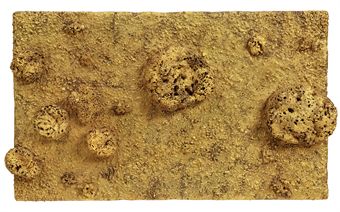
The top lot was  Relief Ă©ponge or (RE47II) by Yves Klein (1928-1962) which sold for $9.15 million including buyers premium against an estimate of $7.8million to $10.92  million (see image).

Francis Outred, Head of Post-War and Contemporary Art, Christie’s Europe stated:
 “This evening’s auction not only showed that confidence has returned to the art market but also that there is a real hunger from international collectors for Post-War and Contemporary art. The strong results at our international auctions during the second half of last year encouraged vendors who were previously resistant to consign works of art, and the increased supply of quality works fed a strong demand and led to competitive bidding this evening. We sold more than half the lots above estimate, including 7 of the top works, and in selling 9 works over £1 million, we have already surpassed the equivalent figure for all three of our auctions of Post-War and Contemporary art in London last year. We saw particularly strong prices for classic European artists including Yves Klein as well as Tapies and Boetti, both of whose work established world record prices. These results should give consignors great encouragement as we look forward to the next major auctions of Post-War and Contemporary art in New York and London in May and June respectively.”

2/15/2010

Artprice Vs Christie's

Last week I posted on an Artprice press release (click HERE to read the AW post).  The press release included information on a lawsuit and what Artprice called an attempt by Christie's to take over Artprice through stock manipulations.  The battle has not been reported by the Financial Times. The Financial Times has a short update, as it is only a two paragraph update, I will take the liberty to post in full.

The FT reports
Christie’s has brought a lawsuit against Artprice, accusing it of copyright and trademark infringement by reproducing its e-catalogues on the Artprice website without permission. The firm is demanding a hefty €63m in damages, a sum that was recently increased from an initial €2m. Christie’s says it is not suing other online art data firms such as Artnet because “Artprice are the only providers that are scanning and copying our catalogues wholesale”.

Artprice belongs to the flamboyant entrepreneur Thierry Ehrmann, who is fighting back. He is countersuing with three complaints including a penal action under article 465-1 of France’s financial code, accusing Christie’s of “seeking to influence his company’s share price”. He claims the battle has an underlying commercial basis, since Artprice also sells art online (the average price for a work of art sold on the site is just over €12,000). He maintains that the auction house is trying “to take control of Artprice at a lower price”.

The Onion

Yesterday I posted an article from the online publication The Onion, which I have now been informed is a mock newspaper based on satire.  The article I posted on was how an appraiser was tired of looking at collectibles like Smurf figurines, and how he had to change the product mix of his shop in order to survive.  Perhaps this was a satirical look at the current state of the antique market, but it is relevant and perhaps sadly true.

As dealers how many times have we seen antique malls in name only, started with good intentions and quality inventory only to devolve into glorified indoor yard sales, with many worthless items.  As appraisers, because of the collectibles craze how many strange and unusual phone calls and visits at shops have we received to appraise or value worthless items, or for us to give our knowledge away for free on items with little to no substance. How many reproductions, fakes, copies and knockoff items have we also witnesses as appraisers, or how many times the clients claim how valuable the piece is only to be informed they were sadly mistaken.

The article was perhaps satire, but also, as in all good satire contained many elements of truth as well.

2/14/2010

Polaroid Forced to Sell Part of its Collection

The NY Times is reporting a banruptcy court is forcing Polaroid to sell some of its collection of photographs.  Some photos within the collection were taken by the likes of Andy Warhol and Ansel Adams. The Banrucpty attorneys tried to place the collection with several museums but was not able to do so. In order to payoff creditors, Sotheby's will now auction 1,200 photographs from the collection on June 21 & 22 in New York.  The pre sale estimates total between $7.5 and $11.5 million. This is only a small portion of the collection, with over 10,000 additional images in storage.
“It’s an amazing body of work,” Mr. Close said in a telephone interview. “There’s really nothing like it in the history of photography.” But, he added, “to sell it is criminal.”

While he and other artists would have liked the collection kept intact in a museum’s holdings, John R. Stoebner, the court-appointed trustee for Polaroid, said he had talks with several museums, including the Fogg Museum at Harvard University, but was never able to reach a deal.

The collection has its roots in the Artist Support Program, a project Mr. Land started after realizing how important artists’ input was in improving his products. It was a handy arrangement, the collection’s longtime curator, Barbara Hitchcock, explained: Polaroid provided some of the greatest talents around with equipment and film, and they gave the company photographs. “Experimentation was encouraged by Polaroid,” Ms. Hitchcock added. “It was a mantra — experimentation, creativity, innovation, pushing the envelope of photography.”
To read the full NY Times story, click HERE.

Tired of Appraising Smurfs

Jane sent me the link to this article in The Onion, an online news source and thought it was interesting, funny and sadly appropriate.  The article details antique dealer and appraiser Milton Jarry from Duluth, MN who is tired of looking at collectibles, such as Smurf figurines.  Jarry talks about the disappointment of what comes through his shop, and what he has to sell in order to stay open.  His passion is items from New York lighting and metalwork firm E.F. Caldwell & Co, and antique European and Russian chandeliers, wall fixtures, and classic reproductions of 18th-century candelabras. Unfortunately, there is little market where is located for these fixtures, so he also deals in a mixture of antiques and collectibles. With that comes an endless stream of smurf figurines, lunch boxes and star war figures.

The article states
Jarry said he dreams of one day running a store that deals exclusively in E.F. Caldwell sconces, table lamps, and chandeliers, along with those of other celebrated firms like Sterling Bronze Co., Bradley & Hubbard, and Murano. Unfortunately, the antique market in Duluth is not large enough to support such specialization. To ensure his store's profitability, Jarry has been forced to offer more in-demand collectibles, such as Star Wars action figures, Schlitz beer signs from the '70s, and Welcome Back, Kotter TV tray tables.

As an added incentive for customers to come to his store, Jarry offers free appraisals.

"This morning alone, I appraised a Dukes Of Hazzard lunch box, a UM-Duluth edition Monopoly game from 1996, some Jaws 2 trading cards, and a smiley-face pillow that the owner found in her basement and thought looked 'pretty old,'" Jarry said. "Why do I put up with this?"

Ever since the debut of the PBS series Antiques Roadshow, Jarry has seen a rise in the number of people hoping to make a fortune selling antiques. A recent customer was disappointed with the $3 valuation he gave a 1999 reproduction of a 1976 Strawberry Shortcake lunchbox, a price Jarry said was "on the generous side."

Renee Knight, 34, owner of the lunchbox, questioned Jarry's appraisal.

"I saw a metal lunch box on eBay go for $60, and all it had on it was a picture of a horse," Knight said. "Frankly, I don't think he knows what he's talking about. Or maybe he was lying so I'd sell it to him for next to nothing."
To read the full article, click HERE.

2/12/2010

February a Good Month for Sotheby's and Christie's

Kelly Crow has a good, yet short article in the Wall Street Journal on the recent sales at Sotehby's and Chrisite's. She reports the two major houses saw recent sales from February Impressionist, Modern and Contemporary sales total nearly $577 million. This is still below the $964 million of February 2008, but a great improvement over February 2009 which saw only $234 million. There are signs of strength and also opportunity in the fine art market. Not every artist has rebounded, but there is enough positive results for future optimism.

Crow reports
Prices haven't rebounded for every artist: Mr. Ruscha's "Nerve" sold Wednesday at Sotheby's for $433,250, less than its asking price, and other works by Neo Rauch, Juan Muñoz, and Lucian Freud went unsold.

But the successful totals underscore the strengthening state of the market. Breakouts included Portuguese artist Joana Vasconcelos, who last year built a giant set of high heels from kitchen pots, "Marilyn," that sold last night at Christie's for $791,222, over three times its high estimate.

Sotheby's led this round by selling $365.4 million worth of art—including a $6.2 million Willem de Kooning abstract, "Untitled XIV," and a $5.1 million Yves Klein blowtorch painting, "F 88," at its $84.7 million Wednesday-evening sale.

Christie's has so far brought in $211.4 million from its sales, and it aims to bring in an additional $13.2 million from its day-long sale of lower-priced contemporary works on Friday.
To read the full WSJ article, click HERE.

2/11/2010

Anatomy of a Satellite Fair

Jonathan Neil has a very good article in the Art Newspaper on the popularity of satellite art fairs.  Those secondary fairs and shows that populate areas around a major show.  They are helpful because the main show then becomes much more of an art destination site because of the activity at so many levels. There are many satellite fairs around Art Basel Miami, the Frieze. The upcoming NY Armory show has several established and new satellite shows with Scope, Pulse, Volta, Pool, Fountain and Red Dot and new shows the Independent, Verge and Critical Design. The Armory show has also grown in size this year going from 239 dealers (perhaps the numbers are low since 2009 was such as poor performing year) to 289 dealers.

Neil makes a very good pointing, stating in his opening, Fairs work just like real estate, and when commercial rents go south, opportunities pop up. 

Where, one feels compelled to ask, do they all come from? And why, in this economy, don’t they go away?

The answers are quite simple. First, by way of clarifying what we mean by a “satellite” art fair, let’s establish what we already know: the Art Show is in no way a satellite. On the contrary, it is a centre of gravity on its own and has been for more than 20 years. Its move to coincide with the dates of the Armory Show are less a challenge to the latter’s status as New York’s “main fair” than a gesture of acknowledgement that a two-sun solar system can be beneficial to all involved—galleries, collectors and the public at large. Satellite fairs, in contrast, require heat, in the form of audience and buzz, which they cannot generate on their own.

Yet the presence of those two shows together points up just how they differ: the ADAA is a self-governing trade organisation that uses its professional network and reputation to maintain certain collectively held high standards of “curatorial excellence”, whatever that may mean; notably, the proceeds from the gala preview and admission to the show go to benefit the Henry Street Settlement, a not-for-profit social services organisation. In contrast, the Armory Show, owned by Merchandise Mart Properties, is, in essence, a real estate deal. A large property is secured, space is parcelled out, applications are considered by a selection committee (anyone who has bought property in New York City is achingly familiar with how capricious a process like this can be), leases are signed and payments made. By the time the doors open, the fair organisers-cum-event promoters are in the black (hopefully); ticket and concession sales are gravy (and with $5 espressos, it’s rich gravy indeed). In the end, the risk is the galleries own.

Most satellite fairs hew to one or other of these models, or they land somewhere in between. An enterprising promoter with access to a big enough piece of property on the right dates and with the right rolodex can put up a fair in no time at all (i.e. Elizabeth Dee and Darren Flook’s “Independent” fair in Dia’s former digs in Chelsea). It doesn’t much matter how one spins the curatorial conceit—“solo shows”, “artist-run”, medium-specific—the mechanics in most cases are pretty much the same.
To read the full Art Newspaper article, click HERE.

Results: Sotheby's London Contemporary Art Evening Sale

Sotheby's London just had a very strong Contemporary art evening sale on the footsteps of the recent Modern Impressionist sale where the Giacometti set an all time auction record for a piece of art. The contemporary sale totaled $84.76 million (including buyers premium), with 74 lots selling.  A total of 77 lots were offered, so only four did not sell for a 96.10% sell through rate. The pre sale catalog estimate range was about $50.40 million to $70.51 million. The sale represented the second highest February London totals for a contemporary art sale at Sotheby's. Given the contemporary art segment has shown serious signs of decline and weakness, the result are positive and encouraging.

With the 74 lots selling 21 new records were set. The top lot was a William de Kooning, untitled XIV (see image), selling for $6.17 million against an estimate of $3.16 million to $4.67 million. Buyers included 5 European private collectors, 1 US private collector, 1 European dealer and 3 anonymous purchases.

Cheyenne Westphal, Sotheby’s Chairman of Contemporary Art Europe, said:
“The outstanding sell-through rates, depth of bidding across the sale – particularly for Lenz – and strong prices we achieved this evening are a clear sign of renewed confidence in this market and build on the positive and strong results of our New York sale in November.

The result for ZERO Art: Property from the Sammlung Lenz Schönberg is affirmation of the market’s hunger and thirst for coherent private collections of visual and fresh to the market works with exceptional provenance. Having been widely exhibited in museums across the world, ZERO Art has now also conquered the art market.”

Sotheby’s Senior Director and Senior International Specialist in Contemporary Art, Oliver Barker, continued: “We’ve witnessed this evening that there’s an intelligent marketplace which is keen to buy the very best of its type from masterworks at the very top end of the market, such as the De Kooning, Freud, Kleins, Fontanas, Manzoni, Doig and Ofili – our top lots tonight – to exceptional works by artists such Heinz Mack and Otto Piene at the middle-market level, the bellwether, which sold well in excess of their pre-sale estimates and set new records for the artists at auction.”

2/10/2010

Sotheby's Taking a Hard Line

Le-Min Lim writing for Bloomberg is reporting Sotheby's is bringing suit against two mainland Chinese buyers. The suits come from the Oct 5th, 2009 Hong Kong sale where the two Chinese individuals purchased a censer (see image) and the other paintings. The two suits total $270,300.00. Lim reports that Sotheby's was quick to sue in order to send a message that the auction house will not stand for defaults in the quickly emerging Asian market.

Lim reports in Bloomberg
The winning bidder on a Qing Dynasty cloisonne censer and cover failed to pay “despite repeated requests and demands,” Sotheby’s said in a copy of its Jan. 30 filing to the city’s High Court that the company provided to Bloomberg. The U.S.- based auction house is also pursuing another buyer who won five antique paintings and wouldn’t pay.

“We can’t have people bid at our auctions and disappear without paying,” Ching said in a telephone interview. If the buyers don’t respond to the city’s ruling, Sotheby’s may apply for the judgment to apply on the mainland, in case “they think the long arm of Hong Kong law couldn’t reach them,” he said.

Hong Kong is the world’s third-largest art market after New York and London and a conduit for the mainland’s antique trade. China-related art-auction defaults hit the headlines last year after southern Chinese dealer Cai Mingchao’s successful $40 million bid on two Qing Dynasty bronzes at the Feb. 25 Yves Saint Laurent sale hosted by Christie’s International in Paris. Cai then refused to pay, citing the items’ controversial background as looted items.
To read the Bloomberg article click HERE.

2/09/2010

Christie's Attempting to Take Over Artprice?

In the past on the AW Blog I have detailed how Christie's was expanding beyond international auctions and into insurance, art galleries, luxury brands and art storage.  Is Christie's now attempting to take over Artprice, the French company which supplies comprehensive databases of auction records and artist biographies.  Many appraisers are familiar with and use Artprice.  Today Artprice issued a press release stating in the heading that "Christie's makes another vain attempt to take control of Artprice at a lower price".

The press release details a lawsuit over catalog information between Christie's and Artprice. It continues, stating that Christies claims Artprice is guilty of "parasitism", in providing catalog and auction information for sale.The onlyl problem is the press release is rather long and rambling and perhaps lost in translation does not detail Christie's attempt to take over Artprice, only about the differences the two firms have over releasing, and re-selling auction information. There are some rather unkind statements in the press relase, in what Artprice states Christie's has said, and in Artprices responses, as you will easily gather from the tone.

Artprice states
With complete transparency, Artprice, represented by its founder Thierry Ehrmann, hereby wishes to inform its 18,000 shareholders and the markets that Christie's Manson and Woods Ltd, Christie's France SAS and Christie's France SNC have launched a civil claim concerning our use of their sales catalogues and corporate identities (which they consider a "brand") and what they call acts of "parasitism" in using the announcements and results of their public sales.

Despite the complete absence of any serious claim from the point of view of intellectual property rights, Christie's has decided - 48 hours before the closure of the trial court's (first instance) pre-hearing preliminary proceedings (February 2010) and nearly two years after the beginning of the case which has not been subject to a court-ordered appraisal - to raise its claim from 2 million euros to 63 millions euros without any shadow of a new or serious increase in motive.

It should be said pointed out that Christie's has a previous history of this type of action. In its new demand, Christie's has taken care not to reveal to the court that already in 2001 it launched a similar claim against Artprice concerning its catalogues (Christie's/ SG Archibald vs Artprice /Cabinet Alain Jakubowicz) which ended with Christie's dropping the claim without any concession from Artprice, whose readiness to defend its copyrights in France and the world has already been amply demonstrated.

At the time, Artprice's principal financial partner was the group headed by Bernard Arnault via Europatweb and Agafin. History is repeating, not by coincidence, just a couple of weeks ahead of the adoption of EU Services Directive 2006/123/CE including the notion of "online auction operators" which France had until 28 December 2009 to apply.

Artprice therefore wishes to communicate a) the details of the completely unfounded claims against it, and b) to inform the public that as a listed company traded on a regulated market without interruption since 2000, Artprice considers this manƓuvre a violation of France's Monetary & Financial Code. By contrast, Christie's an opaque and unlisted company, has all the freedom to act without the constraints of a supervisory authority. This information should therefore be considered as a supplement to the chapter "current litigation" (which already mentions this case) published by Artprice each year in its annual report and its regulated half-yearly report.

With respect to point (b) above, Artprice is justified in making a counter-claim for damages equal (at the very least) to the unfounded claim launched by Christie's. Artprice's defence is being organised by one of the best literary and artistic property rights specialists in France, Emmanuel Pierrat.
To read the full Artprice press release, click HERE.

2/08/2010

Masterpiece London is On

The Antique Trade Gazette is reporting Masterpiece shows has been awarded the planning rights to Chelsea Barracks from June 24 to 29. This is one of many shows that will be replacing the Grosvenor House Antiques and Art show. The new Masterpiece fair has commitments from 15 dealers including A La Vieille Russie (USA), MacConnal-Mason, Marchant, S.J. Phillips, Peter Finer, Tomasso Brothers, Mallett, Ronald Phillips, Apter-Fredericks and Asprey, Anthony Woodburn, Cahn International (Switzerland), Offer Waterman, Galerie Steinitz (France), Vanderven & Vanderven (The Netherlands) and Wartski. Click HERE to visit the Masterpiece website.

The month of June in London is turning out to be a true destination point for antique and art collectors.Given the amount of shows and fine and decorative art and activity planed for London in June, I would think there has to be a fair amount of confidence in the marketplace based upon promoter events and dealer interest.

The ATG reports
Masterpiece London is now officially one of a group of arts and antiques fairs that, while in competition for exhibitors, promise to make this year’s London high season among the busiest ever.

After 75 years, Grosvenor House may have gone but in its place are: David Lester’s revamped London International Fine Art Fair at Olympia (June 4-13); the Haughtons’Art Antiques London fair in Kensington Gardens (June 9-16); The Berkeley Square Art & Antique Fair organised by Patrick Perrin and StĂ©phane Custot (June 24-27) and Masterpiece London (June 24-29).

Caroline Penman’s new West London Art & Antiques Fair at the Kensington Town Hall (June 3-6) and the second Russian, Eastern and Oriental Fine Art Fair, this year in the ballroom complex of the Park Lane Hotel (June 9-12), add to a crowded month full of choice.
To read the full ATG article, click HERE.

2/07/2010

American Furniture - 2009

My copy of Luke Beckerdite's American Furniture, 2009 arrived late last week.  Surprised, but please to see the annual has gone to a hardcover edition, although 2009 seems a bit "thin" at under 200 pages.  Quality usually wins out over quantity, at the American Furniture articles are always excellent. Articles include American Rococo Looking Glasses: From Maker's Hand to Patron's Home by Luke Beckerdite, An Ark of the New Republic by Nicholas R. Bell, Early Polychrome Chests from Hadley, Mass, A technical Investigation of their Paint and Finish by Susan Buck, The Compass Artist of Lancaster County, Pennsylvania, by Wendy Cooper, et al,  Paint Decorated Furniture from Piedmont North Carolin by June Lucas, The "Boston Chairs" of Mid Eighteenth Century Philadeophia by Philip Zimmerman and several book reviews.

I highly recommend the annual for the American antique furniture appraiser.

Available on Amazon, click HERE to view.

Watch the Giacometti Sell at Sotheby's


Auction history on video. Click HERE to watch the Alberto Giacometti Walking Man seall at Sotehby's, a world record for a work of art at auction, $104,168,000.00. The opening bid is GPB 12 million.

2/05/2010

Christie's Looks Forward to 2010 After Decline in 2009

The Antiques Trad Gazette has a good article on how Christie's fared during a difficult 2009.  The ATG states that Christie's is looking forward to a rebound year in 2010 after seeing sales slump 24% in 2009. Christie's believes the traditional auction markets will return in 2010 (perhaps we just saw that at the recent Sotheby's Impressions and Modern sale) and continued strength from mainland China and the middle east. One statistic that caught my eye was private sales were down 1% from 2008, where I would have expected this line item to have shown growth as there were signs the major houses were doing a more behind the scenes transactions and sales.  The percentage of gross for private sales was up in 2009, from 9.5% to 12.5%, so private sales were active and contributed more to the gross as a percentage than in previous years.

An interesting statistic reported the growth of online bidding . Christie’s LIVE recorded 30% of all bids and 14% of all winning bids with nearly 50,000 online bids.  The growth and acceptance of the internet continues, and will continue to grow as more and more young collectors come of age who are more comfortable behind a computer than on the phone in the "room".

The ATG reports
chief executive Ed Dolman was upbeat, saying he had expected much worse – which it would have been without the £304.9m Yves St Laurent sale in Paris last February.

He said the total gave them a 56.4 per cent split of the market they share with Sotheby’s.

Headline figures show a 59 per cent fall in post-War and Contemporary art totals to £244.3m, a 24 per cent drop in Impressionist and Modern works to £500.9m and a 29 per cent decline in Asian Art to £265.1m.

However, Old Masters – seen as one of the strengthening sectors in the recession – were up by six per cent at £181.2m, while decorative arts surged 149 per cent to £77.4m, no doubt boosted by the St Laurent sale.

Christie’s declared private sales of £265.7m, down one per cent on 2008 totals, but up as a share of the overall total from 9.5 to 12.5 per cent. These include deals brokered by Christie’s as well as sales by the firm’s wholly-owned subsidiary, the contemporary art dealership Haunch of Venison.

Christie’s saw a rosier picture when it came to bidding behaviour.

“While sales volumes decreased on previous years, the stability of the art market and the appetite of the global buying audience were demonstrated by a significant increase in average auction sold rates by lot,” they said.

“In 2009, average auction sold rates rose five per cent to 80 per cent from 75 per cent last year. The percentage of lots sold at or above high estimate also increased to 36 per cent, illustrating sustained price levels and the continued intrinsic value of art.”
To read the full ATG report, click HERE.

2/04/2010

Sotheyb's Sets World Record for a Work of Art at Auction

The Sotheby's Impressionist and Modern sale has set some new world records. A new world record for an artist has not been that unusal over the years, but a new record for a work of art is rather impressive, especially given the current economic issues. First, the record, then more information on the sale. The Alberto Giacometti 1961 bronze walking man sold for $104.33 million including buyers premium (see image). The previous record was Pablo Picasso’s Garçon Ă  la Pipe, which sold for $104,168,000 at Sotheby’s New York in May 2004. The buyer or nationality of the Giacometti was not listed. The seller was Commerzbank AG. The pre sale estimate, after conversion from GBP to US dollars was about $19 million to $28 million.

Now on to the sale, which offered only 39 lots of which 31 sold. The buy through rate was 79.5% and the sale totaled $235.66 million. This set a new record for an auction in London. The pre sale estimate total was about $69 million to $160 million. The sale is considered a succes with all of the top ten lots selling for over $4 million each. The average price at the sale was a staggering $7.4 million. Six buyer origins were listed, with 3 European privates, one European trad and two US privates.

Melanie Clore, Co-Chairman, Impressionist & Modern Art, Sotheby’s Worldwide, said:
“We are thrilled to have sold these great works this evening and that they have been recognised for the masterpieces that they are. The competition which generated these exceptional results demonstrates the continued quest for quality that compels today’s collectors.”

Giacometti’s L’homme qui marche I (Walking Man I) The expectant saleroom fell quiet as bidding opened at £12 million. Some eight minutes later, after a fast and furious bidding battle between at least ten prospective purchasers, this spectacular piece - the only life-time cast of this iconic subject ever to have come to auction - sold to an anonymous telephone bidder, establishing a new record price not only for the artist, and for any piece of sculpture ever sold at auction but also, and more importantly, taking its place in history as a world record for a work of art at auction, and eclipsing Pablo Picasso’s Garçon Ă  la Pipe, which sold for $104,168,000/ £58,052,830/ €85,949,017 at Sotheby’s New York in May 2004. Commenting on the price achieved for the Giacometti, Helena Newman, Vice Chairman of Sotheby’s Impressionist & Modern Art department worldwide, said: “The price is a reflection of the extraordinary importance of this exceptionally rare work, and the only life-time cast of this iconic subject ever to have come to auction.”
Formerly part of the corporate collection of Dresdner Bank AG, the sculpture came into the possession of Commerzbank AG after the latter’s takeover of Dresdner Bank in 2009.

Commerzbank intends to use the sale proceeds to strengthen the resources of its new
Foundation Centre, and also to provide funds to their partner museums for restoration work and educational programmes.

Other notable prices, moments and information
• Important still life by Paul CĂ©zanne sells for £11,801,250 / $18,941,006 /€13,468,777 Painted in 1893-4, when Cezanne’s mastery of the still life was at its height, Pichet et fruits sur une table ranks among the finest works by the artist ever to have come to auction. Once part of such illustrious collections as those of Dr Albert C. Barnes, Chester A. Beatty and Laurance S. Rockefeller, the painting has now found a new place in the home of the collector who paid £11.8 million to secure it.
• Egon Schiele’s, Sitzende Frau mit violetten StrĂŒmpfen, (Seated Woman in Violet Stockings), of 1917, made £4,857,250/ $7,795,886 /€5,543,584 against an estimate of £3,000,000-5,000,000. Fresh to the market and never previously offered at auction, this powerful work had been in the same distinguished private collection for the 34 years prior to this evening’s sale.
• Henri Matisse’s Femme CouchĂ©e – a magnificent example of Matisse’s favourite subject, made £4,409,250/ $7,076,846 /€5,032,281 against an estimate of £3,500,000-5,500,000
• The sale saw the highest price of the week for a Surrealist work: Rene Magritte’s Le Beau Navire – one of the finest 1940s nudes ever to have appeared on the market, and in the same private collection since 1977 – made £3,737,250 /$5,998,286 / €4,265,327 against an estimate of £2,500,000-3,500,000.
• Fauve and Expressionist works, which were well represented in the sale, also
performed strongly. In addition to the prices achieved for the Matisse and Schiele
mentioned above, Ernst Ludwig Kirchner’s VariĂ©tĂ©parade (Variety Show) almost
doubled its pre-sale high estimate when it sold for £2,953,250 / $4,739,966 / €3,370, 547 (est: £1,000,000-1,500,000) - the third highest price for the artist at auction

2/03/2010

The Next Good, Better, Best Appraiser Workshop - May 15th & 16th

As many of you may be aware, Jane I and I hold an appraiser workshop at my shops in Alexandria, Va. The program is excellent for both new and experienced appraisers. We have an excellent work book, and as the class is limited to only 10, plus the two instructors the class is very interactive and hands on. Because of the small size, it is more discussion based, rather than a series of lectures. If you are interested please contact me for more information.

Thanks,

Todd


THE NEXT GOOD, BETTER, “BEST” APPRAISER WORKSHOP
“ACTIVE LEARNING AT ITS BEST”

SATURDAY, MAY 15th and SUNDAY, MAY 16th, 2010
IN BEAUTIFUL “OLD TOWN” ALEXANDRIA, VIRGINIA


16 PROFESSIONAL DEVELOPMENT POINTS AND CERTIFICATE OF COMPLETION
COURSE WORKBOOK AND C D INCLUDED


Workshop Sessions:
  • Close the Sale and Determine The Scope of Work
  • Prepare Contracts and Obtain Deposits
  • Prepare for the On-Site Inspection
  • Research Using New Methods and New Technological Techniques, Creating Bibliographies and Incorporating Printed Documents and Appraisals into New Reports
  • Learn How to Deal With Client Challenges
  • Perform an appraisal inspection
  • Advance Product and Specialty Area Knowledge

Inspect and study the inventory of two antique shops packed full of period and quality revival furniture, decorative arts and fine arts. You may remove drawers, turn over case pieces, inspect backboards and even disassemble/assemble a tall case clock. You will learn how to use ultra violet light to detect restorations to paintings, porcelains and furniture, and learn how to write property descriptions and condition reports. Click HERE for a photo album of the shops:

Your workbook with C D will include actual sample contracts, forms, glossaries and documents which are used everyday by successful and experienced appraisers.

The appraisal business is better than ever even in this economy. Are you going to waste another year trying to figure out how to make money in your appraisal practice? What are you waiting for?

Limited to 10 attendees, no more than 5 students to each instructor. Time and Space is limited! Contact us NOW for pricing and availability. The workshop is lead by  Jane C. Brennom, ISA CAPP, and Todd W. Sigety, ISA CAPP.

Click on the link below for further information and registration. Website: www.appraiserworkshops.com or Call The Appraiser Workshops at 703-836-1020

Jefferson Letter Found

I was visiting my friend and fellow Alexandria dealer and collector Gary Elyer today and he mentioned a Washington Post article that mentions him and the discovery of a letter by Thomas Jefferson.

As appraisers we all know that you never know what you can find in the drawers of some homes and businesses.  The Washington Post tells of the discovery of a letter by Thomas Jefferson found in an American Legion Hall in Old Town Alexandria. The couple who discovered the letter contacted the National Archives and the Library of Congress and were referred to Gary.

The Washington Post states
"I saw the handwriting, and I knew," Eyler said. "It's one of the ultimate finds you can find, a letter from Thomas Jefferson that could have been tossed away."

Speaking generally, Eyler said a letter in Jefferson's own hand is worth more than a simple autograph. A letter detailing grand philosophies of state might fetch $100,000 or more. A brief, damaged correspondence would likely bring less than $10,000.

At Monticello, Jeff Looney is the editor of "The Papers of Thomas Jefferson: The Retirement Series," in conjunction with the project Oberg is directing. He hasn't seen the letter from the American Legion, but said that the inks and paper used back then would be hard to fake.

"You can't just take a letter like that from the Library of Congress and trace it," he said. "An expert can see that in an instant."

No one knows exactly how the letter ended up at the American Legion post.

Hewitt's best guess is that someone connected to the post years ago had no heirs, and so gave or deeded papers to the organization. It had happened before, most notably with a soldier's World War I diary.
To read the full Washington Post article on the discovery of the Jefferson letter, click HERE (free registration may be required).

Christie's Impressionist and Modern Sale

Christie's London just wrapped up its Impressionist and Modern sales with some strong results.  The sales totaled $122.18 million including buyers premiums, with 81% of the lots selling.  The pre sale high estimate was just about $124 million, so the 81% of the selling lots came very close to meeting the pre sale high estimate.


The top selling lot was TĂȘte de femme (Jacqueline), 1963, by Pablo Picasso which sold for $12,89 million against a pre-sale estimate of $4.8 million to $6.4 million (see image).  There are reports of strong interest and bidding competition from Russian and Eastern European collectors at this sale. Buyers (by lot / by origin) were 25% UK, 48% Europe, 25% Americas and 2% Asia.

Giovanna Bertazzoni, Director and Head of Impressionist and Modern Art, Christie’s London stated:
 “Tonight’s sale sent a strong signal to consignors that demand is high and that knowledgeable buyers from around the world are committed to acquiring works of art. The increased confidence of vendors meant that this evening we could feed the appetite of these buyers by offering a greater supply than in recent months. Competitive bidding saw eight of the top ten lots sell above their pre-sale estimates and 21 lots realise over £1 million, compared to 26 at both last year’s major London sales combined. We thus look forward with great encouragement to the next major auctions of Impressionist and Modern art in May in New York.”

The top price was paid for TĂȘte de femme (Jacqueline), 1963, by Pablo Picasso which sold for £8,105,250 / $12,887,348 / €9,248,090 against a pre-sale estimate of £3 million to £4 million. A portrait of the artist’s second wife who became the most important of all his Muses and models, it sold to an anonymous telephone bidder.

At this evening’s auction, 4 works of art sold for over £5 million / 21 for over £1 million. Buyers (by lot / by origin) were 25% UK, 48% Europe, 25% Americas and 2% Asia.

2/02/2010

Magnum Photos Sells Archive

Lindsay Pollock writing for Bloomberg reports that Michael Dell, the Texas billionaire owner of Dell Computers, through his investment firm MSD Capital LP has purchased the historic archives of Magnum Photos.  The archives hold over 185,000 vintage photographic prints. The collection has been valued at $100 million.

Dell and MSD Capital will loan the collection for five years to the Harry Ransom Center, a library and museum at the University of Texas at Austin.  To visit the Magnum Photo website, click HERE.

Pollock reports
Ransom is among the leading acquirers of research materials from the 19th and 20th centuries. Among its holdings are the Watergate Papers, Norman Mailer’s archives and page proofs from James Joyce’s “Ulysses.” The Magnum archive includes the work of 103 photographers, images dating from the 1930s to 1998 that in some case are as much fine art as photojournalism. They chronicle world events such as the Spanish Civil War and the U.S. civil-rights movement.

‘Valuable Collection’

“This is a singularly valuable collection in the history of photography,” said Thomas F. Staley, director of the Ransom Center, in a statement. The center will promote the collection with exhibitions, research and fellowships. Magnum and MSD will contribute to maintenance and insurance costs. Magnum retains the copyright and licensing rights to all of the images.

“Some of the images have seeped into contemporary culture and are recognized by people who may not be interested in photography,” said New York dealer Bruce Silverstein, who represents the estate of Magnum photographer Leonard Freed.
To read the full article, click HERE.