7/31/2010

Excerpt from the Journal of Advanced Appraisal Studies - 2010

Fellow appraiser and antique/appraisal book reviewer Jerry Sampson, ASA wrote an article that is near and dear to almost every appraisers heart.  The Appraisal Library.  No appraiser can be without one, and in all honesty many appraisers border on bibliomania.  I think Nicholas Basbanes book title on bibliophiles is very appropriate, A Gentle Madness.

Jerry Sampson touches on most of the important topics involved with accumulating and managing a useful appraisal reference library.  I also recommend Jerry's blog on Antique Reference Book Reviews, a site dedicated to the review of old and new reference materials regarding antiques, books, collectibles and personal property appraisal.

Next weeks excerpt will be by Brian Kathenes, ISA CAPP on appraising coins and stamps.

Jerry Sampson writes in the Journal of Advanced Appraisal Studies:

We appraisers know that there is no substitute for being in a fresh, current market. But there is something else for which there is no substitute either and that is our library. Your library will be a source of comfort and enjoyment to you. It will be a place for you to turn when you are confused, lost or unsure about an object. Yes, your library, if you develop it correctly, will quickly become a major focal point of your appraisal career.

It sounds “old fashioned” in this day of technology, but there is really nothing like having a well-developed, accessible library. Oftentimes I talk with other appraisers who might not have as much experience as I do, and the one thing that I hear so often is “ I don’t have much of a library; I use the computer.” Well, that may be true and, of course, I do the same thing to some extent. But you will never be able to grasp and understand a subject just by reading about it on the Internet.

This article will be broken down into several chapters so it can be easier to absorb. I’ll cover topics like...

• How to acquire books for your library
• Proper shelving and filing
• Magazines and other periodicals
• Hard back or soft back books
• Price guides
• Local books and papers
• The importance of small papers
• Databases and printed auction catalogs
• When it’s time to dispose of a library

Essentials In Your Library: Shelving and Filing

You can have the greatest library in the world, but, if you can't find that particular volume then your library is worthless. The number one thing you must have when starting this business is some type of strong shelving and proper storage.

You might be starting your appraisal career with a dozen volumes, or you might be established and have a library of thousands of titles. Either way, you've got to have proper storage/shelving.

Your ultimate goal is to have your own place. I understand this is not always possible. The author Virginia Wolfe is quoted as saying she “hoped in the future that all women would have a room of their own." That's what we as appraisers should strive for - our own room, our own place, to store our work and materials.
All proceeds from the sale of the Journal support the educational initiatives and scholarships of the Foundation for Appraisal Education. The cost of the journal is only $55.00, a bargain for the amount of content supplied, and for a short time shipping is free.  For more information visit www.appraisaljournal.org to order your copy.

7/30/2010

Spencer's Law Journal

Fellow appraiser Francine Proulx sent me a very good link to a page on Artnet.  It is called Spencer's Art Law Journal, edited by Ronald D. Spencer, attorney and author of The Expert versus the Object (an excellent book on authentication).

According to Spencer, the Art Law Journal will be published three times a year on the Artnet site, and they will post an article per month. All four articles from the first edition are now online.  The authors and topics include:
  • Judith Wallace - Your Art Sold at Christie’s or Sotheby’s Auction. Can the Auctioneer Undo Your Sale Years Later? Probably, Yes
  • Kenneth S. Levine - Insured v. Insurer: When Stolen Art Is Recovered, Who Owns It?
  • Ronald D. Spencer - When Experts and Art Scholars Change Their Minds
  • Arabella Yip - Stolen Art: Who Owns It Often Depends on Whose Law Applies

An excerpt from the Spencer article

Attributions of a work of visual art to a particular artist usually result from a consensus of opinion among art scholars and experts. But it is not uncommon to encounter a work that had been attributed by consensus opinion to an artist, and then, over time, see that consensus change. While, all opinion (expert and otherwise) is subject to change over time as new facts emerge and the cast of experts alters, this is particularly so in the field of visual arts.

There are many examples of this phenomenon. The Rembrandt Research Project, begun in 1968, has reattributed Rembrandt paintings that the Project itself previously deattributed.(FN 1) In January, 2009, Madrid’s Prado Museum publicly announced its decision to remove Francisco Goya’s name from the painting, The Colossus, heretofore considered one of Goya’s most dramatic and famous pictures, and now said to be painted by one of his assistants. And Goya’s "Black Paintings," removed from the walls of his home and also displayed in the Prado museum for many years, may not have been painted by him at all, according to an art historian hired to write on a book on the paintings.(FN 2) The Metropolitan Museum of Art has owned a painting, Portrait of a Man, for sixty years. Since 1917 the painting has been attributed to Velázquez and then deattributed. But now the museum, again, considers it to be by Velázquez ("How does a picture transform itself from a dubious Van Dyck to an indubitable Velázquez, from a Velázquez to a workshop piece back to a Velázquez?") and exhibited it in 2009 as such.(FN 3) A sunflower painting attributed to Vincent van Gogh that broke auction records by selling for nearly $40 million in 1987 is now considered by some experts to be a forgery, while others are certain of its authenticity.(FN 4) These are but a few of the artworks that have fallen into a cyclical pattern of attribution, deattribution, and (sometimes) reattribution.

The oft-changing nature of attributions can have profound legal effects. A buyer may wish to rescind his purchase of artwork, or the Internal Revenue Service might want the new attribution to be reflected in altered income tax liability for the donor. In resolving these conflicts, the consensus of art scholars and experts at a specific point in time is crucial.
To visit the new Spencer's Art Law Journal on Artnet, click HERE.

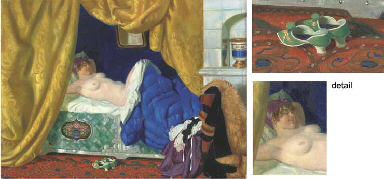
Christie's Sued Over Boris Kustodiev Sale

The Art Newspaper is reporting Christie's is being sued by Aurora Fine Art Fund which purchased a supposed Boris Kustodiev painting from the international auction house at a London sale in 2005. The art fund paid $2,89 million for Odalisque supposedly by 20th century Russian artist Boris Kustodiev. The painting was estimated to sell for between $309,000.00 and 4378,000.00 in the catalog.

According to the article, Chrisite's policy is if two experts or authorities challenge the authenticity within five years, the auction house will annul the sale. Aurora claims to have supplied a total of four reports signed off by 8 experts claiming the painting is not authentic. The painting has been returned to Christie's, and a spokesperson states the auction house is investigating the circumstances, but they remain confident in their position of attribution.

Aurora first approached Christie’s with its suspicions in mid-2006, but says that the auction house did not react. In May 2009 Rosokhran-Kultura, the Russian government’s cultural watchdog, released the latest issue of its catalogue of fraudulent paintings, which included Odalisque. Aurora has expert conclusions from leading Rus­sian art authorities, shown to The Art Newspaper, stating the painting is a fake. These include testimony from the State Tret­yakov Gallery, the State Russian Muse­um, the State Grabar Art Scien­tific Restor­ation Centre, and private expert Vladimir Petrov.

According to their catalogues, Christie’s provides a five-year guarantee of authenticity on works that it sells. During that period, if the buyer presents the conclusions of two experts that are accepted by the buyer and by Christie’s, then the house will annul the sale.

“Christie’s have been provided with four reports, signed in total by eight very well qualified experts in the field of Kustodiev, all of whom came to the conclusion that the painting is a forgery and that Christies’ attribution was therefore wrong,” said Andre Ruzhnikov, managing partner of Aurora, in a court statement.
 Click HERE to read the full Art Newspaper article.

7/29/2010

Sotheby's Earnings Conference Call

Sotheby's has posted a press release inviting the public to listen to  its first half earnings conference call.  The public can listen either by phone or over Internet streaming.  Internet streaming of the conference call will be available for two weeks after the call on the Sotheby's site.

The call will be held on August 5, at 4:45 pm.  the call will b e hosted by Sotheby's President and CEO Bill Ruprecht.  I will try to make the call or listen in on the Internet feed and report the first half results on the AW Blog.

Details and contact information are as follows:

July 29, 2010, New York -- Sotheby’s (NYSE: BID) will be holding its second quarter and first half ended June 30, 2010 earnings conference call on Thursday, August 5, 2010. The call will be hosted by Bill Ruprecht, President and Chief Executive Officer, and Bill Sheridan, Chief Financial Officer, at 4:45 PM EDT. The call will consist of a brief discussion of the Company’s results followed by a question and answer period.

Domestic callers should dial 888-371-8897 and international callers should dial 970-315-0479. The call reservation number is 91052941. Please establish a line approximately 10 minutes prior to the call beginning.

To listen to the conference call via web cast, please go to: http://investor.shareholder.com/bid/events.cfm. You will need Windows Media Player or Real Player to access the call. Please download either of these programs before the call begins. The web cast will be available for replay for two weeks after the call.

Conference call replay will be available for two weeks following the call at 800-642-1687 or 706-645-9291. Enter passcode 91052941.

Please call 212-894-1023 with any questions.

Consumer Confidence Declines

I dont usually post on general economic news, but as we are starting the slow hot and long dog days of summer the current realities are not positive.  Like many business sectors, appraisal practices, auctions, and fine and decorative art dealers can all easily feel the impact of poor economic conditions through decreases in assignments, consignments, sales and total value.  Many small practices and solo professionals may believe this information does not apply to them, but I feel the general mood of consumers greatly impacts buying habits, especially on items and services that are not always considered necessary.

The July consumer confidence index was just released and the news is not good, with continued declines.  Consumer confidence is now at the lowest level in 5 months. The news is not all dire, with some indications that retail stores continue to sell but I wonder if that is more connected to necessities rather than discretionary purchases. I was hoping that after a very slow spring and a typically slow summer economic activity would start to look better in the fall.  Overall debt, high unemployment, tight credit, and high default rates are all contributing to the decline in confidence. The consumer confidence report/index shows we have a long way to go before the American consumer regain confidence in the economy.

Also noteworthy, and not to pile on with the gloomy economic forecasts and news, but the Fed just released its Beige Book results of economic activity.  The news was mixed which is better than being all bad, but the news was not strong when it came to consumer spending and manufacturing. The Wall Street Journal reported but with only modest advances in retail sales and weak numbers in housing and construction. Bank lending, meanwhile, was still tight. The weak snapshot came after a second consecutive monthly drop in demand for manufactured goods that was reported earlier in the day, casting more doubt on an economic outlook that Fed Chairman Ben Bernanke last week called "unusually uncertain."   Unusually uncertain, pretty much sums up the current state of the economy.

The weak snapshot came after a second consecutive monthly drop in demand for manufactured goods that was reported earlier in the day, casting more doubt on an economic outlook that Fed Chairman Ben Bernanke last week called "unusually uncertain."

The Conference Board press release states about the decline:

The Conference Board Consumer Confidence Index® which had declined sharply in June, retreated further in July. The Index now stands at 50.4 (1985=100), down from 54.3 in June. The Present Situation Index decreased to 26.1 from 26.8. The Expectations Index declined to 66.6 from 72.7 last month.

The Consumer Confidence Survey® is based on a representative sample of 5,000 U.S. households. The monthly survey is conducted for The Conference Board by TNS. TNS is the world’s largest custom research company. The cutoff date for July’s preliminary results was July 21st.

Says Lynn Franco, Director of The Conference Board Consumer Research Center: “Consumer confidence faded further in July as consumers continue to grow increasingly more pessimistic about the short-term outlook. Concerns about business conditions and the labor market are casting a dark cloud over consumers that is not likely to lift until the job market improves. Given consumers’ heightened level of anxiety, along with their pessimistic income outlook and lackluster job growth, retailers are very likely to face a challenging back-to-school season.”

Consumers’ assessment of current conditions was more downbeat in July. Those saying conditions are “bad” increased to 43.6 percent from 41.0 percent, however, those saying business conditions are “good” increased to 9.0 percent from 8.4 percent. Consumers’ appraisal of the job market was also more negative. Those claiming jobs are “hard to get” increased to 45.8 percent from 43.5 percent, while those saying jobs are “plentiful” remained unchanged at 4.3 percent.

Consumers’ short-term outlook also deteriorated further in July. The percentage of consumers expecting an improvement in business conditions over the next six months decreased to 15.9 percent from 17.1 percent, while those anticipating conditions will worsen rose to 15.7 percent from 13.9 percent.

Consumers were also more pessimistic about future job prospects. Those expecting more jobs in the months ahead decreased to 14.3 percent from 16.2 percent, while those anticipating fewer jobs increased to 21.1 percent from 20.1 percent. The proportion of consumers expecting an increase in their incomes declined to 10.0 percent from 10.6 percent.

7/28/2010

Update: Salander

Philip Boroff writing for Bloomberg states Stair Galleries in Connecticut recently held another auction with property from disgraced art dealer Lawrence Salander. The auction was a success (as were the previous sales) selling 249 of 251 lots for $245,000.00. The pre sale estimate total was $148,000.00. The top two lots were a Steinway baby grand piano and Chinese vase, each selling for $10,000.00.

Boroff reports
Candlesticks known as pricket sticks were also hot. A pair of Italian baroque brass ones went for $2,500. Another pair sold for $2,800.

“Who knew pricket sticks were so popular?” said Stair auctioneer Rebecca Hoffmann, in an interview. “It was just hilarious after a while.”

Lawyer Portrait

Paintings that Salander created also attracted fierce bidding, with a 2008 portrait of one his former bankruptcy lawyers (“Johnny Moscow Truth Defender”) selling for $500 and the 1999 landscape “Top of the Mountain” going for $800.

Ron Gersten, who worked for Salander in the late 1980s and early 1990s, said the dealer told him in a recent telephone conversation that Michelangelo may have been behind some of the pricket sticks. Gersten said Salander also thought that Donatello may have created a plaster Madonna and Child that Gersten bought for $6,500 at the sale. (The Stair catalog doesn’t attribute either to any artist.)

Salander declared bankruptcy amid lawsuits alleging that he sold works he didn’t own and pocketed proceeds. There were also allegations that he misrepresented the provenance of works and engaged in fraudulent art-related investment schemes.

In March 2010, he pleaded guilty to stealing $120 million from such clients as John McEnroe and Robert De Niro. He’s to be sentenced on Aug. 3.
To read the full Bloomberg article, click HERE.

Hungry and Nazi Looted Art

Carol Vogel has a good piece in the NY Times about the family of World War II  era Hungarian art collector Baron Herzog.  Herzog's collection was looted by the Germans during World War II and now many of the paintings from the collection hang in Hungarian museums.  Vogel reports that after years of attempts to regain the art the family has sued the Hungarian government for return of art, including works by El Greco, Lucas Cranach the Elder, Zurbarán, van Dyck, Velázquez and Monet. Germany recently returned 3 paintings to the family, and they sold the art recently at Chritie's in London for $8.5 million. The family members are using the sale proceeds to fund the current litigation against Hungry. The article states Hungry is one of only a few countries which has been uncooperative despite the requests and actions from familiy members and many US government officials.

Vogel reports

Part of the family’s frustration, Mr. Shuster said — and one reason the lawsuit requests a Hungarian inventory — is that it appears impossible to know just how much art is actually missing. Russia, for example, where some family members filed a lawsuit in 1999 that is still pending, is believed to have a number of works by artists including El Greco, Goya and Renoir that were stolen by the Nazis and then seized by the Soviets in Germany. Those works may be just a small segment of what was lost.

And in Hungary, the Herzogs believe, there may be many more than the works named in the suit, which are valued at a total of about $100 million. (That figure was arrived at after asking dealers and auction-house experts to value the property from photographs and visits to some of the museums.)

“About 12 years ago I was put in touch with one of the Herzog heirs through friends,” said George Wachter, who runs Sotheby’s old master paintings department worldwide. “And I was asked to go to Budapest to meet with their lawyer and look at” several paintings. Mr. Wachter took the trip and described the art he saw as “good, solid, quality pictures,” adding, “I can understand why Hungary wouldn’t let them go.”

Before this latest lawsuit, the heirs tried to compromise with the Hungarian museums. “Fifteen years ago the family offered to split the paintings with the government, and they turned them down,” Mr. Goldstein said. “Germany and Austria have come to terms with this issue, but Hungary has not. They have refused to take responsibility.”
To read the full article, click HERE.

7/27/2010

Tech Tip: Google Docs Easy Translations

Google has long been involved in translation services.  You would go to Google translate and type or cut and paste into a text box and click translate.  Now Google Docs, a cloud based office productivity suit, with word processor, spreadsheet and presentations applications has the translation function directly built in to the program.  That is right, the translation feature is integrated into the program.

The Google Docs service is free and it is a good back up for occasional use on second computers and laptops without spending the money on MS Office as is Open Office (not cloud based, and is what I use on my lap top).

Google Docs just announced a new update with integrated translation that will allow you to type your document into the Google Docs word processor and using the tools tab click translate and select a language for translation. The program will then automatically translate your text into one of 53 different foreign languages.  You can then rename and save the translated document. I can see this working nicely by cutting and pasting foreign text from websites etc into Google Docs and automatically translating.  The use may not be overly great for an appraiser, but every so often we run into those few pages of research material that we wish we could easily translate, document and save.  This could be a very practical solution.

For more information on Google Docs click HERE and for more information on the translation feature, click HERE.

Western Art Slump?

The Reno Gazette Journal has a review of the recent Coeur d'Alene Art Auction held at the Silver Legacy Resort Casino.  The sale totaled $8.5 million (compared to $39 million in 2008, a decline of 80% in total value).  The top selling lot was an oil painting by Eanger Irving Couse, which sold for $650,000. Coeur d'Alene Art Auction partner Peter Stremmel stated the painting would have sold for $3-$4 million several years ago. That is a rather drastic decline in potential value in a very short period of time. The sale offered about 300 lots, and approximately 15% were bought in.

The RGJ reports
Stremmel said he was pleased with the results but said the economy has affected fine art.

"Art is a luxury, and it's not something people who are in foreclosure are going to think about," he said.

He said art never ceases to surprise, and pieces he thought might sell for higher went lower, and vice versa.

He said the Henry Merwin Shrady's bronze bull moose sold for $75,000, almost three times its highest appraisal and oil painting "Fierce Indian" by Fritz Scholder sold for almost twice what he expected.

Last year, a Mian Situ oil painting, "Moving on the Yuba River -- Gold Seekers," sold for $350,000. On Saturday it sold for $100,000.

He said the turnout was good, with about 400 in-person, 200 phone, 50 Internet and 40 absentee bidders from around the country.

It was the first time the auction allowed Internet bidding, which accounted for about 12 bids this year.

"There are definitely bidders, but they are more cautious," he said.

David Walker, executive director of the Nevada Museum of Art, was on a mission Saturday.

He was the winning bidder with $35,000 for "Trail Drive," a piece by American artist Dale Nichols.

"It's always exciting," said Walker, who only bid on the one piece for the museum's E.L. Wiegand Work Ethic Collection with funds from the E.L. Wiegand Foundation.

"I had a limit of $35,000, so I got it for exactly what I wanted," he said. "This acquisition is a wonderful addition to this unique permanent collection of artworks that celebrate the work ethic in America."
To read the full RGJ article click HERE.

7/26/2010

Financial Reform and the Art Market

Daniel Grant has a very good article on the impact of current financial legislation pending in Congress and how it could impact the art market in general,  and auction houses in particular.  As auction houses routinely assist bidders with financing packages, they too could be impacted by these potential laws.  Of course it all depends on how they are intrepreted as well.

Grant reports

The terms of the auction houses' loans and advances, as well as the rate of interest charged to borrowers, are not publicly disclosed. These companies seek to keep confidential their arrangements with clients. Their continued ability to maintain that secrecy may be threatened by the legislation, although it is not entirely clear.

Kip Wainscott, a partner in the Washington, D.C., office of the St. Louis-based law firm Bryan Cave, stated that based on his review of the House and Senate bills, auction houses would be regulated by the Consumer Financial Protection Bureau established by the law. "To the extent that auction houses make loans, and use traditional borrower-lender functions like interest and collateral, it would seem that the spirit of the bills aims to include them," he said. This consumer bureau would write rules for the industry that may affect what has become standard practice in the auction field, such as requirements for increased disclosure.

The major auction houses sometimes wear two hats. The first is as a third-party seller of objects on behalf of consignors. The second is as a lender to prospective buyers. The two may come into conflict. As a seller, the auction house's duty is to maintain a level playing field and create a transparent process of buying and selling. As a lender, however, the auction house has a financial stake in the item up for sale. While the auction house indicates its interest in a particular lot with some symbol—for instance, a small triangle—many bidders may not be aware of what that symbol means, and the amount of the auction house's financial stake in the object is not made public at all.

In March 2010, Sotheby's quarterly report revealed that its loan portfolio amounted to $167.8 million. Earnings—based on annual interest rates of prime plus three or four points for these typically one-year loans, collateralized by the artwork purchased—amounted to 2% of overall revenues and 8% of the auction house's net income. In 2009, Sotheby's total revenues were $2.8 billion, of which $9 million resulted from loans. "Making loans is not a large part of its business," said Kristine Koerber, an analyst at JMP Securities in San Francisco.

Neither Christie's nor Sotheby's would comment on the legislation, although a spokesman for Christie's acknowledged that "we are following the process, but it is not clear yet what might come of it."

Economists are divided on the wisdom of subjecting auction houses to a new layer of consumer protection regulation. George Akerlof, a 2001 Nobel Prize winner in economics and a professor of economics at the University of California at Berkeley, said, "I hope the law wouldn't apply to them. Auction houses haven't been a problem for the economy." On the other hand, New York University economist William Baumol stated, "There has been scandal in the auction world, and the public has been endangered. Some degree of regulation would be important."

Art financing companies also might be subject to new rules. At present, "the usury laws that protect ordinary citizens don't apply to us, because our borrowers are considered highly sophisticated," said Christopher Krecke, co-owner of Art Finance Partners. He added that his company's average loan is $1.5 million to $2 million and that the typical borrower has a net worth of $40 million to $50 million. As a result, the rates the company can charge and the transaction structures it may set up are not covered by state usury laws.
To read the full article in MAD click HERE.

7/25/2010

Update: Estate Tax Bill

The Hill has a good article on the current Estate Tax law bills that are floating around Washington DC.  There are many different proposals and compromise bills, and it appears many lawmakers and trade groups want to re-instate some form of estate tax.  It is appears there will be a new estate tax so we should not see the reversion to the extremely high rates from 10 years ago. The question is of course at what tax  rate (some form of incremental level increase based upon the size of the estate) and exemption will the new law allow.

This Hill article gives a brief overview of what is going on and the main players.  The article states the time to pass a new estate tax bill is now, before the summer recess is August, as taxes are too much of hot button issue to be considered during fall elections.

The Hill states

Both Rubin and Trumka said restoring the tax would be “sound policy.”

“You would actually increase demand, not decrease demand, if you restored the estate tax immediately,” Rubin said.

Trumka said the government revenue could be used as aid to state and local governments or infrastructure projects as well as for reducing the deficit.

“Anyone who is for deficit reduction but is opposing reinstating the estate tax is clearly residing on a different planet than working people who are struggling in this economy right now,” Trumka said.

Concerned that a more burdensome estate tax could be imposed, business associations as well as trade groups for ranchers and farmers have gotten behind a compromise bill sponsored by Sens. Blanche Lincoln (D-Ark.) and Jon Kyl (R-Ariz.).

That proposal would institute a tax rate of 35 percent and an exemption level of $5 million for the estate tax.

In a letter Tuesday to senators, the Family Business Estate Tax Coalition (FBETC) asked that the Lincoln-Kyl measure be attached to a small-business lending bill that is likely to move through the Senate.

The coalition is typically for full repeal of the estate tax, but such a bill would receive little support in a Democratic-controlled Congress.
Click HERE to read the full article.

IRS Guidelines

I was searching the ISA site for some information on personal property appraising and came across this document called the Internal Revenue Manual or IRM.  I believe the manual is meant for IRS employees in what to they should look and expect for appraisal supporting various types of tax returns.  Most items are from 2006, pre Pension Protection act, but much of it is very applicable.  Below is the first section from the Personal Property section introduction.

Other sections are on development guides, planning, identifying, documenting, analyzing, workpapers, reviewing,  resolution guidelines, objective, conclusions etc.  Each section is just short sentences or bullet points, very refreshing for an IRS document. It is easy to read and easy to follow, and receive a very good idea of how the IRS are to review personal property appraisal reports and and how value conclusions should be supported.  Not ground breaking information or really anything most professional appraisers dont already know, but it is nice to see it in an easy to follow and understand format.  I recommend all appraisers print it out, save and refer to every once in a while as refresher of what the IRS is looking for in a personal property appraisal report and value conclusion.

Look below for links to my viewer with the document, or go direct to the web pages within the Internal Revenue Manual on the IRS website.

Introduction

1. The purpose of this document is to provide guidelines applicable to all IRS personnel that are engaged in valuation practice (hereinafter referred to as valuators) relating to the development, resolution and reporting of issues involving tangible personal property valuations and similar valuation issues. Within these guidelines the term personal property refers to tangible personal property. Valuators must be able to reasonably justify any departure from these guidelines.

2. Personal property includes but is not limited to paintings, watercolors, prints, drawings, sculpture, ceramics, furniture, decorative arts, antiques, textiles, carpets, silver, rare manuscripts, historical memorabilia, antiquities, ethnographic art, collectibles, gems and jewelry. Machinery and equipment and other items classified as personal property are all intended for inclusion. The guidelines provided here regarding identifying, documenting and analyzing the property are applicable to all types of personal property. The information cannot provide specific details for every type of personal property, but a similar detailed breakdown can be outlined for any kind of property.

3. IRM 4.48.2, Valuation Assistance for Cases Involving Works of Art, which requires all taxpayer cases selected for audit with taxpayer claimed values of $20,000 or more per item of art to be sent to Art Appraisal Services for review by the Commissioner’s Art Advisory Panel is still applicable.

4. This document incorporates by reference the ethical and conduct provisions, contained in the Office of Government Ethics (OGE) Standards of Ethical Conduct, applicable to all IRS employees.

5. Valuation of assets owned and/or transferred by or between controlled taxpayers (within the meaning of Treasury Regulation section 1.482–1(i)(5)) may present substantive issues that are not addressed in these guidelines.

4.48.3.2 (07-01-2006)
Development Guidelines

1. Successful completion of a valuation assignment includes planning, identifying critical factors, documenting specific information, and analyzing the relevant information. All relevant activities will be documented in the workpapers.

2. A review appraisal may be the best approach to the assignment.

4.48.3.2.1 (07-01-2006)
Planning

1. Valuators will adequately plan the valuation assignment. Their managers will supervise the staff involved in the valuation process.

2. Quality planning is a continual process throughout the valuation assignment.

4.48.3.2.2 (07-01-2006)
Identifying

1. To determine a valuation conclusion, valuators should define the assignment and determine the scope of work necessary by identifying the following:
A. Property to be valued
B. Interest to be valued
C. Effective valuation date
D. Purpose of valuation
E. Use of valuation
F. Statement of value
G. Standard and definition of the value
H. Assumptions
I. Limiting conditions
J. Scope limitations
K. Restrictions, agreements and other factors that may influence value
L. Sources of information

2. The interest to be valued includes:
A. Fee simple, leased fee, etc.
B. Fractional interest
C. Personal property held in partnerships, corporations and trusts
Click HERE to view the guidelines in an online viewer or HERE to visit the IRS page.

7/24/2010

Excerpt from the Journal of Advanced Appraisal Studies - 2010

Given the current economic climate, many appraisers are searching for new assignments and clients. If our practices are going to grow and thrive we need to continually be on the look out of new opportunities. Logan Adams wrote an article for the Journal of Advanced Appraisal Studies on building relationships and business with the moving industry. The work may not be a glamorous or exciting as some other high profile work, but it can also be a mainstay of an appraisal practice.

Next weeks excerpt is from Jerry Sampson, ASA on Establishing the Appraisers Library.   Click HERE to order your copy of the Journal of Advanced Appraisal Studies and for more information on this exciting project.

Logan Adams writes

It is most important to know who is your client – who are you work-
ing for, who is paying your bill? Is it a big national mover or a local company representing a national company? A local company can be out of your immediate area. If you have not worked for a local mover that is giving you an assignment, you might want to ask for upfront payment.
There are three categories of clients that may be sources of damage
claims work.
1. A national carrier.
2. A local carrier.
3. A shipper. You can work for the shipper, making the same detailed
on-site examination of damages. However, you would not ask for
the inventory packing list in this case. You will develop a report in
this instance based on what you see and what the shipper is telling
your. They are paying you to assess the damages, not to review their
paperwork. You are telling them the cost of making them whole. A
shipper may also be a source of work for providing a pre-move in
Building Bigger & Better Business with the Moving Industry 207
section. This is especially true if the shipper has antiques and collectibles.

You will want to develop a network of associates to provide you
with information helpful in completing your claims report. Develop a
network of third party shops and experts both in and out of your area.
These can include local furniture upholsterers, repair technicians and
refinishers, steam cleaning companies as well as suppliers of glass, marble, etc. Recommend third party services, if necessary, with estimates of their charges. You may add a charge for your services to the third party estimate if you want to broker the repairs.

Colleagues in your professional societies are good sources for third
party associates.

After you have done your on-site inspection and developed your report, there are other issues that you should reflect on such as billing and collection.
1. Develop a sliding scale for billing based on the number of items inspected and the number of locations you visited.
2. Develop a fee structure for travel considering mileage and driver time and photos.
3. If you have military bases in your service area, you may be asked to
inspect moving damages for a shipper moving in from out of the United States. Be sure your bills for these carriers are requested in US dollars.
4. Be prepared to offer appraisal services. Items may appear on claims that you recognize as needing more examination than a cursory inspection or there may be a very high dollar item on the claim. Contact your adjuster and ask to send in a copy of your résumé showing your qualifications to handle this step up assignment. Carriers may have an appraiser on retainer but it does not hurt to offer these ser-
vices.
5. Don’t overlook the possibility of becoming a broker for repair services. You will already have your third parties lined up and can oversee the repairs and settlement of the claim. If you broker repairs, be sure to note the authorization level. A repair assignment
may give a “not to exceed authorization amount.” This can be negotiated if repairs become more involved than anticipated.
6. Whether doing an inspection or a repair assignment, get a signoff from the shipper that the inspection has been done or that the repairs are completed. These signoffs may be required and they will speed up the payment process.
7. Follow up making sure that your bill has been received. Often FAXs or emails are misplaced or never received even though confirmations have been received. It never hurts to make sure the adjuster has your bill.
8. If you are activated by the carrier, never share your report or bill with the shipper or their representative without authorization from the carrier. You are working for the carrier, not the shipper.
9. Occasionally, you will receive assignments from both the carrier and the shipper. Typically, you will have received the assignment from the carrier first and will decline working for the shipper.
All proceeds from the sale of the Journal support the educational initiatives and scholarships of the Foundation for Appraisal Education. The cost of the journal is only $55.00, a bargain for the amount of content supplied, and for a short time shipping is free.  For more information visit www.appraisaljournal.org to order your copy.

7/23/2010

UPDATE: Lehman Collection


The Art Newspaper is reporting that bankrupt investment house Lehman Brothers will auction portions of its large art collection at Sotheby's in New York.  The partial collection is the remaining art that was not either previously sold at Freeman's in Philadelphia (a very successful sale) and what was not purchased by a Lehman spin-off Neuberger Berman.

The Art Newspaper report is rather short, so I will post in its entirety.
NEW YORK. Sotheby’s New York will sell the Neuberger Berman and Lehman Brothers corporate art collections on 25 September, now that a bankruptcy court has approved the sale. Proceeds will go towards paying off Lehman’s creditors.

Lehman has sold some of its art since declaring bankruptcy—notably at Freeman’s Auctioneers in Philadelphia last autumn—but retained the bulk of the collection. When it was spun-out from Lehman as its own firm, Neuberger Berman had the option to purchase works of art from Lehman Brothers. Over the past year and a half, Neuberger Berman has been evaluating the collection and deciding which pieces to keep, a decision they finalised at the beginning of May this year. Lehman Brothers Holdings still maintains a 49% interest in Neuberger Berman.

“olding on to assets to maximise them is part of our strategy for paying off creditors,” said Kimberly Macleod, spokeswoman for Lehman Brothers. “We’re pleased that we’re selling to a better market than we would have at the time of the bankruptcy.”

Over 400 works will be up for auction, many by well-known artists including Damien Hirst, Gerhard Richter, Richard Prince, and Takashi Murakami. The collection is estimated at more than $10m.

7/22/2010

Philippines to Open First Art Auction House

Cyril De Leon writing for the Manila Bulletin states that after seeing Filipino art being sold at auction houses throughout the world, a group of art lovers and investors have decided to open the first auction house in the Philippines. The auction will be called Salcedo Auctions and will sell fine and decorative art, jewelry and other luxury goods. This opening, as well as the post from the other day on Eastern European Gallery growth, and the expansion of mainland Chinese auction houses all trends for continued growth and interest in cultural property. I hope the trends continue. All this activity is pointing to growth in new and expanding markets and is no longer limited to the major market or major players.

De Leon writes

Those wishing to spruce up their interiors with antique furnishings may likewise choose from several Chinese-furniture as well (e.g. armoire, buffet cabinet, and wedding cabinet). All the said items are in mint condition and still have their brass locks and fittings intact.

Those who might not be able to make it for the auction on July 24 can rest assured though that more auctions are scheduled. “The auctions will happen on a regular basis,” says Miguel, adding that they will have auctions every two months, interspersed with exhibitions by artists at their Salcedo Village premises.

Like their international counterparts, Salcedo Auctions will likewise have themed auctions with one already set for September 25 of this year. Dubbed “Ilustrado Home + Modern Decorator”, the said event will feature furniture and home accessories just in time before the start of the holidays.

At present, Karen seems very pleased with the prospects of Salcedo Auctions creating a special niche for itself. “Setting this up entailed a lot of hard work,” she says, “So far, it’s paying off as people see the potential and need for it. It’s very exciting and it’s good to finally be able to showcase what our country has to offer without going overseas.”
To read the full article, click HERE.

7/21/2010

Christies Moving Into Art Fairs

Scott Reyburn reporting for Bloomberg states that Christie's is now moving into show promotions with a fair planned for the Frieze Art Week in London.  The Frieze draws over 60,000 dealer and collectors to the main show, satellite shows and auctions, so the opportunity for a Christie's expansion fits their aggressive business plan.  According to Reyburn the show will be called Multiplied focusing on  contemporary prints, editions and photographs and will be held at  Christie’s South Kensington showroom from Oct. 15 to 18.

As noted on the AW Blog in the past, Christie's has been expanding into many art related fields beyond auctions, to include galleries, appraisals, art storage, insurance, private sales, direct artist to auction sales and now shows.

Reyburn states

The model for the event is the annual Editions/Artists’ Book Fair in New York, Richard Lloyd, Christie’s international head of prints, said in an e-mail.

Creating Buzz

“I was inspired to stage something similar in London and help to create a buzz and a platform for the very best in contemporary publishing,” said Lloyd. “Christie’s isn’t taking any percentage of the sales; stands are very competitively priced and entry to the fair is free.”

Christie’s has participated in international art fairs. In March 2007, the company exhibited as King Street Fine Art Ltd. at Tefaf, Maastricht. Christie’s wholly owned subsidiary Haunch of Venison has exhibited at the Netherlands-based fair since 2008, having been excluded from Art Basel, Art Basel Miami Beach and Frieze.

The Moniker International Art Fair will be another newcomer during Frieze Week. The Oct. 14-17 event in the disused warehouse setting of the Village Underground in east London will provide spaces for 12 galleries specializing in urban art.
To read the full article, click HERE.

7/20/2010

Chinese Auction Agreements

I recently made some comments on the AW blog about new regulations and business practices of mainland Chinese auction houses.  Asian expert Daphene Rosenzweig, Ph.D. send me a copy of a Conditions of Business page from the Chinese Auction House Beijing Hanhai listing some of the restrictions and caveats involved when dealing with the auction house.  It shows the Chinese are very good at small print as we are here in the US.

Daphne only sent me a single page of the Conditions of Business, and it appears to go on for pages, the one page I have includes only articles 11-25.

Here is a small excerpt on what the insurance package does not cover. Interesting to see they dont cover losses in the event of many nuclear events.

Article 18 Uninsured

We will not be liable for the damages or losses of the Lot caused by natural wear, inherent flaws, inherent or potential defects, inherent material changes, self-combustion, self-warming, oxidation, rust, leakage, rate-bite, woodworm, changes in atmospheric (climate, temperature or humidity) conditions, changes in normal water level, or other reasons of natural changes or caused by earthquake, tsunami, war, actions similar to war, hostile actions, armed conflicts, terrorism, rebellion, coup, strike, riots, or nuclear fission, nuclear fusion, nuclear weapon, nuclear radiation, or radioactive pollution. We will also not take responsibility for any dames to or any losses of frames, glass, drawer, bottom mat, trestle, mounting, insert pages, roller or other similar accessories caused by any reason.

Click HERE if you wish to read the one page of Conditions of Business that I have from the catalog. The text is small in the PDF.  You may wish to use the zoom slide at the bottom of the page to increase the text size.  (Note: I had to scan from a photo-copy, and the lower portion of the page is blurred.)

Eastern European Galleries

Newsweek has an interesting article on the growth and promotion of Eastern European art galleries,and how they are raising their profile with exhibitions at major art fairs. The galleries are not only specializing in established art, but also newly emerging artists.

The article points out that many Eastern European countries are expanding both their private and public interest and funding of cultural property.  An interesting article to read.

It’s no accident that the rise corresponds to an increase in private backing. In cities like Warsaw, Sarajevo, and Sofia, Bulgaria, younger artists—tired of the lack of support from cash-strapped ministries and museums—are curating and promoting their own shows and hosting exhibitions in everything from small studios to abandoned nuclear bunkers. “Across the region there is not a lot of governmental support for contemporary art,” says Jonas Zakaitis of Vilnius, Lithuania’s Tulips & Roses Gallery. “So the art scene is driven by personal initiatives, or by some crazy guy who has an idea.”
Click here to find out more!

Meanwhile, commercial galleries are increasingly present not only at art fairs like Basel and London’s Frieze, but also in cities throughout Western Europe. The gallery Plan B in Cluj, Romania, has an outpost in Berlin, as does Ljubljana’s Galerija Gregor Podnar. Warsaw’s Lokal_30 opened a gallery in London’s East End last autumn, and Tulips & Roses is relocating to Brussels in September. Galleries from Eastern Europe are also working together to create projects like Villa Reykjavik—organized by Warsaw’s Raster Gallery—where 14 Western and Eastern European galleries have set up an international art district in Iceland’s capital for the month of July. “It is very important to develop a regional exchange of ideas,” says Lukasz Gorczyca, the cofounder of Raster Gallery. “We understand each other well because of the black hole of communism that we all went through.”
To read the full article, click HERE.

7/19/2010

Switzerland Returns Over 300 Antiqut

Bloomberg is reporting that Italian police have exhibited portions of 337 stolen antiquities valued at nearly $20 million which were recently returned to Italy by Switzerland.

The article is short, so I will post in its entirety.

Bloomberg reports


Italian police unveiled some of the 337 pieces of stolen antiquities valued at 15 million euros ($19.5 million) repatriated last month after being recovered in Switzerland.

The collection includes Greek urns and vases, pieces of frescoes, bronze statues and marble sculptures produced between the eighth century B.C. and the fourth century A.D. The items were illegally excavated in Italy and smuggled out of the country, police said.

“We could make 10 museums abroad with what we’ve brought back,” General Giovanni Nistri, head of Italy’s cultural heritage police, said today at a press conference inside Rome’s Coliseum, where dozens of the pieces were displayed.

Italy has increased efforts to recover ancient artwork that authorities say was illegally excavated and smuggled abroad. The campaign led to a dispute between Italy and the J. Paul Getty Trust over allegedly looted antiquities on display at its Los Angeles museum. The Getty agreed in August 2007 to return 40 pieces including a statue of Aphrodite that authorities said was looted from Sicily.

The pieces unveiled today were recovered in a joint operation with Swiss authorities from an unidentified Japanese art dealer storing them in Geneva. He turned over the goods voluntarily after the police provided evidence that they had been looted from Italy. They were repatriated on June 25 and are believed to have come from illegal excavations in the regions of Lazio, Puglia, Sardinia and areas in southern Italy where the ancient Greeks maintained colonies, the police said in a statement.

7/18/2010

More on Art and Science

I recently posted about several forensic techniques of art analysis. This has included info on fakes at London's Art Museum, the recent New Yorker article on Peter Biro, as well as conservation using light. I guess when there is a little interesting information on a subject, in starts to expand go a bit more viral in the reporting.  There has now been additional information gained on the Mona Lisa and other paintings in the Louvre, as well as some examination of works by Matisse.

CNN World is reporting of the non invasive x-ray analysis of the Mona Lisa and how Da Vinci was a master at using ultra thin layers of paint.  The technique is called sfumato at Da Vinci of course was a master in applying.

CNN reports (the article is short so I will post in its entirety)

(CNN) -- Scientists have unlocked another Mona Lisa mystery by determining how Leonardo Da Vinci painted her near faultless skin tones.

Using X-ray techniques, a team "unpeeled" the layers of the famous painting to see how the Italian master achieved his barely perceptible graduation of tones from light to dark.

The technique used by Da Vinci and some other Renaissance painters to achieve this subtlety is called "sfumato," and unraveling it allowed the scientists to determined the composition and the thickness of the paint layers.

Philippe Walter, a senior scientist at the Paris-based Laboratoire du Centre de Recherche et de Restauration des Musees de France, told CNN: "This will help us to understand how Da Vinci made his materials... the amount of oil that was mixed with pigments, the nature of the organic materials, it will help art historians."

Walter and his colleagues used X-ray fluorescence (XRF) spectrometry to determine the composition and thickness of each painted layer of the Mona Lisa in the Louvre Museum in Paris, where the painting is normally kept behind bulletproof glass. Art historians believe it was painted by Da Vinci in 1503.

They found that some layers were as thin as one or two micrometers and that these layers increased in thickness to 30 to 40 micrometers in darker parts of the painting. A micrometer is one thousandth of one millimeter.

They believe this characterizes a technique of painting that uses a glaze, or very thin layer, to build up shadows in the face.

The manner in which Da Vinci painted flesh, "his softened transitions," were pioneering work in Italy at the end of the 15th century, say the researchers, and were linked to his creativity and his research to obtain new paint formulations.

Walter said it is almost impossible to see any brushstrokes on the Mona Lisa.

The research, which is reported in the journal Angewandte Chemie, also looked at several other Da Vinci paintings and could eventually help to determine when and how he painted some of his masterpieces.

However, Walter, added: "There is still plenty of mystery surrounding the Mona Lisa. This does not tell us why he painted, about his motivation, just about the materials."


Carol Vogel also wrote an article on the analysis of art by Matisse


Before they turned to high-tech analysis, the conservators removed the varnish and previous restorations from “Bathers.” As a result, the colors came through more brightly. (They ended up removing the varnish from 20 of the 40 paintings in the show.)
In addition to their work with the paintings, the curators unraveled the steps that had gone into the making of a suite of four large-scale relief sculptures depicting the back of a woman inspired in part by “Three Bathers,” a Cezanne painting owned by Matisse. The sculptures, which he began around the time he was working on “Bathers” and developed over 23 years, also grew more and more radical over time.

Using laser scanning, they better understood how the process that went into the sculptures’ evolution. The first, depicting a female body, was made in clay and then he cut two casts in plaster, one to make in bronze, the other to use as a starting point for the next sculpture. The scanning showed how he used a cast from the previous sculpture for each of the four works, changing the surface of each succeeding figure until the overall form had a flatter surface and was quite stark and architectural. “Like ‘Bathers,’ it’s one conception being evolved over all these years,” Elderfield said.

The curators trace how Matisse added or subtracted details, scraped and rescraped the surface, moved objects, sharpened lines – and juggled several works, borrowing from one, experimenting with another. The result is a complete portrait of the artist during one of the least understood, yet critical, periods in his life.
To read the full article, click HERE.

7/17/2010

Excerpt from the Journal of Advanced Appraisal Studies - 2010

Soodie Beasely, ASA AM has written several articles for the journal over the past few years.  Soodie's specialty is 20th century modern and she writes an excellent article on furniture by designers.  She focuses on the designs of Samuel Markx, James Mont, Tony Duquette, and Karl Springer.

If you noticed some of the statistics on 20th century design, many of the highest prices and bulk of the total value in sales is generated by the top designers.  This is a good article to become familiar with 4 such furniture designers.

Next weeks excerpt is from Logan Adams, ISA CAPP on working with the moving industry.

Soodie Beasley writes

The story of twentieth-century design has been dominated by designers who learned how to mass produce the essential elements -- Le Corbusier, Marcel Buerer, Charles and Ray Eames. With each new idea of good design came new ideas of comfort and luxury. In the 1920s and 1930s, the majority of the upper classes were firmly against the idea of modernist furniture. Modernism has always had a democratic strain -- the idea that good design should be available to anyone.

As such, modernism was a bane to the majority of the privileged classes, who, understandably did not see the point to having furniture that anyone could have. The custom work pioneered by Marx, Mont, Duquette and later Springer helped the elite classes understand that modernism was also an aesthetic and intellectual movement.

The definition of modernism is still undergoing significant change. Early twentieth-first century designers believed that design could improve the human condition and the quality of life. The object in the way was the machine. How to incorporate the machine into the process for making beautiful furnishing for beautiful homes? Most designers needed to redefine their role. The solution to the problem has usually been for the designer to look back to the past and take inspiration from the forms that flourished then.

Unlike modern painting, the modern novel, even modern architecture, the modern interior is not readily identifiable. It does not necessarily reject cultural traditions and values. Rather, in its most useful sense, it marries them with modern ideas about how to live. The modern interior constantly redefines itself out of the bits and pieces of ephemera that haunt us like a worrisome dream. Although furniture, lighting and textiles may remain the same over a long period of time, the overall design of a room is fleeting, shifty and kaleidoscopic. While the initial visual impact may be memorable, its staying power is limited to the whims of popular taste.

The hand-crafted look of the American Modern pieces belied the fact that they were mass produced, which allowed them to retain the aura of individual craftsmanship. Designers of these pieces aimed for a high-level of execution primarily by being the product of private commissions. Each designer was fond of high-style living, liberally exercising this practice in their own lives, and each of their designs was quite pricey. Many designers also created interiors that were different -- James Mont and Karl Springer emphasized that at least one piece of furniture should be the focal point of the room, whereas for Samuel Marx and Tony Duquette the ensemble produced by the pieces working together were more important that an individual piece.
All proceeds from the sale of the Journal support the educational initiatives and scholarships of the Foundation for Appraisal Education. The cost of the journal is only $55.00, a bargain for the amount of content supplied, and for a short time shipping is free.  For more information visit www.appraisaljournal.org to order your copy.

Appraisal Library for Sale

I usually dont make these types of posts, but I thought this might benefit fellow appraisers. Steve Minor is selling his appraisal library of over 300 books. It is his preference to sell the complete library instead of selling piecemeal. If he is not able to sell as a whole, he will then sell groups or individual books.

Many experienced appraisers may already have many of the books, but if you are new to the profession or know someone who is, this is an excellent opportunity to acquire a  needed appraisal practice business resource. It can take years to put together a complete appraisal reference and resource library, and it  is a rare opportunity to find this number of books.

Click HERE to view a list of the books in the library. Steve is located in Raleigh,NC if that helps with logistics. His email for more information is sgminor@mindspring.com for more information on condition, shipping and price.

7/16/2010

Auction Buy Ins and Post Sale Activity

Daniel Grant writing for the Huffington Post has a good article on auction post sales and buy ins.  Many collectors and connoisseurs look at auctions and also at what does not sell.  Many are not aware of the post sale activities.

Grant does a good job in explaining the nuances of buy ins and post sale transactions. Grant mentions the auction world likes to talk about and of course promote the special item or the record breaking item. But there is also much additional activity and negotiations after the sale. He reports the Phillips auction claims the nearly 50% of the bought in lots are sold post sale.

Grant reports

The days after a major sale are often quite busy ones for auctioneers, making sure that sold lots are shipped to the new owners and that the consignors are promptly paid, as well as looking ahead to the next sale. However, during this period, they also are making calls to consignors of pieces that didn't sell (explaining what happened during the auction and what steps to take next) and fielding calls from dealers and collectors who are expressing interest in the buy-ins. "We usually take a week or so to let all the offers come in," said Jennifer Wright, specialist for Old Master drawings at Christie's. The result is "a dozen or more after-sales. I think that's true for all departments here."

At Phillips de Pury, post-sale activity generally results in half of the buy-ins being sold, said Aileen Agopian, the London-based auctioneer's director of contemporary art in New York. "It can turn a so-so sale into a very successful one."

Dealers form a significant pool of post-sale buyers, according to New York City dealer and former Sotheby's department head, David Nash. "You see dealers scurrying around, looking for leftovers," he said. "I've done some of that myself." Some dealers regularly call auction houses for a buy-in list, so they know what's available. Another Manhattan gallery owner, Nick Acquavella, noted that "buy-ins present an opportunity to buy, and I've done it lots of times." At times, he has been an underbidder at auctions, "letting it buy in and seeing if I can get it after the sale." At other times, he may sense from the catalogue pre-sale estimates that certain lots won't sell, because "the prices look ridiculous. So, I'll wait until something buys in and make an offer, or just ask 'What will the guy take for it?'"
 To read the full article, click HERE.

7/15/2010

New Yorker Article on Forensic Examiner Biro - Must Read

I just posted on the London National Gallery exhibit on fakes, and that much of the information was devised through scientific means and study. The New Yorker just published an excellent article by David Grann on Peter Paul Biro, the Canadian forensic art expert. The article documents Biro's authentication background and his ability to locate and examine fingerprints in the canvas. The article is long, but is certainly interesting reading material.  It also reveals some issues with forensic art examination and inspection.

The article is not all flattery about Biro. It delves into some dark sides of Biro's life including lawsuits, false art sales/authentication claims and unpaid creditors. The article also mentions Terri Franks, who is in a legal battle with Park West Gallery (well documented from both sides on the AW Blog), and calls her a crusader against art fraud. Perhaps most interesting is how the article also explores the possibility of fake fingerprints taken from molds of originals.

Grann writes

For the first time, Hanley was able directly to observe Biro’s fingerprint evidence. He noted several fingerprints on the back of the picture, including two on the wooden stretcher frame, which were black, as if they had been made with ink. Looking through a magnifying glass, Hanley focussed on the most legible fingerprint, which appeared to be covered with a clear finishing coat, like a varnish. Parker said that before giving the painting to Biro he hadn’t noticed a fingerprint on it. “I don’t know where it came from,” he said. He said that Biro had told him he had used some sort of “resin process” to make it more visible. Hanley had never seen a print developed in this fashion. Based on the clarity of the impression, Hanley thought that the fingerprint had to be relatively new—certainly not from half a century ago, when Pollock was alive.

Parker also retained the services of Lawrence Rooney, a retired detective sergeant and latent-print examiner who had worked in the Suffolk County Police’s identification unit, and who had more than two decades of experience as a fingerprint analyst. Rooney agreed that the fingerprint appeared too recent to have come from Pollock. He was also alarmed by the “resin process,” and, as he wrote in a report, the use of a “liquid seal” coating was “beyond all acceptable professional methods of latent print preservation and opens the door to many valid questions relating to the latent prints’ origin of placement and development.”

Hanley kept staring at the way the fingerprints rested on the surface of the wood, without the usual smudging or obliteration. He noticed that they shared an eerily similar shape. And he began to wonder if he was seeing something virtually unheard of: forged fingerprints. In a 1903 Sherlock Holmes story, “The Adventure of the Norwood Builder,” the detective discovers that a criminal has made a wax impression of a solicitor’s fingerprint and then framed him by stamping the forged fingerprint at an apparent murder scene. “It was a masterpiece of villainy,” Holmes says. The scheme became a common trope in detective fiction, but there are almost no documented cases of a criminal forging another person’s fingerprint. In the nineteen-forties, a safe burglar named Nedelkoff set himself up as a fortune-teller in Eastern Europe, and asked clients to press their hands into a soft clay tablet. Later, he poured liquid rubber into the clay impressions, creating soft casts of their fingertips. During his robberies, Nedelkoff pressed his former clients’ fingerprints onto safes. (Eventually, his scheme was unravelled by police.)

Grann continues

Looking at four fingerprints on the back of the stretcher frame and the canvas, Wertheim was struck by their extremely irregular shape—the bulges and curves along their boundaries. Then he noticed something even more peculiar. Each one of a person’s ten fingers leaves a distinct impression, and the elasticity of skin makes it all but impossible to leave precisely the same fingerprint impression twice. Yet the two most visible fingerprints on the Parkers’ painting, Wertheim says, were virtually exact overlays of each other: the same shape, the same pressure, the same ridge patterns. What’s more, the visible parts of the two other fingerprints also lined up perfectly with these prints. In his more than three decades as an examiner, he had never seen a set of fingerprints like this.

When Wertheim examined one of the prints closely, he could make out several bubble-like voids. Although a person’s sweat pores often leave voids in a fingerprint, Wertheim says that these voids were unusually big and elongated.

Wertheim had a hunch about what had caused the voids, and he went with Hanley to Pollock’s old studio. Wertheim examined the fingerprint impression on the paint can. It matched the clearest fingerprints on the Parkers’ painting, Wertheim says. Hanley then made a silicone cast from the impression on the paint can. Incredibly, Wertheim says, all four fingerprints on the Parkers’ painting fit snugly within the boundaries of the cast impression. As Wertheim suspected, the cast also produced similar voids—they were caused from air bubbles that had formed in the rubber.

Altogether, Wertheim says, he tallied eight characteristics that were inconsistent with normal fingerprints. In a final report, he concluded that all of them had been made by a cast from the fingerprint on the paint can. As he told me, the fingerprints “screamed forgery.”

When a forgery is exposed, people in the art world generally have the same reaction: how could anyone have ever been fooled by something so obviously phony, so artless? Few connoisseurs still think that Han van Meegeren’s paintings look at all like Vermeers, or even have any artistic value. Forgers usually succeed not because they are so talented but, rather, because they provide, at a moment in time, exactly what others desperately want to see. Conjurers as much as copyists, they fulfill a wish or a fantasy. And so the inconsistencies—crooked signatures, uncharacteristic brushstrokes—are ignored or explained away.

If a forgery’s success were to depend on fake fingerprints, rather than on the sly imitation of a painter’s style, it would represent a radical departure from the methods employed by art forgers over thousands of years. And yet such a forgery would perfectly reflect the contemporary faith in science to conquer every realm, even one where beauty is supposed to be in the eye of the beholder.
To read the full New Yorker article, click HERE.

7/14/2010

Contmporary Desing Market Report

Fellow appraiser Judith Vance sent me information from a blog post about ArtTactic adding a contemporary design market price index to its art tracking databases.  The index and results of the survey are available or ArtTactics site for a fee of $75.00.

The report shows mixed results, with the market price index increasing, and total value dropping.  I posted on some of the mixed results on the AW Blog about the Christie's and Phillilps sales.  Interesting to see the market is being driven by the top 10 designers.

ArtTactic released the following information from the Contemporary Design report.
* The ArtTactic Contemporary Design Market Price Index has experienced a recovery of 17.6% in 2010.
* Total value of Contemporary Design is down 18% for the first half of 2010, compared to the same period last year. This is largely a result of Christie's focus on early 20th century design, with no significant contemporary design material sold in 2010.
* Phillips de Pury becomes the leading house for Contemporary Design, with 68% market share for the first half of 2010.
* The top 10 designers account for 67.6% of the total auction turnover of contemporary design. The rest is shared among approximately 270 designers that have come to auction since 2006.
* Marc Newson defines the top end of the Contemporary Design auction market, with a 24% share of the total contemporary design value. One of his 'Lockheed Lounge' chairs sold for a record $1.8 million in May 2010.
To view portions of and order the ArtTactic Contemporary Design report click HERE.

Good News from the Mei Moses Index


The Mei Moses 2010 Mid Year results are in, and the art gains for the first half of the year are substantial.  The overall index for the first 6 months of the year is up 13.4% compared to a loss of 6.5% for the S&P 500.  The impressionist and modern art index is also at an all time high.

Although that news is very positive, and continues to build from the 3 month increases, I still believe and see and hear many indicators that the middle markets for both fine and decorative arts are still experiencing slow sales.

not all collecting categories are reacting in tandem to the changing economic climate of the first half of 2010. However what is obvious is that there is growing positive momentum in the impressionist and modern and the post war and contemporary collecting categories. In addition to this momentum the improvement in the American category was sufficient to overcome the flat performance of the Latin category and the reversal in the old master category to yield positive results for the all art index.
Click HERE to visit the site and read the press release.

7/13/2010

Call for Articles - Journal of Advanced Appraisal Studies

Although it seems like the 2010 edition of the Journal of Advanced Appraisal Studies was just published it is now time to start the process in seeking and soliciting article contributions for the 2011 edition.

This will be the fourth annual edition of the Journal and as I have mentioned in the past it has been well supported by the appraisal community.  How do I know this, from continued sales and from the number of contributors interested in publishing in the journal.

I already have a good start for the 2011 edition, with many potential contributors already submitting article ideas and proposals.  If you have interest in contributing an article to the 2011 edition, please contact me at toddsig01@gmail.com or call me at 703-836-1020.

Publication of the 2011 edition will be several months early, with a target date of  February to coincide with the International Society of Appraisers Annual Conference (Nashville, TN at the same time as the Heart of Country antique show).  Therefore, completed manuscripts must be submitted by October 15th.  Minimum article length is 3,000 words. There is more information on our editorial guidelines on the website at www.appraisaljournal.org.

Please contact me directly if you are interested in publishing an article in the Journal. Scholarship is important to the professional and to the development of a profession.  The importance of scholarship, including publishing is and should be no different for the personal property appraiser. The primary goal of the Foundation, and the journal as a tool, is to promote appraisal eduction and the expansion of knowledge.  Appraisers, as professionals need tp show their dedication to the development of the profession and continue to expand and develop personal property principles and methodologies.

Please contact me at toddsig01@gmail.com or call 571-357-3550 about sharing your knowledge and expertise with fellow personal property appraisers.

British Selling their History

Vanessa Thorpe writing for the UK Guardian has an interesting article on the landed gentry of England selling many items from within their collections. The article is short, but still rather insightful.

Thorpe reports that experts believe the odd combination of a poor economics in general, but a strong art market at allows many with the prime opportunity of maximizing value.

Thorpe statees

Stephen Deuchar, director of the Art Fund, believes the aristocratic fire sale is "a combination of a difficult economic climate for owners plus a buoyant art market at the top end – an unusual combination".

Auction house experts have noticed that, while such sales are normally prompted by the need to fund death duties or to finance a divorce, owners of stately homes now commonly regard works of art as an asset to be deployed and not as part of their historic legacy.

Four days ago Earl Spencer, Princess Diana's brother, completed the London sale of hundreds of heirlooms from horse-drawn carriages to valuable artworks. More than 1,000 individuals made bids for the 750 lots at auction, with interest registered from China, Australia, the Philippines and Morocco. The Peter Paul Rubens work A Commander Being Armed for Battle sold on Tuesday for £9m and Thursday's final sale saw items from the family's historic London residence, Spencer House, go under the hammer. Seventy lots were sold for £4.8m.

Trustees of the Althorp estate said the windfall would provide them with money to invest in property. It could also be used for the stately home itself, which is undergoing major restoration.
To read the full article, click HERE.

7/12/2010

Fakes at London's National Gallery

I posted a short while ago about London's National Gallery exhibition on fakes and frauds within the collection. It was a short video, which is still on the Appraiser Worskhops blog home page (click HERE to visit).  Martin Gayford writing for Bloomberg has a good preview of the show. He does state there is a lot of scientific information, so I assume there is less connoisseurship and more forensic evidence of the fakes and frauds. Proving that at combination of both are necessary in determining the artisan and strong authentication, as it should be in national museums.

Gayford writes

The show amounts to a sequence of studies conducted by the conservation department, the police pathology unit of art history. The subjects are works in the museum’s own collection, and the case files -- old and new -- reveal the countless ways in which pictures can be disguised, confused, doctored, misunderstood and just plain faked.

The deliberate, criminal forger isn’t the only villain in this plot. Equally important sowers of confusion are art dealers, ever hopeful of putting their goods in the best possible light.

Take for instance Giorgione’s “The Sunset,” one of the better-known pictures in the collection. Most of the painting is (probably) by Giorgione, one of the most mysterious and contentious of artists. Yet the St. George killing a dragon in the middle distance is the handiwork of an early 20th-century restorer.

At that spot there is a gap in the original paint surface -- and no evidence of what Giorgione might have put there. So this isn’t exactly a fake, though it was definitely “improved” to enhance its marketability.

A lot of that has gone on, and still does. There are other pictures on show in the same category, among them a picture purchased as a Holbein. It’s an authentic 16th-century work, but it has been discreetly altered to look more Holbein-like.
It sounds like a very interesting exhibition. To read the full article, click HERE.

Chinese Auction Standars

The Antiques Trade Gazette is reporting that the Chinese are instuting new standards and guidelines for Chinese auction houses. The new standards are the first new set of guidelines since auctions became legal 23 years ago.

The ATG report is short, so I will post in its entirety.

The ATG reports

A SERIES of guidelines designed to encourage standard and proper practice in the fine art auction industry in China were unveiled on June 31. They are the first measures of their type since sales by auction were permitted to resume in the People’s Republic 23 years ago.

The new guidelines, titled The Standard for Auction of Cultural Relics and Art Works, represent three years of research undertaken by the China Association of Auctioneers, a non-profit organisation commissioned in 2007 by the Ministry of Commerce.

The new regulations – described as a standard to be upheld rather than a change in law – are a response to what Zhang Yanhua, director of the CAA, termed the ‘disorder’ in domestic auctions and the wider desire to tighten up on issues of cultural heritage.

In recent years, China has vigorously pursued cultural relics that it believes were removed from the country illegally and has taken a number of measures to avoid any repeat of the mass export of artefacts that took place in the 1980s and the 1990s.

The Standard for Auction… covers all aspects of the auction process, including consignments, the formal terminology to be used in cataloguing and the archiving of auction records.

The new standards also reinforce a provision passed by the State Administration of Cultural Heritage in 2003 that requires vendors to supply auctioneers with a certificate of provenance and legal ownership.

7/11/2010

Park West - Sued by Artist

According to the Detroit Free Press, South American artist Alex Perez has sued Park West Gallery for printing and selling his art without his permission. According to the article, Perez had a sales agreement with Smart Publishers of Fine Art, who in turn assigned the rights to Park West. Perez is claiming the transfer of rights was not legitimate, and was done without his knowledge. Park West had won a defamation suit against Perez several years back, which prevented him from saying anything negative about Park West.

Park West attorneys claim the suit has no merit.

The Detroit Free Press reports
In the suit, Perez alleges Smart Publishers assigned his contract to Park West without his permission, and Park West began reproducing and selling his artwork at land-based and cruise ship auctions, in some cases with a forged signature.

Perez, in the suit, accuses both of copyright infringement.

"This is a totally ridiculous lawsuit," said Park West lawyer Rodger Young of Southfield. He said Park West won a defamation suit in Florida against Perez about three years ago preventing him from saying anything adverse about the company.

Perez's lawyers, Donald Payton and Jonathan Schwartz of Farmington Hills, want U.S. District Judge Patrick Duggan to order the defendants to stop reproducing and selling Perez's artwork and to pay him for his work.
To read the complete article, click HERE.

7/10/2010

Excerpt from the Journal of Advanced Appraisal Studies - 2010

Jill Kent, ISA AM wrote an excellent article on appraising folk art. It is a well documented article and covers portraits, weathervanes, Redware and ceramics, samplers, and decoys. As a generalist appraiser, if you ever come across folk art this article touches on many of the necessary areas and topics of each important sector, and includes information on artisans, value factors and condition factor. It is a great primer for appraisers on evaluating folk art.

Next week, Soodie Beasley, ASA AM on Fantasy Furniture by Designers: Mark, Mont, Duquette and Springer.

Here is an excerpt from Jill Kent's article on folk art about weathervanes.

American weathervanes date back to the earliest settlers and continued to the first quarter of the 20th century. The evolution from the purely functional to art form was “gradual and unintentional”. Though common in Europe for centuries; weathervanes became “a quintessentially American form” in the 18th and 19th centuries.  During the 17th and 18th centuries, the subject matter was limited to a few simple designs—roosters, arrows, fish, cocks, Indians, serpents and grasshoppers, to name a few. The weathervanes were either carved from wood or made of sheet metal. Wooden vanes were always painted for protection from the elements, as well as to make them more conspicuous. They were often used as trade signs. The metal ones could be painted or gilded; but the majority were unpainted. A copper cockerel, made in 1656 for the Dutch Reformed Church at Albany is one of the earliest in America. Another early weathervane is a codfish, studded with copper nails, that originally topped the Paul Revere coppersmith shop in Canton, Massachusetts. The most famous early weathervane maker was Shem Drowne (1683-1744). He crafted the huge copper cockerel for New Brick Church on Hanover in Boston and the hammered copper grasshopper with green glass eyes for the cupola of Fanueil Hall in Boston in 1749.

Although most of the survivals of early weathervanes are in New England, there is a small number of surviving Pennsylvania weathervanes; There is a weathervane of an Indian of more than human scale (76 ½”x 35 ½”) probably from Dauphin County (c. 1780-1820). It is likely that Peter Derr (1793-1868), of Berks County, made metal weathervanes, including Indians associated with the history of Indians near his family property. 

After the mid-nineteenth century, the majority of the weathervanes were factory-made. These weathervanes, in general, were molded in the round or half-round. The materials used were mostly copper; but they were also cast in iron, zinc and tin. They were then painted or covered with yellow ochre under gilding. They were finished by hand.
All proceeds from the sale of the Journal support the educational initiatives and scholarships of the Foundation for Appraisal Education. The cost of the journal is only $55.00, a bargain for the amount of content supplied, and for a short time shipping is free.  For more information visit www.appraisaljournal.org to order your copy.

7/08/2010

Results: Sotheby's London Old Master and British Paintings Evening Sale

Sotheby's has concluded its Old Master and British Paintings Evening Sale. The sale included the record breaking Turner, Modern Rome (see image), and was also the top selling lot at $44.9 million. The sale offered 57 lots with 39 selling and 18 bought in. This represented a 68.4 sell through rate. It was about equal (actually a little less than the Christie's sale). The sale totaled $80.86 million including buyers premium.

More than half the sale came from the Turner, which was estimated to sell between $18.25 million and $27.4 million. Even with the record priced Turner, the sale made only 90% by value. Factoring out the Turner, I think the sale fell below expectations. Many of the top ten selling items fell either within or above pre sale expectations.

According to Kelly Crow of the Wall Street Journal, the Getty Museum beat our 5 other serious bidders for the Turner.

Crow states

The artist displayed "Modern Rome" in the Royal Academy that same year he painted it, and sold it to Scottish collector Hugh Munro. In 1878, Mr. Munro's heirs sold it to the 5th Earl of Rosebery. Until this spring, the painting had been on long-term loan to the National Gallery of Scotland. Sotheby's said the seller was one of the earl's heirs.

The sale represents a coup for the Getty, whose Turner holdings currently consist of an 1844 choppy seascape, "Van Tromp, Going About to Please His Masters," and a pair of watercolors.

After the sale, the museum's acting associate director, Thomas Kren, praised the Turner's rarity and "perfect condition." He said he expects the work to be a "cornerstone" of the museum's collection and be as powerful a tourist draw as Vincent van Gogh's "Irises" or Nicolas Poussin's "The Holy Family with the Infant St. John the Baptist and St. Elizabeth."

As far as the price, Mr. Kren said the museum was actually prepared to spend even more to win the work. "We had a bidding limit, but we didn't reach ours this time," he said. "We really wanted this one."

The Turner anchored Sotheby's $80.8 million sale of Old Master and British Paintings in London.
To read the full WSJ article, click HERE.