9/30/2009

Asian Art Heading Home

The Economist has a very good review of the recent New York auction sales as well as the May sales in London of Asian of fine and decorative art.  The article points out the strong market created by Asian buyers, both collectors and dealers who are bringing the art back to Asia.  At the recent sales the showrooms were full of buyers from Hong Kong, mainland China and Taiwan.

The article points out the large number of Asian bidders, but also mentions the high prices realized for some art which was not considered by many experts to be of the highest quality.  Although, it is noted, and as is usually the case, the highest prices were realized by the best pieces. The article states the May London sales were satisfactory, but if the items were considered less than high quality bidding was mild.  That changed at the recent NY sales.

The Economist reports

In the last round of sales, in London in May, buyers were both skittish and picky, shying away from anything they believed was over-priced or of less than stellar quality. Four months on, confidence has visibly returned to the market. Both auction houses reported exceptional sell-through rates; only a small proportion of the works were returned unsold. Lot after lot exceeded its top estimate as newly rich agents, dealers and collectors from South-East Asia fought for the chance to bring ancient treasures home.

Of the top 20 lots sold at Christie's on September 14th and 15th, 15 were carried off by Asian buyers, six of them private bidders. At Sotheby's later the same week, private collectors from Asia were even bolder, taking 12 of the top 20 lots. Only one lot was sold to a Western buyer: a 17th-century Buddhist painting of a multi-headed and multi-armed figure, it had been consigned by a Japanese family that acquired the picture before the second world war. It was bought by a private European collector prepared to pay $530,500, far above its top estimate of $150,000.

The results were particularly surprising because not everything on offer was of the highest quality. At Doyle, a small New York auctioneer that piggybacked on the bigger houses with a Chinese sale of its own on September 14th, two quite ordinary lots were bitterly fought over. Both came from the collection of Hugh Grant, a lawyer and philanthropist (his father and namesake had been mayor of New York from 1889 to 1892). Bryan Chow, a Hong Kong agent who proved an aggressive bidder at both Sotheby's and Christie's sales, bid $590,000 (the hammer price, before taxes and commission) for a Jiaqing-dynasty moulded porcelain vase with bats and dragons under a white glaze, estimated at $30,000-50,000. A Hong Kong competitor, William Chak, proved even bolder a few moments later, bidding $550,000 for a slightly older, 18th-century, Qianlong-dynasty blue-and-white vase that Doyle believed would sell for no more than $2,000-3,000.

To read the full Economist article, click HERE.

9/29/2009

$27 Million Worth of Art Stolen From Pebble Beach Home

The Herald newspaper from Monteray CA is reporting of a private home which was burglarized and where art was stolen worht $27 million.  It is reported 13 pieces of art are missing. There is a $1 million reward being offered for the recovery.  The art includes paintings by Rembrandt, Pollock, Matisse, Renoir and Van Gogh. The $27 million figure is considered rather fluid, and perhaps suspect, either up or down, as one of the owners says the Pollock alone could be worth $40 million (stating it has never been shown in the market).

Just a short while ago a series of Andy Warhol paintings were also stolen.  I dont know if it is the economic times, or just more coverage, but there seems to be more and more stories of art crime from forgeries and fakes to outright theft.  As appraisers, this is worth knowing as it is important that these collections are properly insured.

One of the owners comments the collection was not insured, stating it would have cost too much, within the range of $20 - $30 million, which I find as a rather unusual statement.   Because of the high cost to insure, they owners decided to self-insure the works.  They may increase the reward to $5 million.

The Hearlad reports

The artwork was uninsured, Amadio said. Their collection was so extensive that it would have cost $20 million to $30 million to insure it, he said.

"Nobody can afford that. It was a calculated risk," he said.

Amadio said the thieves apparently entered through a guesthouse and garage and took computer records pertaining to the stolen pieces.

He said whoever took the pieces probably had a buyer lined up in the black market for artwork. Their value on the black market could be $3 million to $4 million, Amadio said.

He said the reward may be increased to $5 million if information they receive leads to the arrest and conviction of the thieves.

He said he and Kennaugh are working with security companies to safeguard their large collection. He said they called in professional investigators Monday who specialize in tracking stolen artwork.

Amadio said they have never before lost anything in their collection to thieves.

He said the two Rembrandt pieces are widely known, identifying them as "Woman Making Water" and "St. Jude Praying."

He said the stolen piece by American abstract artist Jackson Pollock has never been shown on the open market. The 3-by-7-foot painting could be worth more than $40 million, Amadio said in an e-mail.

In a follow-up e-mail, He said they were still completing an inventory to determine exactly what was taken.

To read the full Herald article, click HERE.

Sotheby's Sells Down Under Division


The Age.com.au of Australia is reporting that Sotheby's has solds its Australian auction operations to a rival auction house owned by First East Auction Holdings Limited. The interesting aspcect is that First East Auction Holdings currently partners with Bonhams and operates as Bonhams Goodman. The partnership and licensing agreement with Bonhams is expected to expire at the end December, which is the same time the Sotheby's sale is expected be consummated. Bonhams is expected to stay in the Australian market.

The Age reports
Industry observers were stunned by the takeover.

''It's an extraordinarily audacious move to convert oneself from Bonhams & Goodman to Sotheby's,'' said former Sotheby's Australia managing director Mark Fraser. ''It's also extraordinary that Sotheby's Holdings, the parent company in New York, has decided to move in this direction. In most other countries they have simply closed down the operation. I would say this is unprecedented … Sotheby's has not liked licensing their name.''

Sydney art dealer Denis Savill compared Mr Goodman's feat to Sir Edmund Hillary's conquest of Mount Everest: ''I liken him to Sir Edmund Hillary … in the tenacity and ambition he had to own the plum auction house.''

Sotheby's has been struggling in the economic downturn, and its profit and share prices have plummeted. Its shares closed in New York on Friday at $US15.66, still far below the all-time high of $US57.64 in 2007. In the wake of falling profits and share prices, Sotheby's had been reviewing its operations around the world.

''They were in the process of evaluating operations in Australia as part of a world-wide review when, as I understand, FEAL independently went to Sotheby's and made an attractive offer to acquire it,'' said Sotheby's Australia managing director Lesley Alway.

To read the full article in The Age, click HERE.

9/28/2009

More Fakes


Dave Itzkoff of the NY Times reports Mexican authorities are cliaming more than 1,000 items by artist Frida Kahlo are forgeries. The article is short, so I will take the liberty of listing the full article. The Art Newspaper also reported on the story where the items in the upcoming books on Kahlo are fakes.

Prosecutors in Mexico said they were investigating an assertion that more than 1,000 items attributed to the artist Frida Kahlo in a private collection and two books are forgeries, The Associated Press reported. The attorney general’s office in Mexico City told The A.P. that a complaint filed by the Diego Rivera and Frida Kahlo Trust said that paintings, notes and drawings bearing Kahlo’s signature and featured in the books “Finding Frida Kahlo” and “The Labyrinth of Frida Kahlo: Death, Pain and Ambivalence” are fakes. But Princeton Architectural Press, which published “Finding Frida Kahlo,” said it planned to continue selling the book. “In the book we state that the pieces have not been 100 percent authenticated, that it’s still being researched,” said Katharine Myers, the imprint’s publicity director, according to The A.P.
 To read the Art Newpaper article, click HERE.

Contemporary Art Sales Yet to Recover


Recent sales have shown that perhaps the art markets have hit bottom, along with a few signs for potential growth.  But it appears not all market segments are showing signs of recovery. Scott Reyburn of Bloomberg is looking forward to upcoming large October Contemporary Art sales in London.  His report leaves much to be desired in looking for a rebound, as it shows sales totals are still expected to be well below last years sales. Of all market segments, contemporary art has been hit the hardest. The initial statistic that alerts readers and collectors that all is not well is  the total pre sale estimates are 81% below those of last years Contemporary art sales when combining estimates from Sotheby's, Christie's and Phillips.

We have covered many of the reasons on the AW Blog in the past for the lower estimates such as lack of guarantees, reluctance of sellers and more private sales through the major auction houses. Private sales and art placements appear to be an instrumental part of major auction house business and financial strategies. In any event, the sales will be interesting to track and see the results.  Of course the AW Blog will post the results as they become available.

Reyburn reports
The estimated value of London’s October contemporary-art auctions is down 81 percent from 2008 as prices and lots on offer decline amid the financial crisis.

Sales at Sotheby’s, Christie’s International and Phillips de Pury of “Part I” works during the week of the Frieze Art Fair are estimated to fetch at least 20.8 million pounds ($33.1 million), according to a total of auction-house figures calculated by Bloomberg. The equivalent sales last year had a low estimate of 107 million pounds.

The three auction houses stopped guaranteeing minimum prices to sellers at the end of 2008. Collectors remain reluctant to offer high-priced works in public without guarantees; auction companies are selling more pieces through private transactions.

“There’s still a definite reluctance to sell at auction,” London-based dealer Thomas Dane said in an interview. “People got used to unrealistic prices and they still have them in their heads. A lot of people don’t need to sell at the moment. There are quite a few private transactions going on.”

The volume of sales at contemporary-art auctions dropped between 70 percent and 80 percent and the prices of works by 50 percent or more since the collapse of Lehman Brothers Holdings Inc. last September, said the London-based research company ArtTactic.

To read the full Bloomberg article, click HERE.

9/27/2009

New on the Appraisers Post

The new Personal Property Appraisers Post has been seeing some interesting posts by the many contributors. If you have not visited the site recently there is plenty of new content and useful information and topics for discussion and consideration.

Now being featured is a link to an article by attorney Joshua Kaufman on Assessing the risks of Appraising and Authenticating Art. Kaufman article is published on BNet and is an excellent paper on appraising and authentication which all appraiser should read and review.

From the group of Appraisers Post regular contributors there is the following new articles:
- Daphne Rosenzweig on more Asian Art Web sites

- Brian Hiatt on online web resources for the appraisers

- Jane Brennom on 20 tips for writing

- Todd Sigety writes on a disconnect

- Dave Maloney writes about appraisal report structures (there is a poll on the site for the type of reports appraisers prepare, it is in the right column, please take a moment and check the type of report structure you use)

- Todd Sigety on Social Networking sites and a poll by the National Association of Realtors

- Brian Kathenes on marketing tips

- Jerry Sampson continues his series on building an appraisal library.

I urge Appraiser Workshops readers to visit, review, comment, and take the appraisal report writing structure poll. CLICK HERE visit the Personal Property Appraisers Post.

Anglo Saxon Treasure Found

Fellow appraiser Marcy Molinaro sent me a Hughes Net article on the recent discovery of a large trove of treasure recently found in England. According to the article, an amateur treasure hunter with a metal detector found the buried collection of Anglo Saxon which dates to around the 7th century. According to British archeologists, the treasure included assorted gold and silver sword decorations, crosses and other items. The article notes the discover sheds new information on the 7th century period, so the discovery is considered important from both a treasurer seeking standpoint as well as from a historical perspective.

Hughes Net states
Archaeologist Kevin Leahy, who catalogued the find, said the stash appeared to be war loot and included dozens of pommel caps — decorative elements attached to the knobs of sword handles. He noted that "Beowulf" contains a reference to warriors stripping the pommels of their enemies' weapons as mementoes.

But much other Anglo-Saxon literature and artwork has been lost through warfare, looting, upheavals and the passage of time, leaving scanty evidence for scholars of the period.

Bland said the hoard was unearthed in what was once Mercia, one of five main Anglo-Saxon kingdoms, and is thought to date to 675-725 AD.

The hoard consists of at least 650 items of gold and 530 silver objects weighing more than 2.2 pounds (1 kilo), along with some copper alloy, garnets and glass.

A total of 1,345 items have been examined by experts and 56 lumps of earth were found to contain metal artifacts detected by an X-ray machine, meaning the total will likely rise to about 1,500.

Most of the objects are ornaments for weapons and other military artifacts, some inlaid with precious stones.

"I think wealth of this kind must have belonged to a king but we cannot say that for absolute certain," Bland said.

Leslie Webster, the former curator of Anglo-Saxon archaeology at the British Museum, said the amount of gold uncovered — about 11 pounds (5 kilograms) — suggested that early medieval England was a far wealthier place than previously believed.

To read the full article, CLICK HERE

9/26/2009

Results: Christie's Post War and Contemporary Sale

Christie's, like Sotehby's is pleased with its recent NY based Post War and Contemporary art sale hel in NY. The Post War and Contemporary art sale totaled $4.04 million. The sale offered 155 lots, with and selling 129 for an 83% sell through rate.  The top lot, like at Sotehby's was an Andy Warhol piece, a synthetic polymer and silkscreen ins on canvas from 1964.  It was estimated at $500,000.00 to $700,000.00 and sole for $.08 million including buyers premium.  The top ten lots went to a combination of US private and trade, European private and trade as well as an Asian private.

Alexandre Carel, Head of the sale stated
“Christie's First Open sale demonstrated excellent results, setting a
positive, confident tone for the season. The high sold by value rate of 88%, and busy saleroom, web and telephone activity are indicators of the market's appetite for opportunities to acquire quality works of art at competitive prices. Strong results were achieved for works by Roni Horn, Takashi Murakami, Conrad Marca-Relli, and Yue Minjun, and collectors responded enthusiastically to Andy Warhol's Flowers, which at $1,082,500, was the auction's top lot and the second highest price obtained for a work sold in an off-season sale of this category at Christie’s. It was particularly gratifying to see vivacious bidding for Raoul de Keyser's Depart, which was estimated $15,000-20,000 and ultimately sold for $68,500. The sale totaled over $4.4 million, surpassing the spring First Open sale by over $1 million. We look forward to Christie's Post-War & Contemporary Art sales in London on 16 and 17 October and in New York on 10 and 11 November."

Results: Sotheby's Contemporary Sale

The mid season contemporary art sale at Sotheby's New York this past week shows room for optimism in the market place.  While not a huge success, the results were generally positive.  Connect this to some of the more recent sales (such as the successful NY Asian sales), although a smaller in scope, the underlying fundamentals appear to be headed in the right direction.

The sale totaled $5.54 million.  313 lots were offered and 235 sold for a 75.1% sell through rate. The top lot was an Andy Warhol, Campbell's Soup Can estimated to sell between $250,000.00 and $350,000.00 and sold for $374,500.00 including buyers premium.  The top 10 purchasers revealed purchasers from the US (6), Asian (2) and European trade (1) with one just listed as private.

Judith Roth, Head of the Fine Arts Department at Sotheby's stated
“We were delighted with the results of today’s sale. Our total sold price fell squarely between our low and high estimate and 75% of the lots sold. We saw strong, competitive bidding from many parts of the world on all types of works, from classic Warhols to pieces by younger artists, such as Ruud Van Empel, Jim Campbell and Karen Kilimnik, whose Katherine Ross, The Legacy, Lot 1 of the sale, made $53,125 off an estimate of $12,000/18,000. The cover lot,Warhol’s Tomato Soup Can, was a rare iconographic work in black and white from the 1980s which sparked a prolonged bidding war and achieved the highest price of the sale. Another Warhol, a gold leaf drawing that was a gift to Laura Eastman, the niece of the great American collector and museum benefactor Henry Walters, achieved the second highest price in the sale. The third highest price in the sale scored a record for the artist, Ruud Van Empel. Strong prices were achieved for four lots by Conrad Marca Relli, who is currently the subject of a show at Knoedler Galleries. All four lots sold and three comfortably exceeded their high estimate. All three lots by Victor Vasarely also exceeded their high estimates, and works by European artists Philippe Hiquily, Antonio Saura, Maria Jarema and Manolo Millares all fared extremely well, the latter artist was represented by a watercolor and gouache from 1962, which doubled its high estimate of $15,000/25,000 to reach $50,000.”

9/25/2009

FABERGE TAKES NEW JEWELS ONLINE

Fabergé Chief Executive Mark Dunhill said the company considered a number of options for selling the jewelry, including setting up stores across the world, but finally settled on the online route after a study revealed the big spenders it was targeting wanted to buy online. "High-spending individuals want a level of discretion," says Dunhill.

But shopping on Fabergé online won't involve putting a diamond brooch into an Amazon.com-like cart. Instead, interested clients get their own personal sales advisers(Fabergé is starting with 24), who can talk them through the jewels, sync their computers to create virtual showrooms, and if necessary, fly in from Geneva to show them the jewels in person.

To read the rest of the article CLICK HERE

9/24/2009

Hundreds of Museums to Open with No Charge - One Day Only


Saturday, September 26th is Museum Day, with hundreds of the nations museums open to the public with no charge. The Smithsonian is promoting the day from their website.

To visit the Smithsonian site for more information and a list of participating museums, click HERE.

Charity Wine Auction Brings $$$$$$

Scott Reyburn of Bloomberg is reporting that a 3,000 bottle charitable donation of wine by a Belgian billionaire Albert Frere sold at Sotheby's London for $1.8 million. The donated wine was in support of the Frere's Charles-Albert Frere Foundation which supports children in difficulty and disadvantaged adults. The 3000 bottle collection was sold in 454 lots, with a 97% sell through rate. The top lot was a 12- bottle case of Chateau Petrus from the 1989 vintage which sold for $48,000.00. The estimate for the lot was $24,000.00 to $32,000.00.

Recent wine sales from around the globe have been relatively strong compared to other auction market categories. Reyburn reports many of the lots went to Asian buyers. Luxury items and branding still have a appeal to consumers, and if the quality is there, consumers and collectors are willing to spend.

As appraisers we need to be aware of and familiar with bottles of investment grade wine.  Estate appraisals assignments for upper income level individuals may in fact reveal substantial value in wine collections.  Auction houses should also be aware of the popularity and collectiblity of wine and private wine cellars with valuable inventories.

Reyburn states
Wine is one of the few international auction markets that have maintained price levels and success rates during the economic crisis. Boosted by Asian buying, an average of more than 95 percent of bottles offered at wine auctions held by Sotheby’s and Christie’s International in London, New York and Hong Kong this year have found buyers.

“The market seems to have gone up a gear since the summer,” said Stephen Mould, Sotheby’s European head of wine, in an interview after the auction. “I would guess at least half the lots at this sale went to Asia,” he said.

The sale, expected to fetch as much as 983,480 pounds ($1.6 million), was the third held by Sotheby’s to boost a charity named for Frere’s son, who died in a car crash 10 years ago. The Charles-Albert Frere Foundation supports children in difficulty and disadvantaged adults.

Frere, 83, is co-owner of the Chateau Cheval Blanc vineyard in Bordeaux with LVMH Moet Hennessy Louis Vuitton SA, the world’s biggest luxury group. A six-bottle case of Cheval Blanc 1990, sourced, like all the wines in the auction, directly from its chateau, sold for 8,050 pounds. In June, a 12-bottle case of the same vintage procured from Cheval Blanc sold at Sotheby’s, London, for 11,270 pounds, said Mould.

To read the full article, click HERE.

ECONOMY CASTS NEW LIGHT ON SCULPTURE

Last weekend I vetted the Houston Antiques Dealers Association (HADA) show at the George R. Brown Convention Center in Houston. I was pleased to see so many dealers with packed booths and more then 20 new dealers who were very excited to be at the show for the first time.

My assignment was to vet, among other things, the bronze sculpture. I was amazed at the large number of bronze sculptures brought to the show, more than I had seen before. Many dealers had more than 10 each that ranged from $6,000 to $40,000. This says two things, first they were able to acquire high end bronze sculpture well below cost because the economy is slow, and secondly they are seeing a change in the market for bronze sculpture and were speculating.

On the final day of the show (Sunday) I went back to the booths where the majority of the bronze was. Many, many pieces were sold. I was thrilled and so were the dealers.

I just read an article in Art World News that states: " When it comes to sculpture sales, galleries are finding that today’s collectors are more receptive to expanding their existing collections with the addition of sculpture in an effort to not only own a beautiful piece of art, but to park their money where it may either hold its value or possibly increase as the years go on. While galleries let it be known during the sales process that nothing is guaranteed, collectors are finding that they can put their money into something that will bring beauty to their homes now, that will in future become a part of their legacy to another generation. Sallie Hirschberg, CEO of Galerie D’Orsay in Boston, has noticed over the past few months that collectors are recognizing the dual potential of sculpture as a possible financial safe haven and an inspiration in their lives in difficult times.

To read the rest of the article CLICK HERE


9/23/2009

Fellow Appraiser Seeks Assistance

A fellow personal property appraiser and AW and Appraisers Post Blog reader has an interesting assignment and is seeking some advice from the personal property appraisal community.  If you have any suggestions or comments regarding his assignment please post a comment on the site (click on comments at the top of the post), or if you prefer, you can send to me personally by clicking HERE..

Names are changed or omitted in order to remain confidential. Thanks for your assistance and advice.

I was approached about an appraisal assignment about a week ago. The executor contacted me about doing some estate settlement work. Simple enough. He and his wife were appointed many years ago to this position. The estate owner, we'll call "Mr. Greene", was their close friend, and had moved into a nursing home about six years ago with the last two years battling alzheimer's. "Mr. Greene" died two weeks ago at age 82.

"Mr. Greene" was quite well known in the auction and antique world. He was a serious collector in the fields of books, art and silver but surrounded himself with the best of everything. He was famous for his library which numbered in the low thousands and for his art work in which it is a known fact that he paid in excess of half a million dollars for one example. Very high end personal property.

"Mr. Greene" was survived only by an estranged cousin. Both his mother and father were the last lines of very wealthy families. He never married and had no children. The bulk of his size able estate was slated to go to charity with many pieces of personal property being willed to friends and to various dioceses' and offices, of his chosen faith, to be used as they wished.

About a week ago the executors entered his former home. To their shock they discovered that the entire home was covered with a thick layer of mold. To the degree that it permeated into drawers and cupboards. It was remarked that his clothing in the closets were so mold covered that it was hard to determine what color they were. No one had entered the home for at least six years. It is not known if this was caused from a ruptured pipe, the lack of ventilation or some chemical backlash, o if it is powdery or wet mold. So what do I do now?

Obviously this estate will have to be settled. An estate that will pass by far the $500,000.00 limits. The insurance which continued to be paid was with a high end company. They will have to be contacted quickly. Can things be cleaned and/or restored enough to be given to those in which it was willed to? How will the restoration effect the objects and the wishes of "Mr. Greene?" A important but sentimental piece to a friend valued at $300.00 with a possible $900.00 restoration tag hanging on it will have a lot of bearing on it. Even then will it be safe? Is this estate a total loss? Will the executors, who had keys all along, be asked to explain the negligence? To what level should I expose myself and my staff? Many facets to this problem. The executors just stepped back outside locked the door and alerted me. Please help!

Santa Fe Indian Market Review

NPR Online has an article on the recent Indian Market in Santa Fe. The results from the sale seem to be mixed. So the news is not terrible, but it appears the sales are at best uneven, which going into the season I guess can be expected for many shows and fairs. The Indian Market sales seems to have had some good sales, but the rush to by was not there, replaced by more caution and deliberation. It is also noted some of the benefit auctions around the market received less valuable property as auction donations.

The NPR article states:
Each year at the end of the summer, more than a thousand American Indian artists converge in Santa Fe, N.M., to sell their work at Indian Market. It's the largest showcase of its kind, and a place for artists, museum curators and tourists to mix.

At dawn of the first day, the sluggish economy isn't immediately apparent as artists inch along in bumper-to-bumper traffic on their way to set up their booths along the plaza. But there is some anxiety mixed in with the cool mountain air.

Navajo jewelers Darryl Begay and his wife Rebecca are among many artists with serious concerns about how the economy would affect sales this year. Why? "Because we watch the stock market," Darryl Begay says.

The Begays had just won the best of show award for a concho belt with elaborate silver figures. It's a prestigious honor at Indian Market, which began in 1922, and has long been a magnet for the presentation and sale of authentic American Indian art. The market is a juried exhibition and all of the artists are here by invitation.

To read the full NPR article, click HERE.

Bonhams Expands into Specialty Photography Sales

I recently posted on Phillips auction house along with new ownership was expanding auctions and catalog sales including a new emphasis on lesser known artists as a new strategy. To read that AW Post, click HERE.

Anne Crane of the Antique Trade Gazette is now reporting that Bonhams is taking advantage of Sotheby's reduction and will start a new series of photography specality sales. According to Antique Trade Gazette, Bonhmas will compete with Stotheby's. Christie's, and Bloombury in this market segment. All of the scheduled and planned sales are for the London offices. Crane notes that many collectors have left purchasing at sales and fairs, and now look to the major auction houses to supply the market. If that is the case, the Bonhams strategy could be very well received.

Anne Crane of the Antique Trade Gazette reports:

While Bonhams have been selling vintage photographs for some time, this has previously been as part of their book department with the content focussing on fields such as social history or topography with their bi-annual India and Beyond auctions.

They have now appointed Jocelyn Phillips, who was a member of Sotheby’s photograph department from 2004 until last year, to head up the new stand-alone department.

She will be holding two sales per year in May and November, the dates when photo auctions have traditionally been held by the other London rooms.

Jocelyn Phillips said she expects to cover the same range of material as Sotheby’s and Christie’s, but with a broader price range.

Bonhams’ book department will continue to offer appropriate photographic material (including the India and Beyond sales), but Ms Phillips will be working closely with them on sale content.

The addition of another player in the specialist photograph field should be a welcome one as it helps boost London’s profile as a centre for photography alongside New York and Paris.

To read the full Antique Trade Gazaette article, click HERE.

9/22/2009

Appraisal Report Formats

David Maloney wrote a very good article for the Appraisers Post on the proper structure and format for an appraisal report. Many appraisal organizations have their own report writing standards, but to be compliant with USPAP certain items of course must be included, but USPAP does not state how the style, form or structure of the reports should be, that is up to the appraiser and any report writing standards and formats dictated by appraisal groups.

Maloney discusses in some detail the difference between the two major styles of appraisal reports, the narrative and the form style. I also set up a poll for the type of reports appraisers are using, either narrative or form.  Visit the Appraisers Post to take the poll.

Maloney states:
There is no single approved format for all personal property appraisal reports, nor is there a required method of presenting information within the appraisal document. USPAP's STANDARD 8 states that USPAP does not "dictate the form, format or style of personal property appraisal reports, which are functions of the needs of the intended users and appraisers. The substantive content of a report determines its compliance [with USPAP]."

Appraisal reports typically contain a logical presentation of the required elements of information. Appraisers usually choose to prepare either a narrative letter-style appraisal report or a form-style appraisal report.

In a narrative letter-style report the appraisal has the look and feel of a formal letter on company letterhead complete with salutation, content, the USPAP certification statement, signature and enclosures.

In a form-style report the report is prepared in sections according to a pre-designed format, with each section appropriately titled and addressing the relevant elements of information it is designed to contain.

Regardless of which appraisal report form is used, in general terms, the appraisal report must contain three categories of information:

* Appraisal-specific information
* Item-specific information
* Supporting documentation

To read the balance of the article and other articles on appraising, click HERE.

UK Business Cut Art Giving

Farah Nayeri writing for Bloomberg states that business in the UK plan to give less to the arts, and dont plan on increasing donations until 2011.  The report is based upon a study from the London based Art and Business non-profit group.

Art and Business surveyed 240 cultural groups and 32 business this past July.  They found that 68.2% of the cultural groups reported less business investments and donations, while more that half of those reporting a decrease claimed a decreases of over 50%.

I dont know if there are any figures for cultural giving here in the US, but I would expect cultural organizations have also seen decreased in giving.  Although the news has slowed a bit, for a fair amount of time a few months back there was a regular amount of news stories on museums and cultural groups facing declining revenue.

Nayeri reports

The report showed that out of the businesses polled, which together invested 4 million pounds ($6.5 million) in the arts last year, a total of 41.9 percent reduced spending over the three-month period. One in four respondents cut funding by more than 50 percent. Overall, respondents said they didn’t expect year-on-year growth in their arts spending until 2011.

“It is the arts that give this city its unique selling point,” said Mayor Johnson. He said that the tourism industry generated 10 billion pounds a year for London and the surrounding region, and that arts institutions were a prime factor. He suggested there be voluntary contributions to London museums as there are in New York, a city he recently visited.

In a release added to the report, Arts & Business Chief Executive Colin Tweedy said the economic crisis had “radically altered the commercial and cultural landscape in the U.K.”

To read the full Bloomberg report, click HERE.

9/21/2009

You Never Know Where You Might Find an Old Master

Sotheby's Amsterdam has announced the recent discovery and pending sale in December of two paintings by 17th century artist Adriaen Coorte. According to Sotheby's Amsterdam, the two still life paintings were found inside of an old cupboard and have been owned by the same family for over a century. The owners called a specialist at Sotheby's Amsterdam location where the two paintings are now consigned for sale.  The two still life paintings are expected to each bring $146,000.00 to $220,000.00.

The newly discovered paintings certainly reinforces that there still are undiscovered works of art in private hands, many not knowing what they have.

Sotheby's sstates in a press release:
Works by Adriaen Coorte - a painter of outstanding quality and originality - are rare to the market, and few museums possess his works. At the time of the major Adriaen Coorte exhibition in the Mauritshuis in Den Haag last year, only 64 paintings were known of him, to which these two pictures are major additions. The two paintings – one entitled Still life of a peach and two apricots and the other Still life of strawberries in an earthenware bowl – are highly representative of Coorte’s simple and distinctive style and they come to auction in fine, untouched condition. One is dated 1692 and the other is probably slightly later, and like the majority of Coorte’s work – and rather unusually in Dutch art – they were
painted on paper and later glued to panel. The 1692 painting is the artist’s earliest known dated work on paper.

Of all the still life painters of the Dutch Golden Age, Coorte is the most enigmatic, as well as one of the most loved by modern collectors. Towards the end of the 17th century and into the early part of the 18th century he seems to have worked in complete isolation in the city of Middelburg in Zeeland, the same region where the Dutch family who discovered the painting originates from. Very little is known of his life although he is believed to have been a pupil of Hondecoeter in Amsterdam. Apart from a few of his earliest works, his painting betrays no influences whatsoever of any other painters or schools of painters and he had no followers or imitators. His still lifes are nearly all very simple compositions of produce from a typical garden (fruits, vegetables and nuts etc.) and always strictly according to season.

Coorte was almost completely disregarded until the 1950s when a series of articles and an exhibition curated by Laurens Bol drew attention to him. Since then the profile of his work has continued to rise, culminating with a major exhibition devoted to him at the Mauritshuis in The Hague in 2008.

Another Art Scheme

The New York Post is reporting on another art scheme.  The article is rather short, so I took the liberty of cutting and posting the complete NY Post article.

With so much art fraud being reported I find it very interesting and also very disturbing that so many individuals are taken advantage of without doing any due diligence.  Perhaps some of these art investors should be calling for an independent appraiser to review the deal.


A Queens man is suing for the return of $800,000 he loaned another man hoping to buy an Andy Warhol original.

Yong Choi, of College Point, was approached in June 2008 by an intermediary who said Won Young Youn was looking to buy a Warhol silkscreen of Mao Tse Tung for the below-market price of $2 million, according to court papers and Choi's lawyer, Stephen Song.

Choi ponied up the money, according to papers filed in Queens Supreme Court.
After failing to pay, Youn signed a promissory note for the entire amount, plus 9 percent interest due in full last Feb. 8.

But no cash was forthcoming.

Meanwhile, a multimillion-dollar collection of Warhol's paintings was stolen from the Los Angeles home of businessman Richard Weisman.

9/20/2009

New York Asian Week in Review

Kelly Crow of the Wall Street Journal reviews the results of the last weeks Asian auctions in New York by Christie's and Sotheby's. Crow reports the sales totaled $55.7 million between to the two auction houses and exceeded the high estimates of $41.3 million.  That alone is a positive sign, but the large auctions are still not back to where they were or perhaps where many are used to.  Last years sales totaled $157.2 million, over $100 million difference.  That represents a lot of lost commissions for the two large auction houses.

Crow notes many positives beyond the total values in comparison to last years sale, but one segment that did not perform as well, or was not represented well was Asian contemporary art. She stated Western collectors who were responsible for past increases in Asian contemporary art were missing. The Asian buyers passed on the contemporary segment staying with more fundamentally sound and traditional Asian fine and decorative art which typically carries less risk.

Crow of the Wall Street Journal reports:
This week, Chinese buyers dominated the bidding, but they competed with collectors in Indonesia, Korea and the United Arab Emirates. Western collectors, credited with pushing up prices for contemporary Asian art five years ago, largely stayed home.

Sotheby's and Christie's both offered pieces owned by the late psychiatrist Arthur M. Sackler, who founded a namesake museum at Harvard. At Sotheby's, an anonymous Asian collector paid $1 million -- nearly six times the high estimate with fees -- for a pair of Huanghuali-style cabinets from the 17th century. Monday, a private Asian collector spent $362,500 at Christie's for Mr. Sackler's bronze ritual food vessel dating to the 12th century B.C., 10 times its high estimate. The total combined take from Mr. Sackler's Asian holdings was $7.8 million.

Chinese ceramics had the strongest showing of the week. Sotheby's sold a milky celadon jade vase with floral carvings from the Qing dynasty for $926,500, tripling its high estimate. At least four bidders also fought over a fuschia vase owned by collector Gordon Getty, which went to an anonymous bidder in the salesroom for $902,500, exceeding its $350,000 high estimate.

Over at Christie's, several bidders fought over a 1778 wooden inkpaste box carved with poems. An Asian buyer got it for $1.4 million, four times the high estimate.

To read the full WSJ review, click HERE.

9/19/2009

Rembrandt Coming to Auction


Back on September 10th I posted about quality art finding its way back to the major international auction houses.  That post was on 17th-century Italian artist Domenichino and a large painting entitled “St. John the Evangelist”. Christies' has the consignment, and the estimate is $16.5 million. To read the post, click HERE.

High quality and unique items have not been seen much over the past year at the large international auction houses, at least not in thee quantities prior to the economic concerns.  Perhaps there is now a more accepting mood on the part of consignors, or the realization that quality will bring acceptable bidding no matter the economic realities.

The London Times is reporting that Chrisites has announced it wil be offering a Rembrandt in its December old masters sale.  The estimate is between $29.7 million and $41 million.The auction record for a Rembrandt is just about the low estimate of this painting, so expectations are high.

The London Times state:
Portrait of a man, half-length, with his arms akimbo has a price estimate of £18-£25 million, the highest placed on an Old Master work.

It is a bold statement of intent at a time when much of the headline-grabbing fizz has gone out of the art market but Paul Raison, head of Old Masters at Christie’s in London, said that the auction house was “very confident about our market”.

The world record for an Old Master at auction was set at Sotheby’s in 2002 when bidding on Peter Paul Rubens’s The Massacre of the Innocents raced away from the estimate of £4-6m to sell for an eventual £49,506,648. The nearest price realised before or since is £20,489,143 for a Turner in 2006. The most raised by a Rembrandt is £19,800,000.

As in the recession of the early 1990s, art collectors have forsaken the more fashionable periods (Impressionists back then, Modern and Contemporary now) and sought refuge in the reassuring Old Masters sector, Mr Raison said.
 To read the full article, click HERE.

9/18/2009

Government Guidelines for Yard Sales

Fellow appraiser Nancy Bosch sent me an interesting article about regulations for selling items in the secondary market.  This information can apply to appraisers who consult and advise on downsizing and liquidating personal property as well as estate sale services. The content is noted as consumer products, but mostly applies to items that might hurt children.  That being said, many homes have old and used consumer products which are typically sold in estate and yard sales. As the value of many of these items are nominal, the more prudent method of disposal might be to trash the item or items.

The new regulations are connected to the sale of tainted manufacturing, such as items that have recently come out of China with high lead content etc. According to the article the new Consumer Product Safety Improvement act was originally thought to apply to new sales, but that is not the case and it impacts secondary market sales of consumer products as well including estate sales and even individual yard sales.

What is a Consumer Product as defined by the Consumer Product Safety Commission?
A consumer product, for the purposes of this Handbook, is any product that is found in or around the home, a school, or in a recreational setting, including furniture, appliances, rugs, curtains, bed linens, wearing apparel, jewelry, toys, sports equipment and electronics.

Exceptions include tobacco products, motor vehicles and motor vehicle equipment, pesticides, firearms and ammunition, aircraft and aircraft equipment, boats, drugs, medical devices, cosmetics and food — these products are regulated by other federal agencies.

What cant be sold according to the CPSC?
  • Products that have been recalled by CPSC. (see page 4)
  • Toys and other articles intended for use by children, and any furniture, with paint or other surface coatings containing lead over specified amounts. (see pages 5-6)
  •  Products primarily intended for children age 12 or younger with lead content over a specific amount.(see pages 5-6)
  • Certain toys or child care articles that contain any one of six prohibited chemicals known as phthalates, which are primarily used as plasticizers. (see page 7)
  • Other products that violate CPSC’s safety standards, bans, rules or regulations or otherwise present a substantial product hazard. (see pages 8-20)

The Fox News article states
In order to comply, stores, flea markets, charities and individuals selling used goods — in person or online — are expected to consult the commission's 24-page Handbook for Resale Stores and Product Resellers (pdf) and its Web site for a breakdown of what they can't sell.

Violators caught selling anything on the enormous list face fines of up to $100,000 per infraction and up to $15 million for a related series of infractions.

CPSC spokesman Scott Wolfson says the fines are intended for large companies with serious infractions.

"CPSC is an agency that has used its penalty powers over its 30-year history against companies," Wolfson told FOXNews.com. "CPSC is not seeking to pursue penalties against individuals hosting a garage sale or yard sale, we are encouraging them to take the right steps to not resell recalled products."

But FOX News Legal Analyst Bob Massi says the law makes no distinction for families and small resellers.

"Most people having garage sales at this point don't have much anyway, so to have a fine levied against them is tantamount to harassment," Massi told FOXNews.com. "And if you or I asked 100 people about this, they would never even know the law exists."

Don Mays, senior director of product safety planning at the publisher of Consumer Reports, says the hefty penalties are necessary to have an impact.
To read the full Fox News article, click HERE.

9/17/2009

Ex Sotheby's Employee Faces Jail Time for Jewelry Fraud

The London Evening Standard has a short piece on ex Sotheby's London Jewelry head being arrested and facing jail for fraudulent trade.

The Evening Standard article is rather short, so I will post the full artilce.
A former Sotheby's boss was told he faces jail today after admitting ripping off customers to keep his Mayfair jewellery business afloat.

Jonathan Condrup, 46, pocketed tens of thousands of pounds by pawning antique gems and watches entrusted to him at Bond Street Jewellers Ltd.

The victims, who were expecting 90 per cent of the sale, were fobbed off with claims he could not find a buyer for the pieces.

His fraud was only uncovered when the firm went under owing at least £35,000 to customers.

Five wealthy clients gave statements to investigators after complaining to the liquidator but prosecutors believe many victims have not come forward.

Condrup enjoyed a 15-year career with Sotheby's, becoming head of UK jewellery sales in 1996. He left in 1999.

Condrup, of Liphook, Hampshire, admitted fraudulent trading between June 2003 and October 2005 at Southwark crown court today. He will be sentenced on 16 October.

Results: Sotheby's Asian Sales

Asia Week in New York continued to see strong sales as Sotheby's held several auctions, including Asian Works of Art from various owners and a portion of the Sackler Collection.  The two sales totaled $15.53 million, with the WoA sale bringing $10.91 and the Sackler sale totaling $4.6 million (all sales results include buyers premiums).  The Sackler figure quadrupled the low estimate for the sale, so the results are very encouraging.

The Chinese Works of Art sale offered 195 lots with 146 selling, for a 74.9% sell through rate.  The top lot was a large pale celadon jade vase and cover from the Qianlong period.  Estimate was $250,000.00 to $300,000.00 and it hammered down at $926,500.00.  Out of the top ten sales 4 went to private Asian purchasers and 5 went to the Asian trade.

The Sotheby's Sackler sale offered 86 lots with 82 selling for a very respectable 95.4% sell through rate.  The top lot was a pair of Huanghuali Compund Cabinet and two drawer stands. Estimated at $120,000.00 to $180,000.00 and hammered down at $1.02 million (see image).  The top ten sales were all purcahsed by either Asian private or Asian trade dealers.

Dr. Caroline Schulten, Sotheby's Head of Chinese Ceramics and Works of Art Sales for North America commented.
We were incredibly pleased with the results of today’s two sales. We saw a high sell-through rate in both sales, reinforcing our trategy of offering clients well-edited sales of high-quality works. In fact, 70% of the lots sold in our various owner sale achieved prices above the high estimate. While our top buyers in both sales today came from Asia, including Hong Kong, Taiwan and mainland China, we saw active participation and strong underbidding from our European and American clients. We were also excited to see many new collectors from around the world emerging in the market.

9/16/2009

Results: Christies Chinese Auction Results

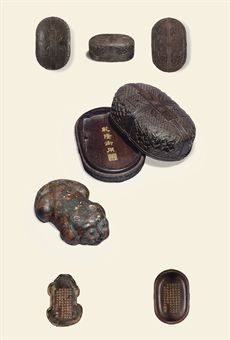
Only limited information on the Christie’s Fine Chinese Ceramics and Works of Art: The sale totaled $20,659,175, selling 83% sold by lot, 95% sold by value. 352 lots sold.  The top lot was a rare imperially inscribed Zitan Stand and cover date to the Wuxu year of the reign of the Emperor Qianlong, 1778. The zitan stand and cover were estimated to sell for between $20,000.00 and $30,00.00 and hammered down at an incredible $1.426 million including buyers premium (see image).

The New York Chinese sales have shown some very encouraging signs with strong prices and high buy through rates.  I hope that translates to other market segments, but as I mentioned in yesterdays post and based upon upcoming sales, by the end of September we should  have a better ideas where many markets are heading.  Think positive.

The Christie's catalog stated
The cover and stand very finely carved overall as a ribbon-tied, brocade-wrapped gift divided into quadrants by the ribbon which is superimposed atop the bow by a rectangular panel carved with the characters hu fu yan ('crouching tiger inkstone'), the quadrants carved with different scenes of birds in flight above waves from which rise various flowers and grasses, the interior of the cover with a carved and gilded imperial poem referring to the shape of the inkstone followed by the date and two seals, the top of the stand carved with a four-character inscription, Qianlong yuyong, (for the personal use of Qianlong), followed by a four-character seal, ji xia ling chi, ('a brief moment to practice calligraphy'); together with a flat clay inkstone of recumbent tiger outline, and a clay inkstone cover molded in the round as a crouching tiger, its recessed underside inscribed with the same dated Qianlong poem and seals as the cover of the zitan box, both inkstone and inkstone cover with mottled green patination
Zitan box 6 3/8 in. (16.3 cm.) long; inkstone 5¼ in. (13.3 cm.) long

Darwins Whale Tooth ........Scrimshaw with Provenance

Scott Reyburn of Bloomberg is reporting a scrimshaw whale tooth owned by Charles Darwin sold for $67,340.00. Why is this single item important for appraisers?  Because this is a good item to review and analyze when determining how provenance impacts the value of personal property. Compare this to similar age and quality scrimshaw whales teeth without provenance and look at the percentage increase as a factor for determining vale and how provenance impacts value for a parallel item.A good value to keep track of as an appraiser.

Reyburn reports
The 7-inch-long tooth was decorated by James Bute, a private in the Royal Marines, who was on H.M.S. Beagle with Darwin when the ship surveyed the Galapagos Islands in 1835.

Both sides of the decorated ivory -- known as a “scrimshaw” -- are engraved with signed depictions of the three-masted sloop, said London-based auction house Bonhams, which expected the piece to sell for as much as 50,000 pounds. The buyer was bidding on the telephone and the price was a record for a scrimshaw sold in the U.K., said Bonhams.

“This is without doubt the most important British scrimshaw to come on the market in my 30-year career,” Jon Baddeley, head of Bonhams’s collectors’ items, said in an e- mailed statement. This year is the bicentenary of Darwin’s birth and 150 years since the publication of “The Origin of Species.”

H.M.S. Beagle left England June 1831 on a surveying expedition that lasted five years. Darwin’s account of the voyage was published in 1839, 20 years before “The Origin of Species.”
To read the full article, click HERE.

9/15/2009

Assessing the Risks of Appraising and Authenticating Art

I have placed on the Appraisers Post a very good article by attorney Joshua Kaufman about appraising and authenticating art from an April 2009 issue of Art Business News.

Providing appraisals and authentications can be an important service for an art dealer to provide in order to facilitate sales and bring in additional revenue. However, appraising and authenticating art do not come without risks and potential liabilities, which must be weighed against any additional benefits that accrue from undertaking such opportunities. Two areas of law often arise when authentication and appraisals take place: contract and tort law. Both federal and state laws can come into play during the course of authentication. An art dealer might sell an artwork he or she owns, or a piece consigned by a collector or artist.
For a link to the full article, visit the Appraisers Post and view the featured article box by clicking HERE.

Sackler Sale at Christie's New York

The results are in for the continuation of the Arthur Sackler sale at Christies.  And, the results are very encouraging.  The Sackler sale of sale Oriental artifacts totaled $3.28 million..  The session offered 115 lots with 111 selling for an impressive 97% buy through rate. A Christie's spokesman noted the Sackler sale tripled the low end estimate totals. The top lot was A Bronze Ritual Food Vessel, Gui, Early Western Zhou Dynasty, 12th-11th Century BC with an estimate of $20,000.00 - $30,000.00 which hammered down at $362,500.00 (see image).

I'll have more from the Asia week sales over the next few days. Also, later in the month reports on the impressionist and modern sales, and in late September an Americana sale at Christie's. There should be some good indications of where multiple markets stands as we get results from these early fall sales. Lets hope the news continues to be positive.

Theow H. Tow, Deputy Chairman, Christie’s Americas and Asia said of the Sackler sale:
“Following the outstanding sale in the spring, we are thrilled once again with the successful sale of Property from the Arthur M. Sackler Collections. Tripling its low estimate, this sale witnessed established collectors, members of the trade as well as new buyers from all over the world, bidding for objects that reflected impeccable provenance, rarity, and quality. Competition was high across the board, with many pieces exceeding their presale estimates. The top lot, a bronze ritual food vessel, Gui, sold for an astounding $362,500. Strong results were also achieved for a black and white jade pendant from the Qing Dynasty and a pair of Huanghuali square waisted corner-leg tables, Fangzhuo. We look forward to tomorrow’s sale of Fine Chinese Ceramics and Works of Art.”

9/14/2009

Swiss Not Retunring Nazi Era Looted Art

Over the past few months we have seen some very good examples of artwork stolen from Jewish families during Nazi occupations being returned to the rightful owners and heirs.  There are many governments, police departments and private organizations actively looking for, tracking and working on either returning artworks or arranging settlements to the families who had art work stolen and plunder during the Nazi era of control.

Unfortunately, there is a situation in Switzerland where there is a known stolen John Constable painting called the Valley of the Stour and it appears it will not be returned.  The painting was confiscated from a Jewish family in France and sold at auction.  The painting is now said to be worth close to $1 million.

According to legal experts who were brought in to review the case, Switzerland has no restitution agreement, and the painting was donated with specific terms and restrictions to the local museum in La Chaux-de Fonds. The Swiss legal opinion is as there is no restitution agreement and due to the restrictive terms of the donation, the Constable can not be returned.

So, the Swiss are claiming because there is no restitution agreement (I wonder why not)  and restrictions in the will the painting can not be returned. A Swiss paper mentioned the decision was in line with the Washington conference on Nazi-confiscated art, and also mentioned, it was purchased in good faith.  OK, perhaps they can make a case for not returning the stolen Constable, but why not some form of settlement.  Perhaps from Swiss law there is no legal need for a return or settlement, but the morally right and ethical approach for the Swiss government as they continue to show the painting is to come to an acceptable settlement with the family.  In my mind I find the Swiss rationale a rather poor and unconscionable excuse for not returning what amounts to stolen property to the rightful owners regardless of Swiss law.

The Associated Press article states
When a relative of the original owner claimed the painting in 2006, the city near Switzerland's western border with France sought two expert legal opinions in the case.

"The first one explains that under Swiss law there is no obligation of restitution," Gogniat said Thursday. The second one concludes that the city is bound by the will of Madeleine Junod, who bestowed the painting along with a series of others to the city in 1986, he said.

Under the will, her collection has to be housed in a specific room of the city's Fine Arts Museum and not to be split up.

"So we don't have the right to return it," Gogniat said.

The painting, which today has an estimated value of around 1 million Swiss francs ($958,000), was confiscated from the Paris home of Anna Jaffe after she died in 1942 at age 90, according to a press release by the city of La Chaux-de-Fonds.

It was in a collection taken by French Vichy authorities who were collaborating with the Nazis and was auctioned the following year and subsequently changed hands several times.

The London-based Central Registry of Information on Looted Cultural Property says Jaffe, a British Jew living in France, had a large collection of artworks that included paintings from famous artists, such as Goya, Rembrandt and Turner.

"Vichy-imposed laws mandated that all Jewish properties were to be confiscated and sold at public auctions," it said.

The auction took place in July 1943 in Nice, France, according to the registry.
To read the Associated Press article, click HERE.

Chinese Bargains

Sallie Brady of Forbes has a good article on Chinese works of art and how Tang Dynasty (A.D. 618-907) is currently considered undervalued. According to Brady, one of the reasons Tang Dynasty works of art are undervalued is that until just recently many thought the items were to be used in the original owners afterlife. Value determination for these works of art are very similar to other collecting categories, scarcity, age, condition, and quality. Brady also reminds the reader that just because the artwork is old, that alone does not make it good or valuable.

Brady states
"The Chinese felt it was disrespectful to disturb the tombs of their ancestors," says James Lally, a 40-year veteran of the Asian- antiques trade and owner of New York's J. J. Lally & Co. Oriental Art. Over the past five years, though, a robust Chinese economy and greater openness to Western influences, particularly scientific archaeology, have fueled Mainland Chinese demand for antiquities.

What haven't changed are the factors determining value. Foremost among them is the status of the person for whom the work was made: The higher his standing, the higher the value. At the top are objects made for someone with an Imperial connection. The worth also climbs if the paint is original. And value accrues to a piece rich in carved detail: How extensively does it capture facial features, the drapery of the clothing, the various parts of a horse's saddle? Then there's cachet in a work's "degree of movement," those qualities that lend it a lifelike sensibility-- a subjective measure, to be sure.

Beyond the Neolithic era, which dates from 10,000 to 2,000 b.c., and the Bronze Age (up to about 771 b.c.), Chinese antiquities are typically identified by dynasty. Tang and Han (206 b.c. to a.d. 220) works are most popular with seasoned collectors. Bargain hunters will find such pieces as small Western Han pots for $200 or such deals as a 5,000-year-old amphora (wine jar) from the Neolithic era for £300 (about $495), the latter at London's Guinevere Antiques (www.guinevere.co.uk).

To read the full Forbes article, click HERE.

9/13/2009

Phillips de Pury & Co New Aggressive Strategy

Kelly Crow of the Wall Street journal recently reported that Phillips de Pury & Co is expanding the number of sales by 18 over the next year and half.  That is a rather aggressive move by the auction house in the current market.  Phillips also specializes in more modern and contemporary art, which has been hit the hardest over the past 12 months.  Crow points out that as Sotheby's and Christie's have tightened their financial belts in the past and for future sales.  While Phillips is taking a contrarian view, being much more aggressive with more print catalogs, expanded lot sizes, and the promotions of new, unknown artists. Part of the strategy appears to be to bypass the traditional gallery/artist relationship and bring new art directly to collectors through auction.

The expanded auction schedule will be alternated between New York and London.  This new aggressive posture is brought about by Bernd Runge the new Chief Executive of Phillips.  If you recall, and it was posted here on the AW Blog, Russian retail giant Mercury group took control of the auction house. This new strategy is a result of the new management and management style of Mercury.  It will be interesting to see how the new more aggressive strategy fairs.

Crow reports
Critics say that moving more untested artworks into the marketplace now could backfire if collectors hold on to their wallets, potentially rattling confidence in the overall art market. Others say the novelty of the plan—a disc jockey will play during a music-themed sale in October—could also inject life into a scene that's weary of feeling weary.

The art market has taken a battering this year, struggling even as other financial markets have taken small steps toward recovery. In the first half of 2009, Sotheby's sales were down 87% and Christie's sales were down 49% from the same period a year ago. Prices for new art have stopped plummeting, but the volume of contemporary art sales this summer was down 80% compared with last summer, according to ArtTactic, a London-based research firm that tracks global art sales.

Phillips is particularly vulnerable to art-market mood swings because of its tighter focus on contemporary art, photography, jewelry and design. Its auction sales total for the year currently hovers at around $60 million, well off pace from last year's $292 million total. At its last major sale in London this June, only one work sold for over $1 million, and the $8.4 million sales total fell just under its low estimate.

Mr. Runge has been tasked with turning the decline around. On a recent afternoon in London, he sat in a conference room flipping through the catalog galley for "Now," grinning as he pointed out magazine-style additions to the catalog format, including an interview with artist Keith Tyson . Before joining Phillips in March, he spent a dozen years as a Condé Nast International vice president, helping to launch 30 magazines including successful editions of Vogue and GQ in Russian and less successful editions like Vanity Fair in German, which recently closed.

To read the full Wall Street Journal article on Phillips by Kelly Crow, click HERE.

Another Art Scheme

Fellow appraiser Bob Corey sent me an article from the Naples News on a gallery owner who talked investors into purchasing fake paintings by Pablo Picasso and Marc Chagall, amongst others and to roll sales proceeds over into additional art purchases and sales flips.  Similar to an art Ponzi scheme.  There is currently one lawsuit, and more are expected against James Batson, of Jamali Fine Arts, an art gallery on Naples’ Fifth Avenue South. The Naples News tried contact Batson for comment through email and the website at InvestmentArtworks.com but was not succesful

The article is an interesting read, and shows how easily investors can be tricked  and pulled deeper in these schemes. Make sure to read some of the posted comments below the article as well, some less than sympathetic toward the plaintiffs.

The Naples News reports
Meanwhile in late 2006, Batson told them he’d quit his curator position at Jamali so he could focus on opening his own gallery. He asked for their financial help in purchasing art for his gallery, but they declined.

The next month, they traveled to a Miami art show, where the Smiths purchased a Picasso, sight unseen, from a foreign vendor after Batson told them it hadn’t cleared customs quick enough to be in the show.

The Smiths bought Jamalis; a dozen signed Chagall lithographs called “Twelve Tribes of Israel”; Picasso linocuts, lithographs and sketches; shares in sketches from Picasso’s sketch book; and paintings that incuded “The Miro,” “The Secret of the Rose, and “The Vigee LeBrun,” which they paid $7,281 to frame.

When Batson told them about a Picasso “Brush Painting” related to “Head of a Woman,” which was on display at the Picasso Museum in Paris, they paid $150,000 for that and a Jamali. But it was on the condition that Batson help them sell the Picasso.

“(Batson) told the Smiths that Sotheby’s thought their piece of art was quite a find and wanted to verify it in person,” the complaint says.

Batson supposedly made the trip and told them Sotheby’s authenticated it as the third in a series of three paintings, the first of which was at the Picasso Museum, and Maya Picasso, the artist’s daughter, owned the second.

When Batson told them Sotheby’s wanted the art reframed before it was auctioned, they gave him $2,300.

Batson often mentioned his gallery’s continuing construction and rental space. But it never opened and he blamed that on what he said was a recurrence of cancer. He also said he needed to move to Fort Lauderdale to “enjoy life” before undergoing chemotherapy in Naples.

At one point, Batson invited Lionel Smith to The Carlisle in Pelican Bay, which he said was his home, and showed them Jamali’s “Woman of Peace,” which they purchased for $58,000 after he told them there were many interested buyers, including professional golfer Tiger Woods.

They also paid $93,000 for a two-thirds interest in another Jamali after being told Woods also wanted it.

Batston told them the “Dora Maar” would appear in Sotheby’s May 2007 catalog. When it didn’t, he claimed he’d pulled it to have it reframed and it would be in the November catalog with the Picasso “Brush Painting.” That never happened.
To read the full article, click HERE.

9/12/2009

$1 Million Reward for Stolen Warhols

The Los Angeles Times is reporting that a collection of original Andy Warhol art was stolen from the home of collector last week.  There is a $1 million reward for the multi-million collection.  The stolen Wahol silkscreens depicting athletes of the 1970's include Pele, Chris Everet, Dorothy Hamil and Muhammad Ali among others. The owner of the Warhol portraits was Richard Weisman who knew Warhol and commissioned the series. Supposedly 10 pieces were stolen.

The interesting aspect is the report from detectives and art experts will be in identifying the original art, as each set in the athletes series of Warhol art have differences, such as background colors.  The police are trying to identify where original sets are and to rule certain collections out.

The LA Times states
The investigation is particularly complicated because the stolen portraits belong to one of several sets Warhol made of the athletes. Each set has a different color scheme, but they look similar. Weisman is thought to own several of the sets himself, police said. Hrycyk said police are working to identify the other sets in an effort to avoid confusion over which portraits are missing. The FBI and Interpol, which maintain databases of stolen art, will be notified, the detective added.

The total value of the work could not immediately be discerned. However, Tyler Lemkin, director of the Greenfield Sacks Gallery in Santa Monica, which recently opened a show of Warhol prints, said that original Warhol paintings on canvas such as the ones that were stolen "start in the high six figures or $1 million."

"This is a huge deal. You're talking about a major collector who has lost a significant amount of important art," Lemkin said.
To read the LA Times article, click HERE.

To view an LA TV news report on the stolen Warhol art, click HERE.

9/11/2009

HOW CRIME DID PAY

My husband and I (Jane posting, not Todd) were in Marfa, TX (West TX) over the Labor Day weekend with friends where the mountain air is light, the beauty is natural and the sky is vast, a growing community quickly becoming a rather sophisticated location for art and collectors. We stopped in the local book store before dinner for a book signing and reading of “The Seven Pleasures”, but I was more interested in a book that was on sale table. It is one of my favorites and a book that Todd and I recommend to our Workshop students. The title is “Provenance: How a Con Man and a Forger Rewrote the History of Modern Art” by Laney Salisbury and Aly Sujo. Book Synopsis: A tautly paced investigation of one of the 20th century's most bold and daring art frauds, which generated hundreds of forgeries, many, to this day are hanging in prominent museums and private collections.

Provenance is the fascinating narrative of one of the most far-reaching and elaborate deceptions in art history. The investigative authors brilliantly recount the tale of a great con man and unforgettable villain, John Drewe, and his sometimes unwitting accomplices.

Chief among those was the struggling artist John Myatt, a vulnerable single father who was manipulated by Drewe into becoming a prolific art forger. Once Myatt had painted the pieces, the real fraud began. Drewe managed to infiltrate the archives of the upper echelons of the British art world in order to fake the provenance of Myatt's forged pieces, hoping to irrevocably legitimize the fakes while effectively rewriting art history.

The story stretches from London to Paris to New York, from tony Manhattan art galleries to the esteemed Giacometti and Dubuffet associations, to the archives at the Tate Gallery. This enormous swindle resulted in the introduction of at least two hundred forged paintings, some of them breathtakingly good and most of them selling for hundreds of thousands of dollars. Many of these fakes are still out in the world, considered genuine and hung prominently in private houses, large galleries, and prestigious museums. And the sacred archives, undermined by John Drewe, remain tainted to this day.

Ironically I picked up a the free copy of ARTnews from our hotel upon checkout and lo and behold there was a book review by Milton Esterow on “Provenance”. He tells the reader what the Con Men are up to today after being released from prison.

To read a review from the Washington Post on Provenance, click HERE.

9/10/2009

Quality Coming to Market

Over the past year there have been many different rationales and explanations for poor auction results, from declining economic conditions to a lack of quality in auction catalogs.

Here we have some news of quality coming to auction in the Old Master market. Over the past year old master sales were typically soft, but that segment was not effected nearly as much as contemporary and modern art sales. In any event, there was much discussion that prices were low due to the economy, market perceptions, and fresh to market quality art not finding its way to the large auction houses as in the past. Part of this was due to the change in major auction house policy of not offering guarantees (which has been covered in detail on the AW Post in the past).

Bloomberg is reporting that the family which owns the Glyndebourn Oprea House in England will be selling a 17th century old master by Italian artist Domenichino entitled “St. John the Evangelist”. Christies' has the consignment, and the estimate is $16.5 million.

I realize expectations and projections have recently lacked any sort of consistency, but perhaps this is an indication the market may truly have hit bottom and is a sign that the art market is starting to become more consistent and balanced.

Scott Reyburn of Bloomberg reports
“This was a famous picture in the 18th century,” Paul Raison, Christie’s London-based head of Old Masters, said in an interview. “It was mentioned in several Grand Tour guide books and it was copied by Fragonard. It definitely comes in the masterpiece category.”
The work is the most valuable Old Master painting offered by Christie’s since Raphael’s “Portrait of Lorenzo de Medici,” which was expected to sell for between 10 million pounds and 15 million pounds in July 2007. It was bought by a telephone bidder for 18.5 million pounds with fees.
The 9-foot-high Domenichino canvas, showing the author of one of the four Gospels poised over books supported by two angels, was painted in the late 1620s by the Bolognese artist. It will be offered in Christie’s Dec. 8 sale of Old Masters and 19th-century art.

Country Opera

The painting has been owned for over 100 years by the Christie family of Glyndebourne, East Sussex, and is being offered by a trust to diversify the family’s assets, said the auction house. John Christie (1882-1962) was the founder of the countryside opera festival.

In the early 17th century, the painting was owned by Marchese Vincenzo Giustiniani, an Italian collector who owned as many as 12 works by Caravaggio. It was included in the “Treasure Houses of Great Britain” exhibition at the National Gallery of Art, Washington D.C., in 1986.

“That might have been the last time it was cleaned,” said Raison, aware that Old Master collectors are reluctant to buy works that have been restored. “The colors are still very fresh. It’s not particularly dirty, though we did have to get rid of a bit of bird dropping that was on the canvas.”
To read the full article, click HERE.

WHAT THEY SEE IN VAN GOGH'S EAR

Vincent Van Gogh was an influential 19th century artist. In 1890, struggling with depression and insanity, he went to a nearby field and shot himself in the chest, stumbled back to his house where his brother Theo nursed him for two days, before he finally died.

He had been troubled by mental health issues throughout his life, and particularly during the last few years before his suicide. In some of these later periods, he chose not to paint or was not allowed to by attending family and medical professionals. There has been much debate over the years as to the source of Van Gogh's illness and its effect on his work. Over 150 psychiatrists have attempted to get to the root of Van Gogh's illnesses, and some 30 different diagnoses have been offered. The suggested diagnoses include schizophrenia, bipolar disorder, syphilis, poisoning from swallowed paints, temporal lobe epilepsy and acute intermittent porphyria. Any of these could have been the culprit and been aggravated by malnutrition, overwork, insomnia and a fondness for alcohol and absinthe.

It is generally acknowledged that he cut off the lobe of his left ear during a seizure on Christmas Eve, December, 1888. However, the most recent proposed different theory, published in a book last year, is that, Gaugin, Van Gogh's friend and an expert fencer, sliced off Van Gogh's earlobe with his sword during a fight.

Ann Landi writes in the September issue for ARTnews about the infatuation with the craziness of the artist. What is this powerful grasp Van Gogh has on the public imagination?

To read Ann Landi's article Click Here

9/09/2009

A Great Calendar Resource for Appraisers

Fellow appraiser Kathi Jablonsky, ISA CAPP puts together an excellent free calendar of appraisal related events and opportunities for the Antiques and Residential Contents division of ISA. The calendar is open to the public and contains many educational opportunities for appraisers from different associations, museums and historical societies. I highly recommend appraisers and dealers visit the calendar on a monthly basis to view what is available and what might be of interest to personal property appraisers. It is a good site to bookmark.

As an example, here is the week of September 20th from the calendar.
  • Colonial Williamsburg: Textiles for Interiors 1730-1830; Sep 20-22; Williamsburg, VA
  • Winterthur Institute: Fall Session; Sept. 21 - Oct. 2; Winterthur, DE
  • Oglebay Institute: Glass, Ceramics and Appraiser Business Tools; Sept. 21 - 24; Wheeling, WV
  • UCI/ASA: Charitable Contributions & Estate Tax - Are You Qualified?; Sept. 21-22, Irvine, CA
  • Art Initiatives Conference: Enduring Legacies - The Arts & Crafts Movement in Seattle and the Pacific Northwest; Sept. 23-27; Seattle, WA
  • AAA: Study Day at Yale Furniture Center; Sept. 24; New Haven, CT
  • Decorative Arts Trust Fall Symposium: Jefferson's Monticello and Madison's Montpelier; Sept. 24-27; Charlotteseville, VA
  • Costume Society of America symposium: Costume in The American West - Historic to Modern Times; Sept. 25-26; Sacramento, CA
Most items listed on the calendar are hotlinked for additional information.

Click HERE to visit the calendar. You can also access the calendar from the ISA Website, and I have placed banners on the AW Blog and the Appraisers post blog.

Update on the Dunton Sale and Dealer/Appraiser Conflict of Interest

The following content is from appraiser Peter Eller, who was the appraiser/dealer and defendant involving the two Harold "Buck" Denton paintings. From Peter's statement, and how he explains the case evolved, shows how easily a contact for an appraisal, or even what turned out to be a consultation turned into a larger law suite. In any event, Peter gives some very good insight into what transpired and some of the conflicts he faced throughout the process. From an appraisal perspective, one we all wish to avoid, but in certain instances we dont have much control.

I recommend all appraisers and especially dealer/appraisers to read Peter Eller's statement to the AW Blog.

Peter Eller states
9.09.09 Eller on Hicks v Eller and the $600,000.00 Paintings

From an appraiser’s point of view I take a somewhat different approach, though the prior discussions on separation and clarification of dealer and appraiser functions as well as responsibilities under USPAP are highly appropriate. My situation should be proof that these points should be scrupulously heeded.

However, as my dear grandmother used to say, “If the devil wants it, in the short run it will be so.” Things can go awry despite the best intentions; intelligent, accomplished human beings can fall into a misunderstanding that makes one of them angry, and that can be the basis for a situation like mine, in an area of law known as “civil tort.”

Civil tort is an insidious, sophisticated animal, dangerous to any professional. The point here is that it is the plaintiff and their attorney who get to write the script. Defendant has no choice other than to defend against those particular charges or allegations. That the plaintiff controls the action is attested to in the law books themselves.

I was a member of ISA from 1984, starting out with their fine educational program that summer at Indiana University, until 2002; and I have been a member of AAA since 1997. Since 1986 when I started a gallery I have done my best of clarify and avoid the potential confusion between dealer and appraiser in the mind of the other party. I was successful until April of 2007.

This time I made the same effort, offered the same explanations, the ones I thought professionally and ethically appropriate to the situation as presented to me by the other party. And this time something went awry. It is not my part to lay the ground work for either party’s case here, but most people concede that it takes two parties to bring about confusion. And it takes two to work one out. This did not happen here, and so the allegations of one became the premise for a civil tort action that has cost me a lot of money and that in addition intentionally has set out to ruin my career through protracted management of the media.

It can slip right past you when it happens. You can be working with someone highly accomplished in a career. And you can be dealing with such a person whose very accomplishments have made them successful in security work in the defense industry and who has been used to dealing with others on a “need to know” basis. And so while you think you have made your areas clear, this individual may actually hear differently, and take up the things you say differently and without giving you a clue that a mis- communication is in progress.

For example I explained at the outset, during the first of what up to that time I took to be pro bono meetings, the main choices, respective focus and cost structure of an appraisal for estate purposes, and for insurance. Both were soundly and speedily rejected by the other party.

Scott Sandlin’s first article in the “Albuquerque Journal” is well written, factual and even handed. Her second article on the verdict less so. Though present for four days, Ms Sandlin never asked to speak to me. She had clearly and repeatedly talked to plaintiff’s side. Also Dunton, in a huff, resigned from the Taos Society of Artists in 1922, and so could not have been a member until his death in 1936. This was in fact a claim made by the opposition and their witnesses. Clearly noone consulted the notes of the Taos Society as edited by Robert White.

Together the articles present a synopsis, to which I wish to add the following points. I did ask right after the rejection of any appraisal work whether I would be welcome to make an offer on something I saw. I felt this was appropriate because the objective had initially also been presented to me as an estate sale of articles of which the family now wanted to dispose. I was told, Yes, that I was welcome to do so.

We walked from room to room, discussing various items that stood out or in which the other party showed an interest. The paintings were not hung. They were in a side room full of odds and ends, set on a day bed against the wall, with a chair and other items in the way. I spotted them, said the one signature looked like Dunton, and when asked who he was, said Taos Society of Artists. I told plaintiff then I wold be interested in buying them. We discussed the matter briefly, plaintiff telling me more about her father and his early New Mexico advertising business, and then we moved on.

At the end of that first session, I asked again whether I buy them, and I was told by plaintiff that, No, she wold like to think about it. For the time that ended the matter, though it left me with the impression, erroneous, that as executor and personal representative she would do some work to support any acceptance of an offer. I did come back a second time for discussions on other items, including the recommendation of a book dealer who later bought and a dealer in edged weapons. During this visit the conversation about the paintings then also took place pretty much as reported.

One thing generally neglected however was their condition. They had been put away for some forty years in a crawl space below the house that also contained the furnace and whose windows we later found out were not entirely tight against infiltration and weathering. The deleterious result to works on artist’s board can be imagined. They were desiccated; varnish under the grime was oxidizing; their general aspect was dark or muddy, both figures and background indistinct. All of this was apparent from a distance of about seven or eight feet, though on the first visit I did not pick them up or examine them more closely.

This raises at least two points. Regarding condition, after I had bought them I gave them a light cleaning with Winsor-Newton as refresher, and noticed that the cardboard support was also deteriorating and the canvas pulling away or bubbling in several places. It is also important to understand that along the chain of ownership the paintings then had two restorations on their way to final auction. The first, I am given to understand, was a thorough cleaning, which according to testimony brightened them remarkably, brightened colors considerably and separated figures from their background and made the former stand out and become viable.

The other was a much more radical and invasive make-over starting with removal of the finishing varnish that had just previously been applied and taking the canvases off their old boards and relining and restretching them, along with a final finish of in- and over- paint and new varnish. Thus the paintings that came up in Coeur d’Alene were very different from the ones that I bought. I suggest that they, using new techniques and materials, very different from the paintings submitted by Buck Dunton, and then put away by Mr. Hicks or his family.

The other point concerns price and/or value; inherent in the implication “he should have known.” It is not a point I wish to argue directly. Those familiar with the process of remaking paintings, as well as the philosophical debate between “restoration” and “conservation,” understand only too well that there are several views on how far such treatments should go, and whether it is best only to stabilize the piece and retard inevitable, progressive deterioration, or whether it should with new techniques and materials be presented better than new or at least so bright and glistening in a way that not have been possible or even thought desirable by the artist. And we know that some buyers, and some auctions, simply don’t care either way. Other points can be made, including that the entire chain is made up of dealers and art professionals. None really knew or were able to set a fixed value. And as we now know, judging among others by the prices realized at Heritage/Dallas recently for Dunton, the market has already drastically retreated again. With the economy already tanking, the price realized at Coeur d”Alene was lucky, perhaps irresponsible for the buyer, and the result of an anomalous and short lived counter trend.

Henry James: “We work in the dark, we do what we can,.... The rest is the madness of art.”

Perhaps my greatest disappointment throughout the process was the lack of support from AAA, for my attempts to frustrate the plaintiff’s request to see all of my appraisals. In view of the fact that she had not hired me to do an appraisal I did not think that was in any way appropriate and warranted.

Here is how I put it to my attorney, who had the good sense not to want to antagonize a judge new to the court on this issue, which nevertheless altogether caused me the most amount of personal and professional grief:

“I strongly inveigh against the overweening demand to produce ALL the documents since 1997 that meet the dollar criteria [individual, stipulated art values of $10,000, aggregate art values of $20,000or more]. As you now I have signed releases from seven clients, who were informed that their consent would warrant the possible use of their appraisals in a case of adversarial litigation against me, and have nevertheless agreed that their documents may be so used. These should suffice, . . . without forcing the issue of client confidentiality.

“Finally, I continue to maintain that appraisals, as presentations of separate and unique investigations into a set of value conclusions and the particular context that gives them relevance and probity, are a form of intellectual property, and thereby due some form of protection.

“I hereby state my strict professional responsibility to guard the confidentiality of these reports, and I ask the court they not be turned over to plaintiff or her counsel. She and her attorney have not shown good and proper cause why we should do so, and once released, their security is compromised and the privacy of their content can no longer be guaranteed.

I did not expect the association to defend me. That was my job alone.

However, I had hoped they would back more aggressively my stand that the entire body of my appraisals since 1997 should not come into play because, on this scale and for these reasons, plaintiff had no good and proper cause to force this request. My former appraisals were in no way at issue, nor did they in fact later figure into their case.

Finally, I suggest the matter of classifying and finding recognition for appraisals as a form intellectual property, due the legal protections of such, should be considered for implementation. Until that is done all of our appraisals, and the clients who actually trusted us, are at considerable and at times arbitrary risk.

(Comments to be personally may be addressed to Peter@PeterEllerArt.com)