9/30/2008

Christie's in the Gallery Business

Alexandra Peers of the Wall Street Journal is reporting the holding company that owns Christie's has purchased earlier this year London gallery Haunch of Venison, and just recently opened a large satellite gallery in New York. Haunch also has galleries in Berlin and Zurich. Earlier this month I posted on the AW about artist Damien Hirst bypassing the established gallery system and selling directly from his studio at auction through Sotheby's London showroom. It appears auction houses are seeking ways to expand their customer base and influence markets.

The lines very well appear to be blurring between the primary market and the secondary markets with Sotheby's having sales of primary market items, and Christie's selling in the retail market. Both Christie's and Sotehby's have long privately placed items with collectors. Some experts beleive the retail galleries Christie's is now operating will eventually take the place of the private sales division.

Christie's of course states the Haunch of Venison gallery operations will be run independently of from the auction business. They plan to represent artists and artist estates. The NY Haunch of Venison Gallery is very close to Christie's NY showroom. Very convenient. Yet with the recent success of the Hirst sale at Sotheby's, what happens in the future is anyone guess. Any person with even a limited amount of knowledge of the art business should realize that the auction house and gallery will interact. It appears all past informal lines are now being crossed by the two major international auction houses, be it private sales or selling at the gallery or through the auction house.

The article states "Certainly, Haunch gives Christie's some business advantages: It offers spacious, striking venues to showcase work year-round, not just prior to the big spring and fall auctions. It allows the company to make careers, spotting art stars and showing their work internationally before they hit the auction block. Insiders expect the art world to change as a result."

To visit the Haunch of Venison Gallery website click HERE.

To read the Wall Street Journal article click HERE.

9/29/2008

Wynn's Picasso Le Reve to Be In Exhibition

Many of you probably recall the Picasso painting Le Reve which was owned by Las Vegas casino owner Stephen Wynn. Wynn had a contract to sell the Picasso for $139 million and then when showing the painting to friends in 2006 he accidentally put his elbow through the canvas. New York City appraiser Victor Wiener was involved in the insurance claim and consulted on the settlement., Wiener wrote a very interesting and insightful article on the settlement process for the damaged Picasso in the Journal of Advanced Appraisal Studies 2008 entitled Appraising Art in the Stratosphere (click HERE to order).

Lindsay Pollock of Bloomberg news reports Le Reve will be on display at the Acquavella Galleries in NYC along with 11 other Picasso paintings, sculptures and a few drawings. The exhibition opens to the public on October 15th. The value of the Picasso exhibition items totals over $500 million. Regarding the repair, Pollock states "The tear was repaired and the erotic painting of Picasso's dozing lover, with her left breast exposed, usually hangs in Wynn's Las Vegas office.``To the naked eye, you can't really see anything,'' Acquavella said.

To read the Bloomberg news article click HERE.

The Definition of an Appraiser (Humor)

I gave an appraisal technology presentation a few years ago at the ISA annual conference in Santa Fe and used the following "definition of an appraiser" in one of my slides. I found it somewhere on the internet, but with no attribution. I thought it was fitting after the posts of last week about qualified appraisers and qualified appraisals. After reading IRS Guidelines and the Code of Federal Regulations, we can all use a little humor.

"An appraiser is one who compiles and analyzes voluminous data of problematical accuracy from sources of dubious veracity and derives therefrom a numerical quantification of unquestionable necessity, analogous to a nebulous and euphemistic concept representational of value commensurate with ambient configurations of the open market and promulgates thereby a precise written declamation which delineates his observation, deliberations and conclusions all done while he feigns absolute ignorance of the avaricious machinations of Buyers, Sellers, Brokers and Collectors, compensated only by that penurious stipend known as the professional fee."

9/28/2008

Fed Chair Bernake on Valuation

The following quote is from Federal Reserve Chair Ben Bernake when discussing the potential 700 billion dollar Wall Street bailout. I know it doesn't really sound appraisal related, but he is talking about value at auction.

Bernake was asked if any of the $700 billion would eventually come back to the taxpayers, he replied with an art auction analogy.

Bernake stated "Just as when you sell a painting at Sotheby's, you don't know what it's worth until the auction is over."

Hmmmm. So Bernake is saying he does not know if any of the taxpayer money will ever be repaid. Regarding the analogy, I think many appraisers (and probably a few economist) might disagree with the above statement from the chairman of the Federal Reserve Board. Professional appraisers would be able to gauge the value and predict a selling price based upon previously sales and research. And how about the differences between price and value. I guess the Fed Chair doesn't get it, or if he does, he does not wish to be on record.

9/27/2008

FBI Art Crime Team Leader Wittman Retires

Earlier this month I posted on the AW blog about the FBI Art Crime team and its leader Robert Wittman (click HERE to read the AW post). That post was based upon a recent Wall Street Journal article which documented some of the exploits of Special Agent Wittman working undercover to recover stolen art work.

The Philadelphia Inquirer reported earlier this week that Wittman is now retired, and soon to join the Philadelphia area law firm of Fox Rothschild as a private art-security consultant. Wittman also plans to lecture, work with "galleries and individual collectors to recover stolen works, avoid fraudulent purchases, and learn prevention techniques."

To read the Philadelphia Inquirer article click HERE.

9/26/2008

Incan and Pre Incan Artifacts Recovered

The Andina (Sept 10) is reporting that 690 Incan and Pre Incan archaeological pieces were recovered in Cuzco, Peru along with the arrest of the ringleaders involved in the illicit activity. What is interesting or perhaps sad is the artifacts were promoted for sale on an internet video, and within in the half hour video one member of the gang, with his face covered discusses the illicit trade practice of selling items of Peruvian cultural heritage.

OK, so your thinking the perpetrators are a bit on the slow side to advertise in a video and post on the web. According to the article the video was viewed by an international news agency and reported to the Peruvian authorities. Our smart bandits not only advertised on the internet, but must have stated their location as they were quickly arrested, and where was the store, it was across the street from the Incan Museum. The article does not state where the artifacts were stolen from.

To read the full article (which is the Andina's translation from Spanish), click HERE.

9/25/2008

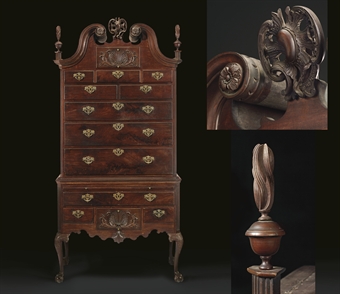
Update - Leigh Keno and the Philadelphia High Chest

On Monday I posted on the AW blog about Leigh Keno selling his Biddle-Drinker Family High Chest through Christie's Americana sale. If you may recall, I was wonder why Mr. Keno was selling through auction and not his New York City gallery. After Mr Keno purchased the high chest he stated "everything about it was right. It had never been cleaned. It had all its original pierced brasses, finials and carving (except for the tip of the cartouche). He saw that it matched a 1753 Colonial Williamsburg high chest that is signed by the Philadelphia Quaker cabinetmakers Henry Clifton and Thomas Carteret." It sounded like Mr. Keno thought he had purchased the high chest at a bargin price and it likely would turn a nice profit when sold.

He paid over $700,000.00 for the high chest earlier this year, the estimated range for the high chest at Christies American sale was $600,000.00 to $900,000.00.

The high chest just sold a few minutes ago for $1,082,500.00 including buyers premium. Factoring a buyers premium and sellers premium, perhaps Mr. Keno broke even or perhaps made a small profit, even with carrying cost.

There are a lot of unanswered questions about why the chest was being sold at auction instead of through Mr. Keno's gallery, but one thing I can assume is, the final auction sales price at Chritie's is probably much lower than the asking price of the high chest when it was for sale in Mr. Keno's gallery.

IRS and the Qualified Appraiser

In yesterdays post I included some basic information from the Code of Federal Regulations on the IRS's interpretation of the Pension Protection Act and guidelines for what constitutes a qualified appraisal for charitable donations. Today's post deals with basically the same issue but instead of looking at a qualified appraisal, we look at what the IRS considers a qualified appraiser. Scroll down to read yesterdays post on qualified appraisals. Click HERE to an August 11 AW post which has a link to the newly published Code of Federal Regulations.

In general, under the proposed regulations, a ``qualified appraiser'' must be an individual with verifiable education and experience in valuing the relevant type of property for which the appraisal is performed. The PPA refers to two types of education and experience: Minimum education and experience in section 170(f)(11)(E)(ii)(I) to establish qualification as an appraiser generally, and verifiable education and experience in valuing the type of property subject to the appraisal in section 170(f)(11)(E)(iii)(I) to establish qualification as an appraiser for a particular appraisal. The IRS and the Treasury Department believe that it is sufficient for an appraiser to satisfy the more stringent requirement of verifiable education and experience in valuing the type of property subject to the appraisal. Satisfaction of that requirement will also satisfy the minimum education and experience requirement of section 170(f)(11)(E)(ii)(I). The proposed regulations provide that an individual has verifiable education and experience if the individual has successfully completed professional or college-level coursework in valuing the relevant type of property and has two or more years experience in valuing that type of property. Furthermore, because significant education and experience are required to obtain a designation from a recognized professional appraiser organization, under the proposed regulations appraisers with these designations are deemed to have demonstrated sufficient verifiable education and experience.

If I am interpret the above guidelines correctly, should the appraiser have a designation from a "recognized professional appraiser organization" the appraiser is considered to have both the necessary education and experience. Although this is only my opinion, it appears that the educational requirements for an appraiser with a recognized designation will have an easier time establishing as a qualified appraiser than someone without. Those without the designation will have to prove two or more years of appraising similar property to cover the experiential portion and verify college or professional level education as well in appraising similar property.

The proposed guidelines certainly support the "recognizable appraisal organizations, which I would assume to be ISA, ASA and AAA. If you are preparing charitable donations appraisals for the IRS on a regular basis, and are not designated by a major appraisal organization, I would highly recommend that you join and go through the various credentialing processes to become a qualified appraiser.

9/24/2008

IRS and the Qualified Appraisal

On August 11 I posted a link on the AW blog to the new charitable donation IRS Guidelines regarding the Pension Protection act as published in the August 7, 2008 Code of Federal Regulations. Click HERE to read the AW post, along with a link to the code. I am not sure how many appraisers have read the new guidelines, but all should be aware of how the IRS is interpreting what a qualified appraiser and qualified appraisal are. Today's post is on the IRS definition of a qualified appraisal for charitable donations reports.

The updated and proposed guidelines state that a qualified appraisal is:

"an appraisal document that is prepared by a qualified appraiser in accordance with generally accepted appraisal standards. Generally accepted appraisal standards are defined in the proposed regulations as the substance and principles of the Uniform Standards of Professional Appraisal Practice (USPAP), as developed by the Appraisal Standards Board of the Appraisal Foundation. See Title XI of the Financial Institutions Reform, Recovery, and Enforcement Act of 1989, Public Law 101-73, 103 Stat. 183 (12 U.S.C. 3331-3351). The proposed regulations are similar to section 3.02(2) of Notice 2006-96, except that the proposed regulations require compliance with the substance and principles of USPAP."

In the past it may have appeared the IRS was hesitant to embrace USPAP standards. That no longer seems to be the case with the IRS calling a qualified appraisal one that requires the compliance with the substance and principles of USPAP. These are currently only guidelines and are not the final code. The IRS is now accepting comment on these proposed guidelines. Since the IRS is nearing the end of the final comment period, I would expect the final guidelines to be similar in content and form.

9/23/2008

Germans and Russians in Art Stalemate

The NY Sun is reporting that Germany is attempting to recover nearly 1 million pieces of art stolen by the Soviet Union after World War II. Over the past 20 years there has been a consistent dialogue between the two countries, but as other economic and foreign policies issues have arisen, the dialogue about the stolen art has fallen from a position of attention.

The NY Sun states "Under Russian law, art looted from Germany by the Soviet Trophy Commission is Russian national property. Many Russians view it as legitimate compensation for the Soviet treasures looted or destroyed by Hitler's troops."

There still is debate over what items where removed from Germany and where many of the items might be. To read the full NY Sun article click HERE.

Divine Provenance


As professional appraisers we know that documented evidence of provenance of works of fine art, antiques and antiquities can help to establish that it has not been altered and is not a forgery, reproduction, stolen or looted. Knowledge of provenance can help to assign the work to a known artist and a documented history of ownership can be of use in providing proof.

Of course the quality of provenance of an important work of art can make a considerable difference to its selling price in the market; this is affected by the degree of certainty of the provenance, the status of past owners as collectors, and in many cases by the strength of evidence that an object has not been illegally excavated or exported from another country. The provenance of a work of art may be recorded in various forms depending on context or the amount that is known, from a single name to an entry in a full scholarly catalog several pages long.

Provenance research is a challenging process. Records are often lost or destroyed in the upheaval of war. In addition, the passage of time and world events often make important information difficult, if not impossible to locate. There are often gaps in the provenance of a particular work because an owner may want anonymity or the records of purchase or sale are not available.

It is interesting that even with the lack of quality provenance people are still willing to purchase an object that has questionable provenance and take the chance that it is the "Real McCoy". It continues to be a hot topic in the art and antique world. As you know in many of the articles that we have posted on our blog, major museums and collectors have had to return art and antiquities purchased from dealers or at auction because they were looted or forgeries.

In an article in Forbes magazine this month the short circuiting of provenance talks about two forgeries in the past year. One, a ceramic faun, purportedly by Paul Gauguin, and a pair of circa 1830 English commodes. The faun came to the Art Institute of Chicago via the reputable dealers John Pillar and Libby Howie, who had purchased the piece at a Sotheby's auction. The commodes, sold to a Los Angeles decorator by the respected London antiques dealer John Hobbs, were made by Hobbs' restorer. To read the article click HERE

9/22/2008

Leigh Keno and the Story of a Philadelphia High Chest

For those of you who attended the fine and decorative arts star studded ISA Annual Conference this past April in Baltimore you may recall Lita Solis Cohen of Maine Antique Digest commenting upon a Chippendale Philadelphia High Chest which had recently been auctioned in New Orleans. The story of the high chest which was purchased by New York Americana dealer Leigh Keno was also prominently included in Maine Antique Digest and now, just recently by the New York times.

The NY Times, recently reporting on the high chest, states "When the high chest arrived in New York, Mr. Keno sat and stared at it for two hours. He said everything about it was right. It had never been cleaned. It had all its original pierced brasses, finials and carving (except for the tip of the cartouche). He saw that it matched a 1753 Colonial Williamsburg high chest that is signed by the Philadelphia Quaker cabinetmakers Henry Clifton and Thomas Carteret." It appears the Mr. Keno was very taken with the high chest, its form, carving and originality.

The New Orleans auction house which sold the high chest incorrectly cataloged the piece as a revival example and had a published estimate of $4,000.00 to $7,000.00. The high chest was hammered down at $660,000.00 ($731,000.00 with premium) to Leigh Keno, with New York dealer Frank Levy of Bernard & S. Dean Levy the under-bidder. It is obvious word got out that the high chest was not as cataloged, and was in fact a period Chippendale Philadelphia high chest in a very original state of preservation.

Now the story starts to get even more interesting. The Philadelphia high chest is now being offered for sale in the Christie's New York, September 25, 2008 Americana sale by Mr. Keno. The estimate is $600,000.00 to $900,000.00.

The questions for connoisseurs and appraiser is why is Mr. Keno not selling the high chest at his New York gallery. Given Mr. Keno's stature within the antique trade, I would assume he would have the means to carry the chest in inventory and the ability to place it with a sophisticated collector of Philadelphia Rococo furniture. Should the chest sell at the low to middle range of the estimate, and factoring in a sellers commission, it appears Mr . Keno might take a loss on this particular transaction. Perhaps Chirstie's is intentionally listing a low estimate to generate interest and discussion (which is working, at least on the AW blog), or perhaps there are other unknown factors and issues involved.

The NY Times reports that when Mr. Keno was asked why he was selling at auction instead of at his gallery, he responded “I consider myself a small link in bringing a masterpiece from a regional auction house to a broader venue. Let the market determine what it is worth.” I did not realize that Mr. Keno was so selfless and altruistic. In my opinion, his explanation for selling at auction instead of his gallery sounds a bit weak. The circumstances certainly give you pause, and leaves much for the imagination.

Given the story behind the chest from surviving Katrina in New Orleans, to being improperly identified by the auction house, to the purchase and now possible sale, it will be very interesting to see the final sale results. Given the course of events, it is easy to come to all sorts of interesting conclusions on what is going on. If you recall the Wall Street Journal article back in July, it did state that the top of the antique furniture markets were also starting to show some signs of weakness. Perhaps that possibly weakness is impacting Mr. Keno's business. (To read the AW post on the WSJ article, click HERE.)

I will of course be following the sale, and will post the results on the AW blog after the sale. Any AW blog readers who care to leave their estimate of a final price are encouraged to do so in the comments section.

To view the lot description at Christie's, click HERE. To read the NY Times article about Mr. Keno and the high chest click HERE.

24th Paris Biennale des Antiquaires

The Wall Street Journal is reporting strong sales at the 24th Paris Biennale des Antiquaires, France's leading antique show and fair. According to the WSJ, "Overall, sales are up 20% over the prior fair, said Christian Deydier, president of the Syndicat National des Antiquaires which organizes and sponsors the fair. Mr. Deydier, who is also a Paris-based Asian antiquities dealer."

The other very interesting point I find in the article is the change in taste as the antiques business trends toward the 20th century and mid century property. The article states "a total of 25% of the dealers are showcasing 20th-century material, emphasizing the importance of this category."

I for one, and I would assume many other personal property appraiser need to start developing additional product knowledge and identification experience in mid century decorative arts. If we fail to do so, and the desirability and collectiblity of this period continues to show growth, there is much danger for mis-identification and improperly setting values. We all know where that leads to, an increased exposure to risk and potential law suits and claims. It certainly appears that more and more higher end shows are starting to allow mid century decorative arts on the floor, and more dealers are starting to sell property that collectors now desire, regardless of age and age biases. Appraisers need to stay current, and not only be aware of trends, but also have the ability and knowledge base to appraiser property as trends come and go.

To read the Wall Street Journal article, click HERE.

9/21/2008

National Galleries of Scotland Could Lose Two Titians

The Times Online is reporting the National Galleries of Scotland might lose two paintings by Titian if the museum system can not raise the necessary funds. One painting by Titian, entitled Diana & Actaeon needs to be purchased for 50 million pounds within four months, and a sister painting by Titian, entitles Diana & Callisto needs to be purchased by the Scottish Museum system for another 50 million pounds within four years. The values are considered under the market, yet the National Galleries of Scotland does not have the necessary funding in place to purchase the two paintings, plus about 18 other pieces of art from the Duke of Sutherland's collection (many consider to be one of the premier collections of Old Master paintings), the paintings will most likely find there way to private collections.

The National Galleries of Scotland is now partnering with the National Gallery of London to each raise 25 million pounds in order to keep Diana & Actaeon. Due to declining tax revenue and the cost of the upcoming London Olympics the treasures of England and Scotland are not able to assist other than granting usually tax relief, allowing the museum system to purchase at under the market level, estimated to be 150 million pounds for the pair of Titian paintings.

The article still is critical of the tax system and charitable donation code when compared to the American and French donation codes. As US appraisers, we thought our system of charitable donations was restrictive, especially after the passing of the Pension Protection Act and yet Scotland is saying our approach is much better and encourages donations.

The Times Online article states "Both galleries will have to approach the various private grant-giving trusts but, above all, they must keep the appeal in the forefront of the public's imagination. By doing this not only will they attract welcome smaller donations, but also, conceivably, large sums from undreamt-of donors. The threat of export of great works of art is a perennial one. The current system is inadequate and should be looked at again. New fiscal measures were suggested by the Goodison review five years ago, but these were never implemented."

To read the Times Online article click HERE.

9/20/2008

Dutch Police Recover Stolen Paintings

The Associated Press is reporting in a Sept 16th article that Dutch police have recovered 5 17th century paintings worth millions of dollars stolen over 6 years ago from the Frans Hals Museum. The recovered art included paintings by Jan Steen, Cornelis Bega, Adriaan van Ostade, and Cornelis Dusart.

The AP article states "Museum spokesman Louis Pirenne said three of the works had been damaged, but all would be exhibited from Wednesday at the museum in Haarlem, just west of Amsterdam."

The AP article continues "The works were done by artists from a movement that aimed to depict daily Dutch life in the 1600s, often with a moral message. Steen's "Charlatan on the Market" portrays a quack doctor selling medicines of dubious value to naive market-goers."

To read the full Associated Press article, click HERE.

9/19/2008

Antiquities Smuggling Through US Ports

The Associated Press recently ran an article by Tamara Lush on the rise of antiquities smuggling through US ports.

The article by Lush states "smuggled goods are intercepted at U.S. airports and cargo ports. Sometimes Customs and Border Protection agents find antiquities in suitcases. At other times, agents will get tips about smuggled items from confidential informants or by trolling sites such as eBay."

The AP article continues "If agents are suspicious, they call academic experts for help. Carol Damian, interim director of the Frost Art Museum at Florida International University in Miami, said she's gotten a steady stream of calls in recent years to examine Pre-Colombian artifacts smuggled into South Florida. Sometimes the goods are fake, but occasionally, the rare treasures are breathtaking.

Lush does mention new museum guidelines which were enacted this past summer by the American Association of Museums which states institutions should make ownership history records publicly available for all ancient artifacts and all new property accessions should be fully researched and vetted. Given the amount of theft and demand for antiquities, it will take much more than new policies by museums to curb the thefts. But it is definitely a good start.

To read the full Associated Press article by Tamara Lush, click HERE.

ARTFUL SCANNING AND ART FRAUD


In my article "Art Bronze" that was published in the "Journal of Advanced Appraisal Studies" I stated that the only sure method for determining the authenticity of a bronze cast is complete documentation of its ownership, which includes the custody of the materials since their creation, including any changes or restorations that successive custodians have made to them. While that is still true, we now have 3-D imaging hardware and software which has become an important tool in fighting the war against art fraud.

One company, "The VanDuzen Archives of Dallas, has built a growing business around the use of imaging hardware and digital shape sampling software as tools to authenticate and conserve works of art. And in one recent job, the company helped ferret out a forged copy of Picasso’s Tete de Fernande, a bronze bust. These 3-D digitizers Art and technology have started to come together in an unlikely place - under the gaze of 3-D digitizers. " To read the rest of the article in Design News click HERE

9/18/2008

Red Baron's Antiques of Atlanta to Hold Final Sale

Antiques and the Arts is reporting that after 35 years Red Baron's Antiques of Atlanta, GA will hold a final sale on Sept 27th & 28th. Owner Bob Brown stated he will still maintain a small store for high end antiques in Atlanta, but the September sale will be his last auction.

Red Baron's is internationally known for selling antique furniture, statuary, mantles, stained glass and architectural pieces. The Red Baron websites states "Our Treasures are designed for nobility".

To read the Antiques and the Arts article click HERE or to visit Red Baron's Antiques, click HERE.

IKE STRIKES - HADA ANTIQUES SHOW CANCELLED


This time hurricane Ike was the culprit that forced the cancellation of the HADA Antiques Show at the George R. Brown Convention Center in Houston TX. The show dates were scheduled for September 19th, 20th and 21st. Just three years ago the HADA Antiques Show was canceled due to the major havoc caused by the Gulf hurricane Katrina. More than 150 worldwide dealers have been notified of the cancellation.

As with the aftermath of Katrina, the George R. Brown Convention Center (GRB), one of two major Houston area convention centers in Houston is being used as temporary staging area for distraught Ike victims, which prompted the center to reschedule the HADA show. The flooding of homes, collapsed ceilings, and downed trees on property has forced thousands to seek shelter and food at the downtown convention center. Fortunately the convention center sustained only superficial damage, officials say, as no floodwater entered the building.

Three exhibit halls on the ground floor are now serving as a homeless shelter, a triage center and a cafeteria to mostly Houstonians whose homes are now in shambles. The American Red Cross, which is organizing the relief efforts at the convention center, said that up to 5,000 people can be served at the site.

The HADA show organizers are saddened by the destruction caused by Ike. As a non-profit organization, they have been able to donate the show's proceeds over the many years to to local charities such as: The Heritage Society, who's mission is to preserve the complete history of the community and region through preservation and restoration of historic structures. The Brookwood Community, an educational, residential, and entrepreneurial village for functionally disabled adults and the Houston Junior Forum, a women's volunteer organization committed to providing charitable service to the children, youth and senior adults.

HADA has their shows twice yearly, in mid February and in the Fall, mid September. Show organizers are having discussions regarding changing the Fall show date since the show has been canceled twice in three years, September being at the peak of hurricane season. The difficulty comes because the Atlantic hurricane season is officially from June 1st through November, 30th. There is nothing magical in these dates, and hurricanes have occurred outside of these six months, but these dates were selected to encompass over 97% of tropical activity. June 1st has been the traditional start of the Atlantic hurricane season for decades. However, the end date has been slowly shifted outward, from October 31st to November 15th until its current date of November 30th. This will make the decision to change the date more difficult.

The Spring HADA show 2009, is scheduled from Friday, February 13th through Sunday, February 15th. We will be praying for “blue skies”.

Jane

9/17/2008

Online Data Bases

Yesterday's post about searching archived lots (click HERE to read or scroll down) at both Sotheby's and Christie's brought two comments to the Appraiser Workshops blog (both are available to read by scrolling to the end of the post and clicking on comments). One comment was about the Liveauctioneers site and the other one about ArtFact. Both comments were left anonymously, but I believe one was directly from Liveauctioneers and the other was directly from ArtFact. That is fine, it is good to see each firm monitoring content on the web and blogs. Both sites are excellent resources for the personal property appraiser. Depending upon my needs, I use both on a regular basis along with p4A and AskArt and a few others.

In the 2008 edition of the Journal of Advanced Appraisal Studies there was an excellent article contribution from Andrew Richmond of Garth's Auctions entitled One Auctioneer's Evaluation of the Online Price Database. It is a very worthwhile article, and one that all appraisers should read and consider when subscribing to online databases. Andrew discusses many of the uses, benefits and functionalities of several price databases. The September 2008 issue of Maine Antique Digest reviewed the Journal of Advanced Appraisal Studies and discussed in detail Mr. Richmond's article contribution. (It should be noted that Andrew Richmond is associated with online price database p4A.com as a content provider and he also writes a column for MAD).

Click HERE to purchase the journal, and click HERE to read the Maine Antique Digest review of the Journal of Advanced Appraisal Studies and Mr. Richmond's article. The journal is published by the non-profit ISA Education Foundation (soon to become the Foundation for Appraisal Education) with all proceeds going to support appraisal educational programs.

Damien Hirst's Sotheby's Sale Totals $201 Million

On August 27th I posted on the AW blog about artist Damien Hirst bypassing the gallery system and selling directly through auction (click HERE to read "A blurring of the Primary and Secondary Markets?" post). Hirst was selling 287 lots of his various creations through Sotheby's London salesroom. The Wall Street Journal is now reporting the 287 lots sold for a combined $201 million dollars.

The Wall Street Journal article states "By the final fall of the gavel at Sotheby's sale of new works by Damien Hirst yesterday, the world's richest artist (reportedly worth more than $1 billion), was $172 million richer. That was the amount left from the $201 million total after subtracting Sotheby's commission and $6.2 million of charitable donations. But perhaps more important, Mr. Hirst was also comfortable in the knowledge he had made history."

Even with economic concerns, the sale was considered extremely successful. The most active bidders for Hirst's works appeared to be from Sotheby's own private client services division for Russian clients and Francois Pinault, owner of rival auction house Christie's and Hirst collector.

Interest for appraisers is the estimates were set about 30% below gallery prices. The WSJ article states that about half the lots sold for above the estimates, and about half below, with several items considered bargains.

As usual, the WSJ article is an excellent read with some great details of the sale. To read the full Wall Street Journal article about the Hirst/Sotheby's sale, click HERE.

9/16/2008

Wall Street Problems May Impact the Arts

Over the past several days Wall Street has witnessed the bankruptcy of Lehman Brothers and acquisition of Merrill Lynch by Bank of America. According to a Sept 16th NY Sun article by Kate Taylor, both Merrill Lynch and Lehman Brothers were large benefactors of the arts. Additionally, many of the officers of these two organizations were also supports and fund raisers for the arts as well as collectors. Now, due to the bankruptcy of Lehman Brothers and the acquisition of Merrill Lynch, much previously pledged funding may be in doubt.

The NY Sun article states "Among the other pressures already facing institutions have been the recent cuts in city funding, diminished earnings on endowments invested in the financial markets, and New Yorkers trying to save money by refraining from buying their usual subscriptions or by buying less expensive tickets."

Taylor of the NY Sun continues "And now the crises at two financial institutions that have been major supporters of the arts will reverberate across the cultural landscape. Lehman Brothers and Merrill Lynch have donated to many of New York's major cultural organizations, and Lehman Brothers also has supported smaller organizations that focus on arts education."

To read the full NY Sun article click HERE.

Searching Sotheby's & Christies


As appraisers we sometimes get into research methodologies and forget to stay current with what is happening on the internet. I have recently noticed that many appraisers are searching on the free ArtFact search page to find comps, but then have to request additional help for the hammer price and auction house. Many of the upper market lots happen to be from Sotheby's and Christies catalog sales. Both sites now have around 10 years worth of archived sales information online for free. Christies's recently redesigned its website, and now has the past 10 years worth of auction results, most with images on-line for free. Sotheby's has had sales archives online for some time now.

In the past I primarily subscribed to ArtFAct because of the access to Christie's and Sotheby's results. I have let my ArtFact subscription expire because of the ability to search both Sotheby's and Christie's for free. This is not to say that ArtFact does not have uses beyond Sotheby's and Christies, but if I now need data from ArtFact, I will buy a single days subscription instead of one of the longer term packages. Jane and I typically review these online database during the Good, Better, Best Apprasier Workshop and recommend the best ways to economically take advantage of them.

To use the archive searches on Sotheby's and Christie's:

On the Sotheby's site, to search past auctions you must register, but registration is free. Once you are signed into your MySotheby's page, click on the Explore Auctions tab and then click on Sold Lot Archive. Fill in the text boxes with the pertenent information and filters, click Go and back come the results, with descriptions, prices and most with images. It is that easy. To visit the Sotheby's site click HERE.

Christie's has now also caught on to the benefits of the internet and listing of sales and sale archives. At Chirstie's you do not need to register like at Sotheby's. You can also search from the home page, but I prefer to go to the Auction Results page. Make sure you are searching Past Lots, if not upcoming lot information will be returned. If so, just click on Past Lots, and the past 10 years (or however you have filtered, date, location etc) will be returned. To visit the Chirsites site, click HERE.

Happy researching.

9/15/2008

How to Write a Press Release

BigNews.biz recently published an online tutorial on how to write a press release. Bignews.biz and its sister site news-antique are press release distribution services geared to help promote small businesses in the antiques & collectibles trade. There is no charge to post press releases, but you must register, and the releases are reviewed for appropriate content prior to posting.

According to the BigNews.biz press release "The new BigNews.biz tutorial breaks down each part of a standard press release into it's key components. To create a press release the user simply follows the step by step instructions and the end result is a press release that is ready for distribution."

The steps include:
  • Headline
  • Summary
  • News release body (including date, location, who's sending, details, quote, summary paragraph, etc)
  • Contact Information
  • Key words
  • Photos and Graphics
  • Putting it all together
To read the full tutorial click HERE.

As appraisers, many who are independent "solo-professionals", we should all know how to write a proper and well organized press release in order to market and promote our services, experience and accomplishments. Bignews.biz and a sister site News-Antiques allow appraisers a forum to issue press releases to the public and I highly recommend that appraisers regularly visit the sites to review the content and also post releases. On News-antiques.com there is a specific appraisers category for press releases.

I can personally attest to the benefits of posting press releases to the news-antiques.com site. I have posted for both the Journal of Advanced Appraisal Studies and the Good, Better, Best Appraiser Workshop on news-antique.com and have noticed increased results in sales and website visits.

Shipping Property Around Metropolitan NYC

The New York Sun recently had an article on shipping antiques and fine art throughout the New York City metropolitan area. The article asks and answers the question of after making the purchase, how do you get it to the home or office. The article lists several specialty moving companies which specialize in shipping fine art and antiques for the major auction houses and museums.

One of the main points of the article is the shipping companies have to be innovative in moving large and heavy items. The article states "Lugging is only half the job description. The other half is possessing the composure and care of a conservator". One recent move included moving a 13 x 10 painting, and when packed weighed more than 450 pounds. Although that was not the problem, the complication was the painting did not fit into the elevator. Time to improvise.

Or the difficulties of packing a chandelier, "If we're breaking down and packing a crystal chandelier we have to number every piece, photograph it, and draw a schematic," Mr. Gauci said. "Obviously, we have to consider the guy putting it back together."

To read the full NY Sun article, click HERE.

9/12/2008

$200,000.00 Reward Offered for Recovery of Stolen Art

The Associated Press and the LA Times are reporting a $200,000.00 reward for the recovery of 12 paintings stolen from the home is currently being offered. The LA Times does not state who is offering the reward for the stolen art, only stating it is not a government source. The paintings, including works by Marc Chagall, Diego Rivera and Emil Nolde were stolen on August 23rd.

The LA Times article states "The big question is what will happen to the stolen art next. Because of the pieces' estimated worth, the works will be difficult to sell, said the LAPD's Hrycyk. Unlike cheaper artwork, he said, "when you get into this range, most people who want to buy art want to know the provenance of the piece."

The article continues "If potential customers or auction houses check the artworks' history, they will find that Hrycyk flagged all of them as stolen in the Art Loss Register and in the FBI and Interpol stolen art files."

To read the LA Times article click HERE, to read the AP story, click HERE.

9/11/2008

Undercover with the FBI Art Crime Team

The Wall Street Journal recently ran an article on stolen art in general, and on FBI Art Crime special agent Robert Wittman, who specializes in going undercover to arrest art thieves and recover stolen artwork. Wittman is also responsible for much of the organization and expansion of the FBI's Art Crime team. The WSJ article states "For years the FBI has relied solely on Mr. Wittman to play the undercover roles of gullible or greedy art lover, but now for the first time the bureau is upending tradition by training a nationwide squad to combat art crime. Prosecutors and law-enforcement officials are hailing the move but wonder whether any of the dozen-odd agents in the FBI Art Crime Team will be ready to take over Mr. Wittman's covert work before he retires later this year."

To read the full Wall Street Journal Article, click HERE.

One of my earlier posts on the AW blog was about a painting that was stolen from my shop and subsequently returned to me by the FBI and an agent from the Art Crime Team. It was an interesting story that also included a very thorough review of the painting by the National Gallery of Art for the FBI to ensure the painting was authentic and as stated. To read this post click HERE.

9/10/2008

Qing Dynasty Scroll Could Reach $10 Million

Sotheby's Oct 4th-8th sale in Hong Kong will offer a Qing Dynasty scroll depicting Emperor Qianlong's military strength. The Qing Dynastry scroll, according to Sotheby's is expected to sell for more than $10 million. The scroll last sold in April of 2004 for 3.84 million at Christie's.

The New York Sun reports "The 15.5-meter Dayue Tu is the third of four hand scrolls commissioned by Qianlong (reign: 1735-96) in 1746 to show his military might, according to Sotheby's. Two of the scrolls are missing and a third is in Beijing's Palace Museum, Sotheby's, which has its main salesrooms in New York, said."

The article also states that Hong Kong is the third largest auction market behind New York and London. To read the full NY Sun article click HERE.

9/09/2008

Appraisal Standards Board Releases August Q&A's

The Appraisal Standards Board (ASB) has released the August, 2008 Questions and Answers document. Main topics for this edition of the ASB Q&A are:

  • Addressees, Clients, And Intended Users
  • Errors and Omissions Insurance
  • Appraisal Update With No Change In Value

Click HERE to download the full Q&A document. The AW blog previously posted links to all of the 2008 Q&A documents from the ASB. For that post with links, click HERE.

Sotheby's Files $16.8 Million Suit Agains Art Collector

The NY Times is reporting that on September 2nd Sotheby's filed a $16.8 million law suite against internet entrepreneur and C-Net founder Halsey Minor for failure to pay for three paintings. The most prominent of the three was Edward Hicks' "The Peaceable Kingdom With the Leopard of Serenity". Halsey bid the record price of $9.6 million for an American folk art painting.

The NY Times article states Sotheby's is claiming Minor informed them he has not paid because he was owed money and was unable to afford the payment. Halsey Minor is claiming he has not paid because Sotheby's failed to disclose it had a financial interest in the painting, and therefore a conflict in marketing and scholarship. Sotheby's spokeswoman Diana Phillips talked to the NY Times and stated "the auction house had fully complied with all consumer regulations involving such disclosures."

I have posted over the past several weeks two articles on similar situations with Australian auctions Deutscher-Menzies and Lawson-Menzies, and wondered if the situation might have ripple effects here in the states. My posted on August 7th stated "The main question I have is, are the Australian issues pertinent to appraisers and auction houses here in the US. I would say, very possibly it is." To read the previous AW posts on the Australian Auction Houses click HERE and HERE.

To read the full NY Times article click HERE.

9/08/2008

WorthPoint on the Move with GO Antiques Merger and Publishing Partnership with Heritage Auctions

It has been a busy few weeks for the social networking web 2.0 antiques and collectibles site WorthPoint. First WorthPoint announced plans to purchase Go Antiques for an undisclosed amount followed by a second announcement to act as a publishing partner with Heritage Auctions of Dallas, TX.

WorthPoint CEO Will Seippel stated that the combined sites will have more than 1 million visitors per month to their online websites. GoAntiques claims to be the oldest web antiques and collectibles site, offering 600,000 items for sale from more than 1,300 dealers.

I had heard about WorthPoint about a year ago during an appraisal assignment with fellow appraiser and "Worthologist" Chris Kent. The site was just starting, and the growth has been amazing. The financial backing also must be strong, which is a real positive in order to give the site time to grow and develop a audience. It will be very interesting to see how the two cultures between Go Antiques and site for dealer sales, and WothPoint, a social networking information site works together. You have WorthPoint, promoting auction items, and Go Antiques, mainly promoting private dealers. It should be interesting to watch the development of both sites and to see how they will interact and play off each other, or even possibly merge together.

Regarding the HA and WorthPoint partnering, a WorthPoint press release stated "Dallas-based Heritage Auction Galleries, the world's largest collectibles auctioneer and third largest auction house, has selected WorthPoint as a data publishing partner."

The press release continued "Under the new agreement, Heritage will provide WorthPoint with upcoming and historical auction data to be published on the WorthPoint website. With information provided by Heritage, WorthPoint is now able to provide more comprehensive data than ever."

For more information on WorthPoint click HERE.

Ralph M. Kovel Passes Away

Ralph M. Kovel, (1920-2008) nationally known antiques and collectibles expert died on Thursday, August 28th. Ralph and his wife Terry, published Kovel's Antiques and Collectibles Price Guide plus other assorted antique and collectible books, newsletters and guides as well as televsion programs and internet information sites. The antiques and collectibles price guide was first published in 1965.

On Saturday, September 6th the Wall Street Journal ran a very nice remembrance piece about Mr. Kovel's life and passion for collecting. Stating "The Kovels produced dozens of books for collectors, and also television series on antiques. They barnstormed flea markets nationwide for HG and the Discovery Channel. The current issue of their monthly newsletter informs collectors about the markets for fairy lamps, rookwood bookends and trivets. Their Web site features prices for about 750,000 items."

According to the Kovel website, Ralph's wife, Terry, children and staff plan on contiuning the business.

To read the Wall Street Journal rememberance click HERE, or to visit the Kovels website, click HERE.

9/06/2008

50 Artists for 50 States

According to ArtNet News, in order to promote legislative change for artist donations, the Museum of Contemporary Art, Chicago will host an event with the Art Dealers Association of America on Sept 8 to draw attention and support the "Artist Museum Partnership Act which is now before congress.

The Appraisers Association of America recently sent out an email blast to members and friends to support the new legislation and contact their senators. The new legislation, entitled "Artist Deduction Bill" (S.548) will allow artists to deduct the Fair Market Value of their art instead of cost of materials. The ideas of course is to give more incentive for artists to donate their creations to institutions in order to preserve our cultural history. I posted on this topic on August 6th, to read the post click HERE.

Artnet states, "The event marks the kick-off of ADAA’s "50 Artists for 50 States" campaign, for which the organization is attempting to arrange donations of works from artists to institutions in all 50 states, as a way to show the public benefits of the proposed law, which would allow artists to write off the "fair market value" of works when donating them to nonprofits."

9/05/2008

Appraisals and a Few Litigation Issue

As appraisers we are all very well aware of the risk involved with personal property appraising and the potential of a lawsuit for a wrongful valuation. The IRS has penalties assessed against the appraiser for improper valuations, also, individuals may sue if they are not pleased with a valuation. To protect yourself, make sure the scope of work is properly explained, limiting conditions are noted and the report and workfile are well documented.

Not to alarm my fellow appraisers, but there are other areas where there is potential for a lawsuit. Lets not forget disparagement of title. This involves authentication issues as well, but the appraiser, if not careful could easily be brought into a suit. An example of a tort action for disparagement might be where a client states he has a piece of art by an certain artist, or a piece of furniture by a particular cabinetmaker, and upon examination the appraiser considers the authenticity to be in question and renders the opinion and valuation. Should the appraiser be wrong in this situation, he may be sued under a disparagement of title action.

How about negligence? Do you hold yourself out to be an expert, and as qualified to render expert valuation opinions. If an analysis of the report reveals a lack of due diligence such as an improper, inadequate or less than full examination, the appraiser could be sued for negligence should the clients property be devalued due to the appraisal report.

When dealing with negligence there simple negligence, where the work effort is minimal and not sufficient to render a proper and researched value under the scope of work and there is gross negligence, where the appraiser knowingly and intentionally values property incorrectly. This scenario typically happens when the appraiser is pressured into rendering a misleading value. Some real estate appraisers are now grappling with this situation as they rendered inflated home valuations in order to keep a lenders business.

Just some food for thought and items to consider as the personal property appraisal field becomes more standardized and professional in scope. Whenever opinions are given, there is always room for debate, and therefore potential for conflict and litigation. Be professional, use the proper amount of due diligence and the potential for litigation will be greatly reduced. Poor research and examinations, sloppy report documentation and unprofessional ethics may all lead to potential litigation problems. Be smart, document research and value conclusions and be professional.

9/04/2008

The Next Good, Better, Best Appraiser Workshop

The Next Good, Better, Best Appraiser Workshop is quickly approaching. If you are interested in attending, but have not yet registered, I urge you to do so soon. There are still a few available spots for the Oct. 4th & 5th Workshop, but dont delay to long before registering or you might miss the opportunity. For more information click HERE. The Appraiser Workshops website has much information on the program, along with images of the shops inventory so you may see the type of property which will be available for hands on inspections.

Jane and I are currently working on a brand new advanced workshop that should interest all personal property appraisers. We will be making an announcement on this new workshop shortly.

Stay tuned, and I hope to see many AW blog readers at the next Good, Better, Best Appraiser Workshop.

Todd

Another Free To Do List Software Program

More on the technology front. In an August post I mentioned the release of a new Personal Information Management software program called Chandler. The number of page views showed there was a fair amount of interest in the program. I have been using Chandler for only a short time, but I do like the easy interface. Although basic tasks are easy to input, I still have to force myself to use a program for organization, since I typically function more on an unorganized basis, and have for far to long. Old habits are difficult to break, but some of this new technology makes it a bit easier. Especially if you like gadgets.

I also posted about Getting Thins Done, or GTD as a means of getting organized and becoming more productive. On the GTD post there was a comment recommending the GTD Agenda program. You might wish to check the GTD Agenda out by clicking HERE or read the original post by clicking HERE.

The other free organizer is called ToDoList and it is another free ToDo list program which appraisers might also might find useful and beneficial in organizing tasks and assignments. One very unique aspect of the program is its ability to track multiple levels of nested tasks. Meaning you can have main tasks, with sub tasks connected to the main task. Another positive is that it is a small program, where you could even run it from a thumb drive. Click HERE to visit and download. I have not tried this particular program yet, but I plan on using it and comparing with Chandler. I will post which program I like better, but the ultimate choice should be which program you like the best, which does what you want.

From the ToDoList website:

ToDoList is a rare form of task management tool, one that allows you to repeatedly sub-divide your tasks into more manageable pieces whilst still presenting a clean and intuitive user experience.

ToDoList has been in continuous development for the last 4 years and is an ongoing project.

Your tasklists are stored in XML which provides many opportunities for advanced formatting and printing using stylesheets.

ToDoList's flexible design makes it ideal for both IT related projects as well as more general GTD (Get Things Done) uses.

9/03/2008

Not another Cruise Ship Art Auction Artilce

At the end of July Law.com ran a Daily Business Review article on Cruise Ship art sales. The article of course mentioned the primary player in Cruise Ship art, Park West Gallery, and discusses the possibility of a class action law suite against Park West.

Much of the information in the article is not new for many appraisers, but it is interesting that Park West continues to profit from these sales while using inadequate appraisals as sales tools, along with much confusing contractual fine print.

Everyone knows "let the buyer beware", but these sales have been going on for a long time and "collectors" are still being victimized and taken advantage of. More needs to be done, the Cruise Ship lines need to protect their clients, and Park West needs to disclose what the terms are at the time of the auction, the auction/sales representatives need to be held accountable for their public statements and the Cruise Ship art auction industry needs to stop hiding behind contractual fine print. The problem in correcting is of course the amount of money being made by the cruise ship auction galleries and the cruise ship lines. Park West and the Cruise Lines don't want to fix the problem since it has been a very lucrative partnership, or they already would have corrected the concerns.

To read the full article click HERE.

9/02/2008

Sotheby's to Move Asian Auctions from NY to Hong Kong

The New York Sun is reporting that Sotheby's has announced it is moving its bi-annual New York Asian sales to Hong Kong. The September 17th sale will be the last Asian catalog sale held at Sotheby's New York location. According to the Sun article, the consolidation will not preclude Sotheby's from auctioning "batches" of Asian art at it London and New York location. Christie's has already made the move with its first Hong Kong sale in May of this year.

The article states "It has become increasingly evident that Contemporary Asian works have consistently fetched the highest prices at auction in Hong Kong," the Sotheby's Hong Kong-based chief executive officer, Kevin Ching, said in a statement. Hong Kong is the third-biggest auction market after New York and London. Results from Christie's and Sotheby's sales of gems, antiques, and art in the city serve as industry bellwethers.

To read the full NY Sun article, click
HERE.

The AW Blog

Since starting the Appraiser Workshops blog there has been steady growth in visitors to the site, along with very good growth in the number of free automatic emails deliveries of the posts. If you are new to the site, or only have been viewing for the past week or two, I urge you to also look at the archives for the past two months. There are now over 60 posts in July and August with an assortment of solid and relevant content for the personal property appraiser. Some of the postings deal with legislative issues and new guidelines by the IRS, some have chronicled the decline in brick and mortar antique shops and the loss of interest in period furniture, replaced by an interest in online sales, auction purchasing and mid century property collections.

According to some of the web statistics, the most viewed or popular posts include the post about the Wall Street Journal article on the decline in popularity of antique furniture, the discussion on the Broad Evidence Rule, new guidelines for the pension protection act (fresh from the Federal Code of Regulations which were published August 7, and posted on the AW Blog on August 11th) and the discussion on related use and charitable donations. Click on any of the above to go directly to the post if you have not read the posting.

Also tossed into the posting mix were some good technology related posts as well as what is happening from a technological standpoint in researching and authenticating fine and decorative arts. Some of the more useful technology based items are taught at our Good, Better, Best Appraiser Workshop (next workshop is Oct 4th & 5th, click HERE for more information) along with client management and property inspection techniques. It is a very worthwhile workshop for both experienced and new appraisers.

I hope you are enjoying the AW blog posts, and I recommend that all new visitors take a few minutes to review the archives. While viewing please feel free to post comments and suggestions to the site as well. Also, if you have any interesting content or information/news that I have missed, please send it to me for inclusion on the blog. The idea behind the blog is to promote the appraisal profession, and be a source for personal property appraisal related news, information and content. The gathering of content and information can be a collaborative effort, ensuring that all personal property appraisers will benefit.

Thanks for visiting and supporting the AW Blog.

Todd

9/01/2008

Thomas Hope: Regency Designer

The Bard Graduate Center for Studies in the Decorative Arts, Design and Culture of New York is currently exhibiting Thomas Hope: Regency Designer.

The NY Times also ran a review of the exhibition. . The NY Times article states "The name Thomas Hope may not be familiar, but his furniture designs are: American craftsmen have been reinterpreting Hope prototypes — in the neoclassical style known as English Regency — for 200 years." Click HERE
to read the full NY Times review of the exhibition.

Partial Press Release from the Bard Graduate Center follows:


July 17, 2008--November 16, 2008

From July 17 to November 16, The Bard Graduate Center for Studies in the Decorative Arts, Design, and Culture is presenting Thomas Hope: Regency Designer. This exhibition was on view first at the Victoria & Albert Museum in London from March 22 to June 22, 2008; it is the second in a series of exhibitions organized by the Bard Graduate Center to be shown at the V&A.

Designer, patron, collector, and author Thomas Hope (1769 - 1831) is one of the major figures in the history of British design who had a profound impact in Britain. Hope helped shape and define what became known as the British Regency, a mode of design and decoration that continues to be influential. Despite the key role he played in the fields of interior decoration, design, and decorative arts, however, Hope’s significance has been largely overlooked. This exhibition examines his incomparable contribution and the remarkable works of art that were created under his patronage. It also further extends the Bard Graduate Center’s international reputation for organizing exhibitions on under-recognized aspects of British design culture and history.

The exhibition conveys how Hope fostered the Regency, a fascinating amalgam of decorative details, ornament, and influences from antiquity and British and Continental European art, architecture, and design. The approximately 140 loans on view reveal the outstanding scope and complexity of Hope’s contribution to the Regency. They include furniture inspired by models from antiquity designed by Hope as well as antique and neoclassical sculpture (by Thorvaldsen and Canova, among others, as well as several Roman-Egyptian sculptures); a group of classical vases from the Sir William Hamilton collection; fascinating silver and other metalwork; and the exquisite portrait by Sir William Beechery, Thomas Hope, now in the National Portrait Gallery, London.

Background
Thomas Hope, of Scottish descent, was born in Amsterdam to one of the wealthiest banking families in Europe. At the age of 18 he embarked on an extensive Grand Tour throughout Europe, Asia, and Africa, that lasted nearly ten years. Along the way he made careful studies of architecture and sculpture and assembled a remarkable art collection. He moved to London in 1794, fleeing Amsterdam ahead of the French revolutionary forces.

Hope installed his collection in the extraordinary interior of his Duchess Street home, designed by Robert Adam, which he would extend and remodel. Duchess Street became a hallmark of quality and craftsmanship and a full-scale remedy to what many 19th century theorists believed was the debasement of British design through the advent of mechanization. In 1804 Hope, like his contemporary Sir John Soane, opened his house to the public. The dissemination of his ideas expanded further in 1807, when he published Household Furniture and Interior Decoration, which contained line drawings of the house’s interiors and furnishings. Like William Beckford, he himself designed and had made furniture and works of art to demonstrate what he considered to be a new and purer design form. (Also like Beckford, he published a novel [1819] that was very successful at the time, Anastasius, or Memoirs of a Modern Greek (1819).

IKE STRIKES - HADA ANTIQUES SHOW CANCELLED


This time hurricane Ike was the culprit that forced the cancellation of the HADA Antiques Show at the George R. Brown Convention Center in Houston TX. The show dates were scheduled for September 19th, 20th and 21st. Just three years ago the HADA Antiques Show was canceled due to the major havoc caused by the Gulf hurricane Katrina. More than 150 worldwide dealers have been notified of the cancellation.

As with the aftermath of Katrina, the George R. Brown Convention Center (GRB), one of two major Houston area convention centers in Houston is being used as temporary staging area for distraught Ike victims, which prompted the center to reschedule the HADA show. The flooding of homes, collapsed ceilings, and downed trees on property has forced thousands to seek shelter and food at the downtown convention center. Fortunately the convention center sustained only superficial damage, officials say, as no floodwater entered the building.

Three exhibit halls on the ground floor are now serving as a homeless shelter, a triage center and a cafeteria to mostly Houstonians whose homes are now in shambles. The American Red Cross, which is organizing the relief efforts at the convention center, said that up to 5,000 people can be served at the site.

The HADA show organizers are saddened by the destruction caused by Ike. As a non-profit organization, they have been able to donate the show's proceeds over the many years to to local charities such as: The Heritage Society, who's mission is to preserve the complete history of the community and region through preservation and restoration of historic structures. The Brookwood Community, an educational, residential, and entrepreneurial village for functionally disabled adults and the Houston Junior Forum, a women's volunteer organization committed to providing charitable service to the children, youth and senior adults.

HADA has their shows twice yearly, in mid February and in the Fall, mid September. Show organizers are having discussions regarding changing the Fall show date since the show has been canceled twice in three years, September being at the peak of hurricane season. The difficulty comes because the Atlantic hurricane season is officially from June 1st through November, 30th. There is nothing magical in these dates, and hurricanes have occurred outside of these six months, but these dates were selected to encompass over 97% of tropical activity. June 1st has been the traditional start of the Atlantic hurricane season for decades. However, the end date has been slowly shifted outward, from October 31st to November 15th until its current date of November 30th. This will make the decision to change the date more difficult.

The Spring HADA show 2009, is scheduled from Friday, February 13th through Sunday, February 15th. We will be praying for “blue skies”.